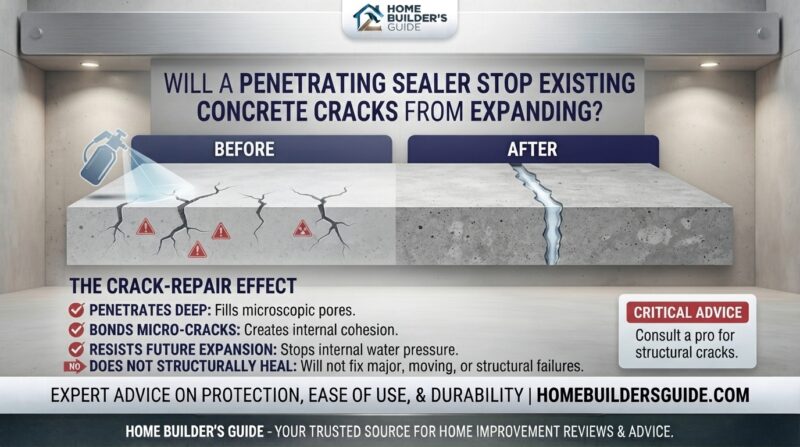
The short answer is: A penetrating sealer alone will not physically glue existing concrete cracks together or prevent expansion caused by structural movement, but it plays a vital role in stopping chemical and freeze-thaw crack expansion.
Penetrating sealers (such as silanes, siloxanes, and siliconates) work beneath the surface inside microscopic concrete capillaries. They do not bridge visible open fissures, gaps, or structural fractures. If water enters an unsealed visible crack, seasonal freeze-thaw cycles, subgrade soil settlement, or rebar corrosion will continue to force that crack wider over time.
However, when paired with an elastomeric crack filler or polyurethane sealant, a high-quality penetrating sealer acts as a critical line of defense. It prevents water from soaking into the concrete matrix surrounding the crack, stopping micro-spalling, salt degradation, and subsurface hydro-pressure from worsening the damage.
Direct Matrix: What Penetrating Sealers Can and Cannot Do for Cracks
To understand how to protect your driveway, patio, or slab, it helps to distinguish between micro-capillaries and structural cracks.
| Damage / Surface Condition | Can Penetrating Sealer Stop It Alone? | Correct Repair Solution |
| Microscopic Pores & Capillaries | ✅ YES — Completely seals against water penetration | Penetrating Silane/Siloxane Sealer |
| Hairline Surface Cracks (< 1/16″) | ⚠️ PARTIALLY — Repels water if liquid tension holds, but doesn’t fill gap | Penetrating Sealer + Low-Viscosity Epoxy/Methacrylate |
| Active Structural Cracks (> 1/16″) | ❌ NO — Water and debris will flow directly through | Polyurethane / Flexible Elastomeric Caulk + Sealer |
| Freeze-Thaw Spalling Around Cracks | ✅ YES — Stops water absorption in matrix adjacent to crack | Full Surface Penetrating Sealer Treatment |
| Subgrade Soil Settlement / Heave | ❌ NO — Cannot overcome ground movement or structural loads | Subgrade Stabilization / Mudjacking / Crack Repair |
The Science: How Cracks Expand and How Water Accelerates Damage
Concrete cracks expand through three main mechanisms: hydraulic pressure during freeze-thaw cycles, deicing salt corrosion, and ground movement.
                   [ CROSS-SECTION OF UNTREATED CRACK ]

    Rainwater / Melting Snow enters open crack
                 │
                 ▼
       ┌──────────────────┐
       │   OPEN CRACK     │  <-- Deicing Salts & Water Collect Here
       └────────┬─────────┘
                │
     ┌──────────┴──────────┐
     │  CONCRETE MATRIX    │  <-- Water soaks into adjacent porous concrete
     └──────────┬──────────┘
                │
    Freezing Temps / Rust Expansion
                 │
                 ▼
     [ CRACK FORCED WIDER & CORROSION EXPANDS ]
1. Freeze-Thaw Hydraulic Expansion (Northern Climates)
When water fills a concrete crack or soaks into the porous concrete lining the walls of that crack, it expands by approximately 9% as it freezes. This expansion creates internal pressure exceeding 30,000 PSI—far greater than the tensile strength of concrete (which is typically only 300 to 700 PSI). Each freeze cycle fractures the concrete walls inside the crack, breaking off micro-fragments and making the crack wider each winter.
2. Rebar Corrosion & Oxide Expansion
If a crack extends deep enough to reach structural steel rebar, water and airborne chlorides (deicing salts or ocean air) cause the rebar to rust. As steel corrodes, iron oxide forms. Iron oxide occupies up to six times the volume of the original steel, creating massive expansive force from within the slab. This causes severe cracking, Delamination, and spalling.
3. Subsurface Moisture Erosion
Water entering open cracks doesn’t just damage the concrete—it drains into the gravel base beneath the slab. Over time, this running water washes away subgrade dirt, creating hollow voids beneath the driveway. Without subgrade support, vehicle weight causes the concrete slab to sink and crack further.
Regional Crack Vulnerabilities: TX, NY, CA, WA & San Francisco
Geographic location dictates the primary threat level to concrete slabs. Understanding local environmental pressures helps determine the right maintenance strategy:
1. New York & Freeze-Thaw Zones
- The Threat: Severe freeze-thaw cycles combined with heavy deicing salt exposure.
- The Mechanics: Water enters open cracks, freezes, and splits concrete apart. Deicing salts lower the freezing point of water, increasing the frequency of freeze-thaw cycles per season.
- Solution: Fill all cracks larger than 1/16″ with a high-performance flexible polyurethane sealant, then apply a water-repellent silane/siloxane penetrating sealer across the entire slab to protect adjacent pores.
2. California & San Francisco Bay Area (Seismic & Clay Soil)
- The Threat: Expansive clay soils (wet winter expansion / dry summer shrinkage) and seismic movement.
- The Mechanics: As soil expands and contracts beneath driveways, slabs flex and form active structural cracks. Penetrating sealers cannot bridge these moving joints.
- Solution: Use flexible, elastomeric joint sealants that accommodate up to 25% joint movement before applying low-VOC water-based silane sealers compliant with local SCAQMD/BAAQMD rules.
3. Washington State (Pacific Northwest Dampness)
- The Threat: Continuous rainfall, high humidity, and moss/algae growth.
- The Mechanics: Constant moisture keeps concrete damp, causing organic growth inside cracks that retains moisture and degrades the substrate.
- Solution: Clean cracks thoroughly with a pressure washer and anti-fungal cleaner, allow complete drying, seal cracks with polyurethane, and apply a breathable penetrating sealer to keep moisture out while allowing internal water vapor to escape.
4. Texas (Thermal Expansion & High UV Exposure)
- The Threat: Extreme summer heat causing daily thermal expansion and contraction.
- The Mechanics: Slabs expand significantly during 100°F+ days and contract at night. Rigid crack fillers break, and unsealed concrete bakes in the UV light.
- Solution: Use heat-tolerant, flexible joint sealants paired with penetrating sealers that do not degrade under harsh UV rays.
Step-by-Step Restoration: How to Properly Seal and Protect Cracked Concrete
To stop concrete cracks from expanding, you must combine mechanical crack filling with penetrating surface sealing. Follow this complete professional workflow:
1.Inspect & Categorize Cracks:15-30 Minutes.
Examine the slab. Classify cracks into hairline (< 1/16″), medium (1/16″ to 1/4″), and structural (> 1/4″). Check for sinking or uneven slabs that require mudjacking or slab leveling.
2.Clean and Routing the Cracks:30-60 Minutes.
Use a wire brush, crack chaser blade, or screwdriver to clear dirt, loose concrete, and weeds out of the cracks. Blow out debris using oil-free compressed air or a high-powered leaf blower.
3.Fill Cracks with Flexible Joint Sealant:1-2 Hours.
For medium and large cracks, insert foam backer rod to control depth. Fill the crack with a professional polyurethane or elastomeric sealant. Tool the sealant flush with the surface and allow it to cure fully according to manufacturer instructions (typically 24 hours).
4.Thorough Surface Cleaning:1 Hour.
Pressure wash the entire driveway or patio (2500–3000 PSI) with a concrete cleaner to remove oil, grease, and surface dirt. Ensure all concrete pores are open and clean.
5.Complete Substrate Drying:24-48 Hours.
Allow the concrete to dry thoroughly. Trapped subsurface moisture blocks penetrating sealers from soaking into the capillary matrix.
6.Apply Penetrating Sealer:1-2 Hours.
Apply a silane/siloxane penetrating sealer uniformly across the entire concrete slab (including over cured crack repair areas) using a low-pressure sprayer. Apply wet-on-wet within 15–20 minutes to achieve maximum depth.
Pro Tips & Essential Concrete Care Rules
- Never Use Rigid Mortar on Active Driveway Cracks: Patching dynamic driveway cracks with standard rigid concrete patch or hydraulic cement will fail within months. Driveways expand and contract with temperature and vehicle loads; rigid materials crack immediately under stress.
- Always Use Backer Rod for Deep Cracks: If a crack is deeper than 1/2 inch, fill the bottom with foam backer rod before applying flexible caulk. Sealant should only bond to the two side walls of the crack (two-sided adhesion) to stretch properly without tearing down the center.
- Match Sealer Chemistry to Climate: In heavy freeze-thaw states (NY, Northern WA), use a Silane-based penetrating sealer, as silane molecules are small enough to penetrate deeply into dense concrete to combat salt and ice pressure.
10 Frequently Asked Questions (FAQs)
1. Will a penetrating sealer bridge open concrete cracks?
No. Penetrating sealers do not form a surface film or bridging membrane. They soak into the microscopic capillaries of concrete. Any visible physical gap or crack will remain open unless filled with an elastomeric caulk or flexible sealant.
2. Can I apply a penetrating sealer over crack filler or caulk?
Yes, provided the crack sealant or caulk is fully cured first. High-quality penetrating sealers will coat over polyurethane sealants without damaging them, creating a continuous water-repellent surface across the concrete.
3. What is the best way to repair hairline cracks before sealing?
Hairline cracks (< 1/16″) can be repaired using low-viscosity polymer repair liquids, high-penetration methacrylate sealers, or fine concrete crack menders that wick deep into thin fissures before applying a penetrating sealer over the entire slab.
4. How long do I need to wait after filling cracks to apply a penetrating sealer?
Follow the cure time on the crack sealant label. Typically, polyurethane sealants require 24 to 48 hours of curing before applying a water-based or solvent-based penetrating sealer.
5. Why do cracks keep appearing in my concrete even after sealing?
Concrete cracks often stem from subgrade soil movement, heavy weight loads, lack of expansion joints, or natural concrete shrinkage during curing. A sealer protects against water and chemical damage, but cannot counteract structural base failure or ground settling.
6. Will sealing concrete prevent spalling around existing cracks?
Yes. Spalling (flaking or chipping of concrete edges) around cracks is caused by water soaking into the crack walls and freezing. A penetrating sealer makes the concrete matrix hydrophobic, preventing water absorption and stopping spalling.
7. Should I seal my driveway before or after repairing cracks?
You should fill cracks first and apply the penetrating sealer second. Filling cracks first prevents liquid sealer from running down deep into the base material and ensures the repair sealant bonds cleanly to bare concrete sidewalls.
8. Will a penetrating sealer change the color of my repaired cracks?
No. Penetrating sealers leave a natural, invisible matte finish without gloss or dark wet-look effects. However, the crack filler material itself may differ in color from the surrounding concrete.
9. How often should I re-apply sealer to keep cracks from worsening?
A high-grade silane/siloxane penetrating sealer typically lasts 5 to 10 years. Inspect your driveway annually by pouring water on the surface; if water stops beading and darkens the concrete, it is time to re-apply.
10. Can a penetrating sealer stop water from leaking through a concrete foundation crack?
Not by itself. While it reduces water absorption into the concrete, active foundation leaks through visible structural cracks require interior or exterior crack injection using expanding polyurethane resin or epoxy.
Conclusion
A penetrating sealer is an indispensable tool in your concrete maintenance toolkit, but it is not a structural adhesive. While it cannot bridge physical gaps or halt ground movement on its own, it plays a vital role in stopping crack expansion caused by water intrusion, freeze-thaw cycles, and rebar corrosion.
By combining a flexible polyurethane crack filler with a high-performance silane/siloxane penetrating sealer, home and commercial property owners can protect their concrete slabs against expanding damage for 5 to 10 years or more.