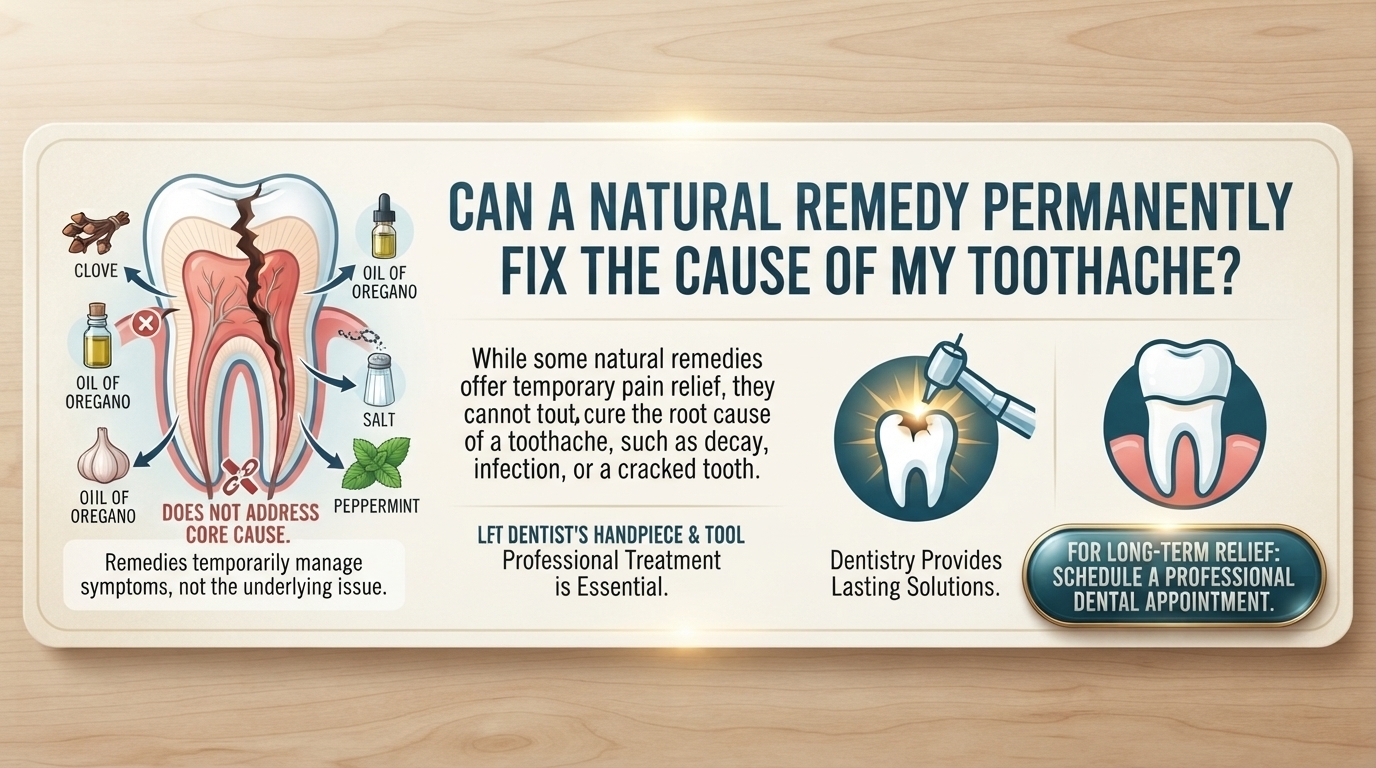
When a sharp, throbbing, or persistent toothache strikes, it can instantly derail your day, make sleeping impossible, and render basic eating painful. In moments of severe discomfort—especially over weekends or late at night—it is completely natural to seek immediate home remedies. From clove oil and saltwater rinses to crushed garlic pastes, natural options are widely touted online as quick fixes.
No, a natural remedy cannot permanently fix the cause of a toothache.
While natural home treatments can temporarily soothe nerve pain, reduce surface swelling, and lower oral bacterial counts, they do not restore lost enamel, rebuild decayed dentin, repair a cracked tooth, or eliminate deep pulp chamber infections. Tooth decay and structural dental damage are irreversible physical conditions. Relying on natural remedies long-term without professional intervention often allows silent bacterial infections to spread deep into the jawbone, eventually leading to permanent tooth loss or systemic health complications.
This comprehensive guide explores the biological limits of natural remedies, the underlying causes of tooth pain, regional climate and health considerations across key US states, top over-the-counter emergency care products, and a detailed 10-question dental FAQ.
Medical Disclaimer: The information provided here is for educational purposes only. Home remedies offer short-term symptom relief and must never replace diagnostic evaluation and treatment by a licensed dental professional.
1. Why Natural Remedies Cannot Permanently Cure Toothaches
To understand why natural remedies cannot provide a permanent fix, it helps to examine how teeth are structured and how dental diseases progress.
1. Biological Inability to Regenerate Calcified Tissue
Human tooth enamel is the hardest substance in the human body, composed almost entirely of hydroxyapatite minerals. Crucially, enamel contains no living cells. Once bacteria produce acids that dissolve enamel and create a physical cavity hole, the body cannot naturally regenerate or re-grow that lost enamel structure. No amount of clove oil, garlic, or herbal tea can fill a physical void in a tooth.
2. Irreversible Pulpitis & Tissue Necrosis
Inside the hard exterior of enamel and dentin lies the pulp chamber—a soft tissue core containing nerve fibers, blood vessels, and connective tissue.
[Bacterial Enamel Invasion] ---> [Reversible Pulpitis (Mild Sensitivity)] ---> [Irreversible Pulpitis (Severe Pain)] ---> [Pulp Necrosis (Nerve Death)] ---> [Periapical Abscess]
- Reversible Pulpitis: Mild inflammation where removing the stimulus (like cleaning out a minor cavity) allows the nerve to heal.
- Irreversible Pulpitis: Advanced inflammation where bacterial toxins penetrate deep into the pulp. The nerve is permanently damaged and will eventually die, creating a breeding ground for anaerobic bacteria inside the tooth root. Natural remedies cannot reverse damaged or dying nerve tissue.
3. The Illusion of Healing (When Pain Disappears)
One of the most dangerous occurrences with home remedies is when a severe toothache suddenly stops hurting. People often assume the home remedy worked and “cured” the tooth. In reality, the nerve inside the tooth has likely died (pulp necrosis). Without a living nerve to send pain signals to the brain, the tooth becomes silent—even while the bacterial infection continues multiplying in the dead pulp space and spreading toward the jawbone.
2. Symptom Management vs. Permanent Dental Treatment Matrix
Understanding what home remedies actually achieve versus what professional dental care provides highlights why both play distinct roles in oral health:
| Common Toothache Cause | What Natural Remedies Do (Symptom Relief) | Why Remedies Fail as a Permanent Fix | Permanent Professional Solution |
| Deep Cavity (Dental Caries) | Saltwater / Clove oil flushes out food particles & numbs exposed nerve endings. | Cannot replace lost enamel/dentin or eliminate trapped cavity decay. | Dental filling, inlay, or composite restoration. |
| Cracked / Fractured Tooth | Cold compresses reduce soft cheek tissue swelling and throbbing. | Cannot bond or fuse fractured enamel and dentin back together. | Dental crown, bonding, or root canal therapy. |
| Irreversible Pulpitis | Eugenol blocks voltage-gated sodium channels to temporarily stop pain signals. | Cannot remove infected or necrotic nerve tissue from deep inside root canals. | Root canal therapy (endodontic treatment) or extraction. |
| Dental Abscess (Infection) | Warm saltwater draws out minor surface fluid via osmotic pressure. | Cannot drain deep bone abscesses or eradicate systemic bacterial infections. | Professional incision/drainage, root canal, or prescription antibiotics. |
| Gum Inflammation (Gingivitis) | Hydrogen peroxide rinses kill surface anaerobic bacteria along gums. | Cannot remove calcified tartar (calculus) buildup below the gum line. | Professional dental scaling and root planing (deep cleaning). |
3. The Biological Limits of Popular Natural Remedies
While natural remedies are effective temporary symptom management tools, knowing their exact biological boundaries keeps expectations realistic:
Clove Oil (Eugenol)
- What It Does: Acts as a potent local anesthetic and mild antiseptic by blocking nerve signal transmission in exposed dentinal tubules.
- Biological Limit: Its numbing effect wears off in 1 to 3 hours. It cannot fix structural enamel holes or sterilize deep root canals.
Saltwater Rinses (Hypertonic Solution)
- What It Does: Uses osmotic pressure to draw excess fluid out of swollen gum tissue, cleanses debris, and maintains a neutral oral pH.
- Biological Limit: It only cleans surface tissue. It cannot penetrate deep inside sealed tooth cavities or root apices.
Fresh Crushed Garlic (Allicin)
- What It Does: Releases allicin, a natural broad-spectrum antimicrobial compound that reduces surface bacterial load.
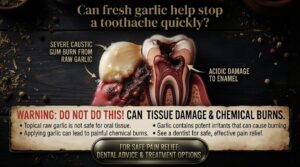
- Biological Limit: It does not possess true nerve-numbing properties and carries a high risk of causing chemical burns on delicate gum mucosa if left on too long.
4. Regional Health & Climate Factors: Texas, California, Washington & NY
Environmental conditions, regional dietary trends, and lifestyle factors across major US states significantly influence how dental decay develops and how sensitive teeth become:
Texas & Desert Southwest
- Environmental Driver: Extreme summer heat ($100^\circ\text{F}+$) leads to high consumption of sugary iced teas, sports drinks, and ice-cold sodas.
- Impact on Dental Health: Constant exposure to refined sugars fuels acid-producing Streptococcus mutans bacteria. Thermal shock from chewing ice or drinking freezing liquids in summer heat causes rapid enamel expansion and contraction, creating micro-cracks that allow bacteria to reach inner dentin faster.
California & San Francisco Bay Area
- Environmental Driver: High consumption of acidic artisanal beverages (kombucha, espresso, citrus juices) paired with cool coastal fog in San Francisco.
- Impact on Dental Health: Frequent acid exposure wears down outer enamel, exposing underlying dentin tubules. When cold coastal air or ocean fog hits exposed dentin, it triggers sharp, sudden nerve shocks along the trigeminal nerve.
Washington State & Pacific Northwest
- Environmental Driver: High dark-roast coffee consumption paired with cool, damp year-round weather.
- Impact on Dental Health: Switching between hot coffee drinks and cold ambient air accelerates thermal fatigue in older dental fillings. Over time, micro-gaps form around filling margins, giving bacteria a direct pathway to cause secondary decay underneath old dental work.
New York & Northeast Urban Centers
- Environmental Driver: Fast-paced urban stress, late-night dining, and freezing winter temperatures.
- Impact on Dental Health: Stress frequently triggers involuntary nighttime teeth grinding (bruxism), which wears down biting surfaces and stresses the periodontal ligament. When freezing NYC winter air hits bruxism-damaged teeth, severe throbbing pain follows.
5. Safe Emergency First-Aid Protocol While Awaiting Your Dentist
If you are dealing with a severe toothache, follow this safe 4-step emergency protocol to manage pain until your professional appointment:
1.Clear Trapped Food Debris:Step 1.
Gently run dental floss around the aching tooth to remove trapped food particles. Follow immediately with a warm saltwater rinse (1/2 teaspoon salt in 8 oz warm water) to flush the area clean.
2.Use Systemic OTC Pain Relievers:Step 2.
Swallow an over-the-counter pain reliever like ibuprofen or acetaminophen with water according to package directions. Never crush pills or place them directly against your gums.
3.Apply Topical Eugenol (Clove Oil):Step 3.
Dilute 2 drops of pure clove oil with 1/2 teaspoon of olive oil. Saturate a clean cotton swab, squeeze out excess liquid, and gently place it over the open cavity or tooth edge for 5 to 10 minutes.
4.Reduce Throbbing Pressure:Step 4.
Apply a cloth-wrapped ice pack to your outer cheek for 15 minutes on, 15 minutes off. When sleeping, elevate your head with extra pillows to prevent blood pressure from building up in your jaw.
6. Over-the-Counter Dental Relief Products Review
Having proper temporary dental care products on hand provides cleaner, safer, and more reliable pain management than DIY folk remedies:
1. Red Cross Toothache Complete Medication Kit
- Primary Active Ingredient: Eugenol (85%)
- Form: Liquid drops with precision cotton pellets and tweezers
- Overview: A classic emergency kit for home toothache care. It utilizes high-potency eugenol liquid paired with pre-cut cotton pellets, allowing you to place concentrated numbing relief directly inside an open cavity void without spreading messy liquids across your mouth.
- Pros: Rapid local anesthetic action within 3 minutes; includes precise application tweezers; highly effective for open cavity pain.
- Cons: Strong herbal taste; can irritate soft tissue if applied carelessly.
2. Dentemp Premium Temporary Tooth Filling Kit
- Primary Active Ingredient: Zinc Oxide & Eugenol Paste
- Form: Pre-mixed temporary filling compound
- Overview: If your toothache stems from a lost filling, loose crown, or open cavity, exposing the inner nerve to air, cold liquids, and food debris causes excruciating pain. Dentemp seals the cavity void, isolating the exposed nerve while continuously releasing soothing eugenol.
- Pros: Seals out hot, cold, and sweet triggers; contains built-in soothing eugenol; holds up until your dental appointment.
- Cons: Requires a clean, dry cavity void to adhere properly; temporary fix only.
3. Orajel 4X Medicated For Toothache & Gum Cream
- Primary Active Ingredient: Benzocaine 20% + Menthol 0.2%
- Form: Topical gel / cream
- Overview: A widely accessible OTC topical anesthetic. Maximum-strength benzocaine blocks nerve impulses immediately upon contact with soft gum tissue, while menthol provides a soothing cooling effect that calms localized tissue inflammation.
- Pros: Instant contact numbing on soft tissue; easy application; pleasant mint flavor.
- Cons: Temporary relief duration (30–45 minutes); less effective at penetrating closed enamel than liquid eugenol.
7. Frequently Asked Questions (FAQ)
Q1: If my toothache completely stops hurting after using a home remedy, is it cured?
No. When a severe toothache suddenly stops hurting on its own, it usually means the nerve inside the tooth has died (pulp necrosis). The infection has not vanished; it is still active inside the tooth root and will continue spreading into the surrounding jawbone, often forming an abscess later.
Q2: Can remineralizing toothpaste cure a toothache?
Remineralizing toothpaste (containing fluoride or nano-hydroxyapatite) can repair microscopic, early-stage surface enamel erosion before a cavity forms. However, once a physical cavity has formed or decay has reached the sensitive dentin layer, toothpaste cannot fill the hole or cure the toothache.
Q3: Why can’t antibiotics permanently cure a toothache?
Antibiotics travel through the bloodstream to kill bacteria in living tissue. However, once the pulp tissue inside a tooth dies, blood flow to the interior of that tooth stops. Antibiotics cannot reach the dead space inside the root canals to eliminate the bacteria hiding there. Only a dentist can physically clean out the root space.
Q4: How long is it safe to rely on natural remedies for a toothache?
Natural remedies should only be used as a short-term bridge for 24 to 48 hours while you arrange an appointment with a dentist. Relying on home care for weeks allows decay to progress, turning what could have been a simple filling into a complex root canal or extraction.
Q5: What is the risk of delaying professional treatment for a toothache?
Delaying treatment allows localized infections to expand. Bacteria can destroy bone around the root, spread to adjacent teeth, cause severe facial swelling, or enter the bloodstream and deep neck spaces, creating life-threatening systemic medical emergencies (such as Ludwig’s angina).
Q6: Can oil pulling with coconut oil fix a cavity?
No. While oil pulling can help reduce surface oral bacteria and plaque when used as part of a daily hygiene routine, it cannot repair structural enamel loss, dissolve cavity decay, or heal infected tooth pulp.
Q7: Why does a toothache feel worse when lying down flat at night?
Lying flat increases blood flow and vascular pressure to your head and jaw. This elevated pressure expands blood vessels inside the rigid walls of an inflamed tooth pulp chamber, putting extra force on sensitive nerve fibers. Elevate your head with extra pillows while resting.
Q8: Is it safe to place an aspirin tablet directly against a sore tooth or gum?
No! Never place aspirin directly on oral tissue. Aspirin is acetylsalicylic acid; placing it against soft tissue causes severe chemical acid burns (“aspirin burn”) on your gums and cheeks, creating an additional painful wound alongside your toothache. Always swallow aspirin whole with water.
Q9: What are the signs that a toothache has become a medical emergency?
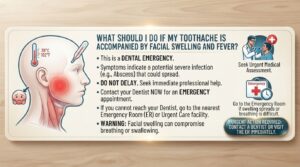
Seek immediate emergency dental or medical care if your toothache is accompanied by facial swelling, difficulty swallowing or breathing, a high fever, a visible pus-filled bump on your gums, or severe pain that radiates to your eye, ear, or neck.
Q10: What is the most cost-effective way to handle a toothache?
The most cost-effective approach is seeing a dentist at the very first sign of mild sensitivity. Treating a small cavity with a simple filling costs significantly less than waiting until severe pain requires complex root canal therapy, dental crowns, or tooth replacement options like implants.
Conclusion
While natural remedies like clove oil, warm saltwater flushes, and cold compresses are valuable tools for managing temporary pain, they cannot permanently fix the cause of a toothache.
Enamel cannot re-grow over a cavity, cracked teeth cannot fuse back together on their own, and deep pulp infections require physical removal by a professional. Treat natural home care strictly as a short-term emergency bridge—and schedule an evaluation with a licensed dentist as soon as possible to permanently resolve the issue and protect your smile.