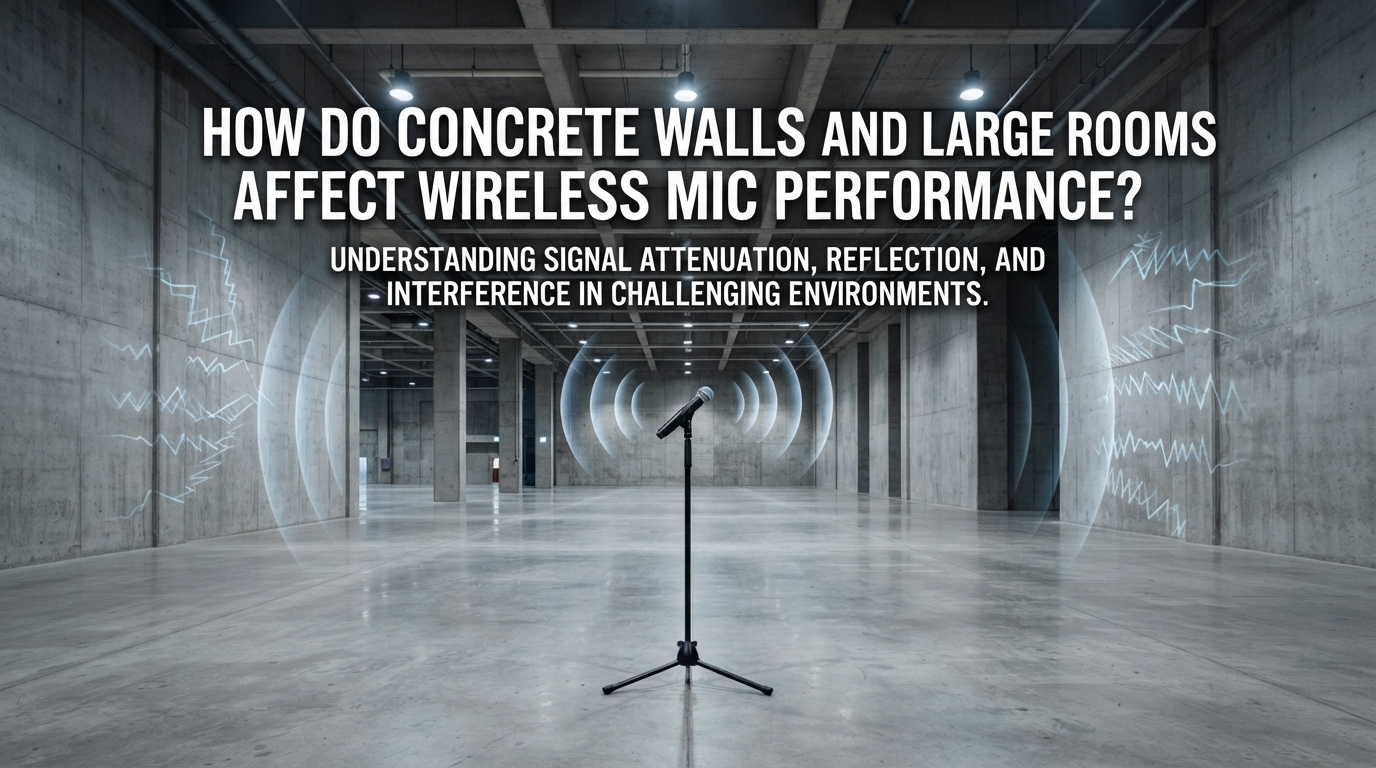
How do concrete walls and large rooms affect wireless mic performance? Setting up a home entertainment system or hosting an energetic gathering in metropolitan hubs—from modern high-rises in San Francisco and New York to expansive suburban homes in Texas, Washington, and California—often involves outfitting a space with wireless audio gear. While cutting the cord frees performers to move around without tripping over cables, wireless systems face an invisible adversary: structural physics.
Physical room dimensions and dense building materials profoundly impact radio frequency (RF) transmission. Understanding how architectural layouts interact with wireless microphones is essential for maintaining pristine, drop-out-free sound.
The Physics of Wireless Audio Transmission in Buildings
Wireless microphones rely on radio frequency (RF) waves—typically operating in UHF, VHF, or digital 2.4GHz bands—to transmit audio data from a handheld transmitter to a base receiver. When these waves encounter physical barriers and vast open spaces, their structural integrity degrades through distinct mechanisms.
1. Signal Attenuation and Dense Materials
Dense building materials absorb, scatter, and reflect electromagnetic waves. Concrete is exceptionally dense, heavily loaded with moisture during its curing process and often reinforced with an internal grid of steel rebar.
- Decibel Loss: A standard reinforced concrete wall can cause anywhere from 15 dB to over 30 dB of signal attenuation. Because decibels operate on a logarithmic scale, a 20 dB loss strips away roughly 99% of the original signal power.
- The Rebar Cage Effect: Steel mesh embedded within concrete acts as a partial Faraday cage, reflecting and scattering radio waves. This creates severe blind spots where a microphone receiver simply cannot register the transmitter’s data packet.
2. Large Room Dimensions and Inverse-Square Law
In very large rooms or open-concept floor plans, distance becomes a major performance bottleneck. According to the Inverse-Square Law, RF signal strength drops exponentially the further the transmitter moves from the receiver.
- As a user walks to the far corner of an oversized great room or multi-purpose hall, the signal level drops past the receiver’s threshold sensitivity.
- This decline manifests as white noise bursts, compressed audio artifacts, or sudden audio dropouts right when a performer steps away from the stage zone.
3. Multipath Interference and Phase Cancellation
Large rooms with hard, reflective surfaces—such as bare concrete walls, hardwood floors, and glass windows—encourage signal bouncing.
- The radio wave travels directly to the receiver while secondary reflections bounce off walls and arrive a fraction of a millisecond later.
- These overlapping waves collide out of phase, causing multipath interference (phase cancellation), which heavily distorts vocal clarity and triggers sudden static snaps.
Comparative Analysis: Building Materials vs. Wireless Performance
Different structural environments impose unique challenges on wireless microphone links:
| Building Material / Layout | Typical RF Signal Attenuation | Impact on Wireless Karaoke Performance |
| Drywall / Stud Walls | Low (3 to 5 dB) | Minimal impact; minor drop in maximum usable range. |
| Brick / Masonry Block | Moderate to High (6 to 18 dB) | Noticeable range reduction; occasional dropouts if line-of-sight is blocked. |
| Reinforced Concrete | Severe (20 to 30+ dB) | High risk of complete signal loss, severe audio stutter, or total disconnect. |
| Large Open Halls (>50 ft) | Distance-based dropoff | Requires high-gain antennas or booster units to combat free-space path loss. |
| Glass and Metal Partitions | High reflection / blocking | Causes multipath scattering and erratic audio dropouts. |
Product Review Insights: Overcoming Structural Limitations
Consumer feedback on wireless microphone performance in urban apartments and expansive homes highlights recurring hardware vulnerabilities:
- Fixed-Antenna Consumer VHF/UHF Systems: Budget sets with internal or short fixed antennas struggle significantly in concrete-heavy buildings. Stepping behind a structural column or entering an adjoining room frequently results in total signal muting.
- True Diversity Systems with External Antennas: Premium systems featuring dual independent receiver circuits (True Diversity) and removable BNC antennas perform far better. They dynamically select the strongest signal path, mitigating the reflection issues common in large, concrete-walled rooms.
Expert Tips to Optimize Wireless Performance in Challenging Spaces
If your architecture features heavy concrete construction or expansive floor plans, you can protect your sound quality by applying these deployment strategies:
- Maintain Clear Line-of-Sight: Position the wireless receiver inside the same room as the performers. Never place the base unit behind concrete pillars, inside metal equipment racks, or tucked away in closed entertainment centers.
- Use Remote Antenna Kits: For large halls or multi-room setups, use low-loss coaxial cables to mount directional antennas (like paddles or helicals) high up and out into the open performance zone.
- Upgrade to True Diversity Hardware: Invest in multi-antenna diversity systems that continuously evaluate signal paths to prevent dropouts caused by room reflections.
- Keep a Wired Backup Ready: In heavy commercial structures or thick-walled historic buildings where RF performance is unpredictable, keeping a dynamic wired mic on hand guarantees a failsafe performance.
Frequently Asked Questions
Why does my wireless microphone cut out when I walk behind a concrete pillar? Concrete pillars contain dense mass and often steel rebar that absorb and block radio frequencies, causing immediate line-of-sight signal attenuation and dropouts.
How far can a wireless karaoke microphone travel in a large room? While manufacturers often rate consumer mics up to 100 feet or more in ideal open air, real-world obstacles like walls, furniture, and crowds typically cut reliable operating ranges down to 30 to 50 feet.
Can glass windows block wireless microphone signals? Thick, double-paned, or energy-efficient glass often contains metallic tinting films that reflect and attenuate RF signals, contributing to unexpected performance dips near large windows.
What is the difference between UHF and 2.4GHz digital mics regarding room penetration? UHF frequencies have longer wavelengths that generally penetrate obstacles slightly better than crowded 2.4GHz digital bands, though both suffer heavy degradation when crossing thick concrete structures.
Why does my mic produce static only in specific corners of a large room? Those specific zones are usually dead spots created by destructive wave interference, where direct signals and wall-reflected signals cancel each other out.
Does room size affect microphone audio latency? Room size itself does not affect digital processing latency, but distance forces the receiver to work with weaker signals, which can trigger error-correction buffering and audio stutter.
How can I boost my wireless mic range in a large hall? You can improve range by elevating your receiver, using high-gain external antennas, avoiding low-battery conditions, and minimizing distance between the performer and the base unit.
Do crowds of people inside a large room affect wireless signals? Yes. Human bodies are mostly water and act as effective RF absorbers. A dense crowd can significantly dampen wireless signals traveling across a room.
Are there microphones designed specifically for concrete or brick buildings? While no microphone changes physics, professional systems with high RF output power, adjustable squelch control, and external directional antennas handle difficult environments much better than standard consumer toys.
What should I do if my venue has too many structural dead zones? If architectural obstacles continuously disrupt your wireless setup, switching to high-end professional diversity gear or running heavy-duty XLR wired microphone cables are your best alternatives.
Conclusion
Building materials and room dimensions dictate the practical limits of wireless audio. While concrete walls, steel rebar, and expansive layouts introduce severe signal attenuation and reflection issues, understanding these factors allows you to strategically place receivers, select robust equipment, and ensure flawless vocal execution for any event space.