A throbbing toothache is hard enough to handle on its own, but when it progresses to visible facial swelling and a fever, the situation changes dramatically. This combination of symptoms is a clear sign that a localized dental issue has escalated into a spreading bacterial infection.
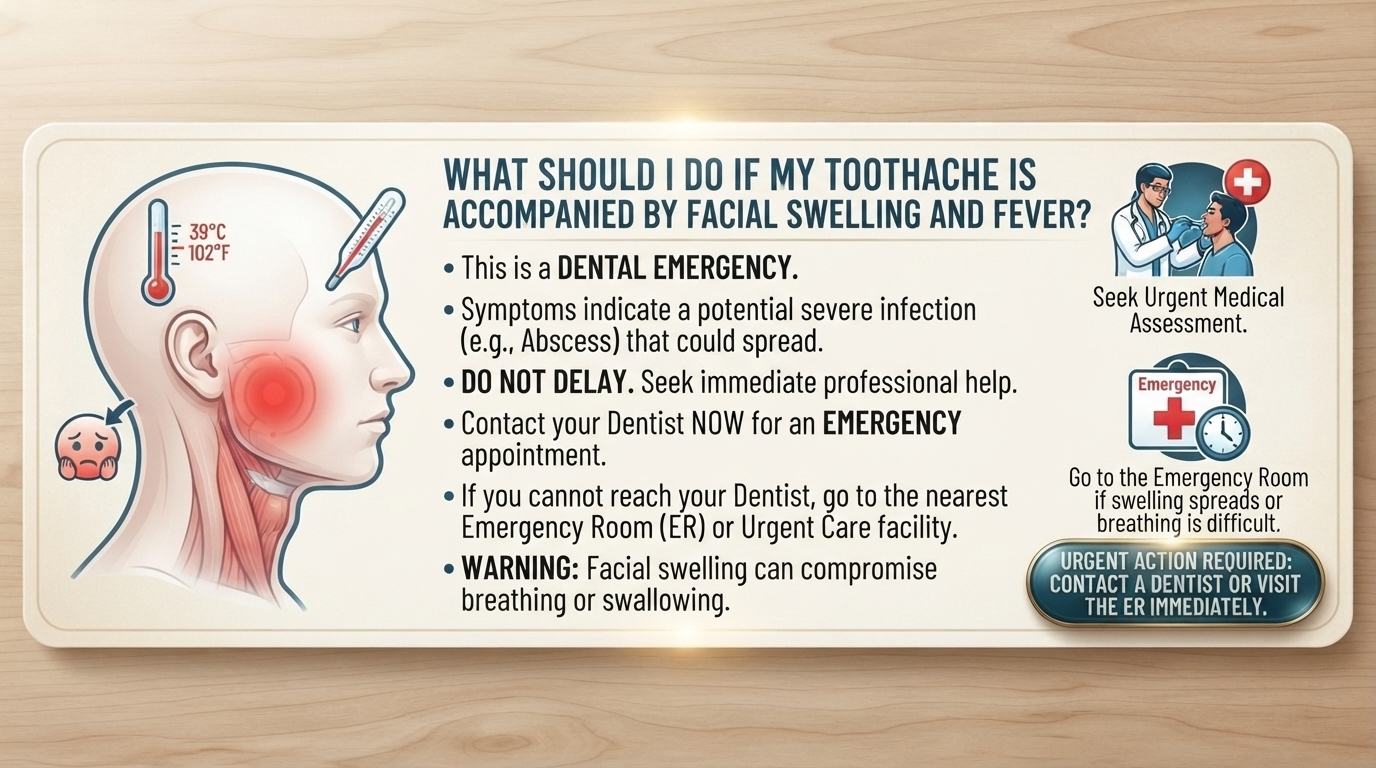
If your toothache is accompanied by facial swelling and fever, you should seek emergency dental or medical care immediately. Do not wait for a routine appointment, and do not rely on home remedies like clove oil, ice packs, or saltwater rinses to fix it.
When bacteria penetrate past the protective enamel and dentin into the soft inner tooth pulp, they can travel down through the root tip and into the surrounding jawbone and soft tissues of the face. A fever means your immune system is fighting an active, systemic infection, while facial swelling shows that inflammatory fluid and pus are spreading through the deep tissue spaces of your face and neck.
This comprehensive guide covers the medical emergency protocols for a dental abscess, how spreading infections travel through facial pathways, regional climate and health factors for key US states, reviews of over-the-counter emergency kits, and a 10-question emergency dental FAQ.
CRITICAL MEDICAL WARNING: If your facial swelling spreads to your eye, lower jaw, or neck, or if you experience difficulty breathing or swallowing, go to the nearest hospital emergency room (ER) or call 911 immediately. This can indicate Ludwig’s angina—a rapidly progressing, life-threatening airway emergency.
1. The Science of Spreading Dental Infections: From Cavity to Abscess
Understanding how a simple cavity transforms into a dangerous facial infection highlights why urgent professional intervention is necessary.
1. Bacterial Invasion of the Pulp Chamber
A toothache typically begins when dental caries (decay), a cracked enamel shell, or a failed filling allows oral bacteria (Streptococcus mutans, Peptostreptococcus, Bacteroides) to reach the living inner pulp chamber. The resulting inflammation (pulpitis) causes intense pressure within the unyielding walls of the tooth.
[Deep Cavity / Cracked Enamel]
             │
             ▼
[Pulpitis & Nerve Death (Necrosis)]
             │
             ▼
[Periapical Abscess at Root Tip]
             │
             ▼
[Facial Fascial Space Swelling] ──► (Risk of Ludwig's Angina / Airway Compromise)
             │
             ▼
[Systemic Fever & Sepsis Risk]
2. Root Tip Escape & Abscess Formation
If left untreated, the infected nerve tissue dies (pulp necrosis). Bacteria then migrate down the root canal and exit through the apical foramen (the tiny opening at the bottom of the tooth root) into the surrounding periodontal ligament and jawbone. The immune system responds by surrounding the bacteria with white blood cells, creating a painful pocket of pus known as a periapical abscess.
3. Fascial Space Migration (Facial Swelling)
Once the abscess breaks through the thin outer cortical bone of the jaw, the infection enters the soft fascial spaces of the face and neck:
- Upper Teeth: Infection can spread to the cheek, upper lip, or underneath the eye (canine space / orbital cellulitis).
- Lower Teeth: Infection can spread under the tongue or jaw (submandibular and sublingual spaces), pushing the airway closed.
4. The Immune Response (Fever)
Fever ($100.4^\circ\text{F} / 38^\circ\text{C}$ or higher) occurs when pyrogens (fever-inducing substances released by immune cells and bacterial toxins) travel through the bloodstream to the brain’s hypothalamus. It signals that the infection is no longer confined to a single tooth—it has entered your systemic circulatory network.
2. Emergency Action Plan: Step-by-Step Response Protocol
When you notice facial swelling and a fever alongside a toothache, follow this immediate emergency protocol:
1.Contact an Emergency Dentist or Urgent Care Immediately:Action 1.
Call an emergency dental clinic, your regular dentist’s after-hours line, or an urgent care center right away. Clearly state: “I have a severe toothache with visible facial swelling and a fever.” This symptom combination usually moves you to the front of the line for immediate evaluation.
2.Assess for Airway & Orbital Danger Signs:Action 2.
Check for red-flag symptoms: Is the swelling spreading toward your eye socket? Are you having trouble opening your mouth wide (trismus)? Is it painful or difficult to swallow your saliva or breathe normally? If yes to any, go directly to a hospital emergency room.
3.Use Systemic Oral Pain Relievers (Never Apply Pills to Gums):Action 3.
To manage severe pain while traveling to the clinic, swallow over-the-counter pain relievers like ibuprofen or acetaminophen as directed on the packaging. Never place aspirin, ibuprofen, or crushed pills directly against your gums, as this causes severe chemical acid burns (aspirin burn).
4.Apply External Cold Therapy & Stay Hydrated:Action 4.
Hold a cloth-wrapped ice pack against the outer cheek for 15 minutes on, 15 minutes off to help reduce localized swelling. Drink plenty of water to support your body while fighting a fever, and sit upright to keep fluid pressure from building up in your jaw.
3. Emergency Level Assessment Matrix: Where Should You Go?
Knowing whether to visit an emergency dentist, an urgent care facility, or a hospital emergency room ensures you get the right level of care without losing valuable time:
| Symptoms Present | Medical Urgency Level | Recommended Facility | Primary Medical Objective |
| Toothache + Mild Gum Swelling (No Fever) | High (Urgent Dental) | Same-Day Emergency Dentist | Clean out cavity, start root canal, or place temporary restoration |
| Toothache + Visible Cheek Swelling + Mild Fever ($100.4^\circ\text{F}$) | Severe Emergency | Emergency Dentist / Urgent Care | Clinical diagnosis, prescription oral antibiotics, abscess drainage |
| Swelling Under Jaw / Tongue + Difficulty Swallowing | CRITICAL (Life-Threatening) | Hospital Emergency Room (ER) / Call 911 | Airway monitoring, IV antibiotics, emergency surgical drainage |
| Swelling Reaching Eye Socket + Double Vision + High Fever ($102^\circ\text{F}+$ ) | CRITICAL (Life-Threatening) | Hospital Emergency Room (ER) | Prevent orbital cellulitis & cavernous sinus thrombosis via IV therapy |
4. What Professional Medical & Dental Treatment Will Involve
Home remedies cannot drain a deep bone abscess or eradicate a spreading bacterial infection. Here is what to expect during your emergency appointment:
1. Clinical Evaluation & X-Rays
The clinician will take digital periapical X-rays or a CBCT scan to locate the exact source of the infection, assess the depth of bone loss around the root tip, and map out the fascial spaces involved.
2. Incision and Drainage (I&D)
If a fluctuant (fluid-filled) swelling is present along the gum line or soft tissue, the dentist will administer local anesthetic and make a small incision to drain accumulated pus and relieve pressure instantly. A small rubber drain tube may be placed temporarily to keep the site open.
3. Targeted Prescription Antibiotics
Oral antibiotics (such as Amoxicillin, Augmentin, Clindamycin, or Metronidazole) are prescribed to halt the spread of bacteria through your bloodstream and soft tissues.
Note: Antibiotics eliminate the spreading infection in soft tissue, but they cannot reach dead pulp space inside the tooth. You must still complete definitive dental treatment.
4. Definitive Dental Source Control
To prevent the infection from returning once antibiotics finish, the dentist must remove the infected source material via one of two methods:
- Root Canal Therapy (Endodontics): The dentist drills into the tooth, cleans out infected pulp and nerve tissue, sterilizes the internal canals, and seals the void.
- Tooth Extraction: If the tooth is too fractured or damaged to save, it is extracted under local anesthesia to remove the infection source entirely.
5. Regional Health & Environmental Factors: Texas, California, Washington & NY
Geographic location, climate conditions, and regional lifestyle habits across major US states play a notable role in dental health and access to emergency care:
Texas & Desert Southwest
- Environmental Driver: Extreme summer heat ($100^\circ\text{F}+$) combined with high intake of sweet iced teas, sodas, and sports drinks.
- Impact on Dental Infections: High heat accelerates dehydration, which lowers natural salivary flow (your body’s primary defense against oral bacteria). High sugar intake feeds acid-producing bacteria, allowing silent cavities to reach inner pulp tissue faster during hot summer months.
California & San Francisco Bay Area
- Environmental Driver: High intake of acidic beverages (artisanal espresso, kombucha, cold-pressed juices) paired with cool coastal winds in San Francisco.
- Impact on Dental Infections: Acidic drinks erode protective outer enamel, exposing dentin tubules. When cold SF bay winds hit exposed dentin, people often ignore early sensitivity warnings until the nerve dies and suddenly erupts into a swollen periapical abscess.
Washington State & Pacific Northwest
- Environmental Driver: Persistent cool, damp weather paired with high dark-roast coffee consumption.
- Impact on Dental Infections: Alternating between hot coffee and cold ambient air causes rapid thermal expansion and contraction in old dental fillings. Micro-gaps form around filling margins over time, allowing bacteria to enter underneath and cause quiet, deep decay that leads to unexpected swelling.
New York & Northeast Urban Centers
- Environmental Driver: High-stress urban environments, late-night dining, and freezing winter temperatures.
- Impact on Dental Infections: Elevated stress levels frequently trigger nighttime teeth grinding (bruxism), which cracks teeth and stresses the periodontal ligament. In NYC winters, freezing air exacerbates underlying tooth fractures, giving bacteria a direct path to the pulp.
6. Over-the-Counter Emergency Dental Care Kits Review
While waiting for your emergency dental appointment, having the right OTC products at home helps manage pain safely—without resorting to dangerous folk remedies:
1. Dentemp Premium Temporary Tooth Filling Kit
- Primary Active Ingredient: Zinc Oxide & Eugenol Paste
- Form: Ready-to-use temporary filling compound
- Overview: If your toothache and infection stem from a lost filling, loose cap, or broken tooth, exposing inner dentin to air and food particles causes severe pain. Dentemp fills the void, sealing out hot/cold triggers while releasing soothing eugenol.
- Pros: Seals open voids quickly; contains built-in soothing eugenol; protects exposed nerves from food debris.
- Cons: Does not cure deep infections; temporary fix only while waiting for your dental appointment.
2. Red Cross Toothache Complete Medication Kit
- Primary Active Ingredient: Eugenol (85%)
- Form: Liquid drops with precision cotton pellets and tweezers
- Overview: A classic emergency kit for localized toothache pain. It uses high-potency eugenol liquid paired with pre-cut cotton pellets, allowing you to place targeted numbing relief directly inside an open cavity without spreading liquid across tender gums.
- Pros: Fast local numbing within 3 minutes; includes precise application tools; ideal for exposed cavity nerve pain.
- Cons: Strong herbal taste; will not reduce facial swelling or treat fever.
3. Orajel 4X Medicated For Toothache & Gum Cream
- Primary Active Ingredient: Benzocaine 20% + Menthol 0.2%
- Form: Topical gel / cream
- Overview: Maximum-strength benzocaine numbs soft gum tissue on contact, while menthol provides a cooling sensation that helps calm localized tissue discomfort.
- Pros: Instant contact numbing on soft gums; easy to apply precisely; pleasant mint flavor.
- Cons: Short duration (30–45 minutes); offers no internal antibacterial effect against deep abscesses.
7. Frequently Asked Questions (FAQ)
Q1: Can a tooth infection with facial swelling go away on its own?
No. A dental abscess with facial swelling will not resolve without professional treatment. While the pain might temporarily subside if the nerve inside the tooth dies completely or if the abscess pops and drains into your mouth, the underlying bacterial infection remains active in your jawbone and will continue spreading.
Q2: Why is a dental infection accompanied by facial swelling considered dangerous?
Facial fascial spaces interconnect closely with critical anatomical structures. Swelling in the lower jaw can push the tongue back and compress the airway (Ludwig’s angina), while upper jaw infections can spread toward the brain or eye socket (cavernous sinus thrombosis or orbital cellulitis). Both are life-threatening conditions.
Q3: What should I do if my swelling makes it hard to swallow or breathe?
Go to the nearest hospital emergency room (ER) or call 911 immediately. Difficulty breathing or swallowing means the infection has spread into deep neck or floor-of-mouth tissues, threatening your airway. This requires emergency IV antibiotics and immediate surgical airway management.
Q4: Can antibiotics alone completely cure a tooth abscess?
No. Antibiotics help stop bacteria from spreading further through soft tissue and blood vessels, but they cannot travel inside a dead, bloodless tooth root canal to clean out the source of the infection. You must still see a dentist for a root canal or tooth extraction to remove the infected tissue permanently.
Q5: Is it safe to pop or pop-and-drain an abscess on my gums at home?
Never try to pop or pop-and-drain a dental abscess at home. Using unsterilized pins, needles, or fingers introduces new bacteria into an open wound, damages surrounding blood vessels, and can push bacteria deeper into facial fascial spaces. Let a licensed dentist drain the area safely using sterile instruments.
Q6: What can I take for pain while waiting to see an emergency dentist?
Over-the-counter anti-inflammatory medications like ibuprofen combined with acetaminophen offer effective temporary pain management when taken as directed. Always swallow pills whole with water; never place pills against your gums, as this causes severe chemical burns (aspirin burn).
Q7: Why do I have a fever with my toothache?
A fever indicates that your immune system is responding to a widespread, systemic bacterial infection. White blood cells release pyrogens into your bloodstream to raise body temperature and help fight off invading bacteria that have spread beyond the tooth root into surrounding tissues.
Q8: Should I use a warm compress or an ice pack on a swollen face?
Use a cold compress (ice pack) wrapped in a towel on the outside of your cheek for 15 minutes on and 15 minutes off. Cold temperature constricts blood vessels, reduces fluid buildup, and slows pain signals. Avoid warm compresses on the cheek, as heat can expand blood vessels and draw more fluid and pus into soft facial tissues.
Q9: What happens if I go to an Urgent Care clinic instead of a dentist?
Urgent Care medical providers can evaluate your symptoms, prescribe oral antibiotics to control the infection, and provide prescription pain relief. However, because they do not have dental chairs or dental X-ray equipment, they cannot perform root canals or extractions. You must still follow up with an emergency dentist promptly.
Q10: How can I prevent a minor toothache from escalating into facial swelling?
Visit a dentist at the very first sign of tooth pain, temperature sensitivity, or minor gum tenderness. Catching decay early when it only requires a simple filling prevents bacteria from reaching the pulp, forming a root abscess, and spreading into soft facial tissues.
Conclusion
A toothache accompanied by facial swelling and a fever is a clear signal that a dental infection has spread beyond the tooth into surrounding facial tissues and your systemic circulation.
Take action immediately:
- Contact an emergency dentist or urgent care center right away for clinical drainage and prescription antibiotics.
- Go to an emergency room if you experience red-flag signs like difficulty swallowing, trouble breathing, or swelling that reaches the eye socket.
- Use swallowed OTC pain relievers and external ice packs strictly as temporary support while on your way to receive care.
Treat this situation with the urgency it requires—prompt professional intervention stops the infection, protects your airway, and preserves your health.