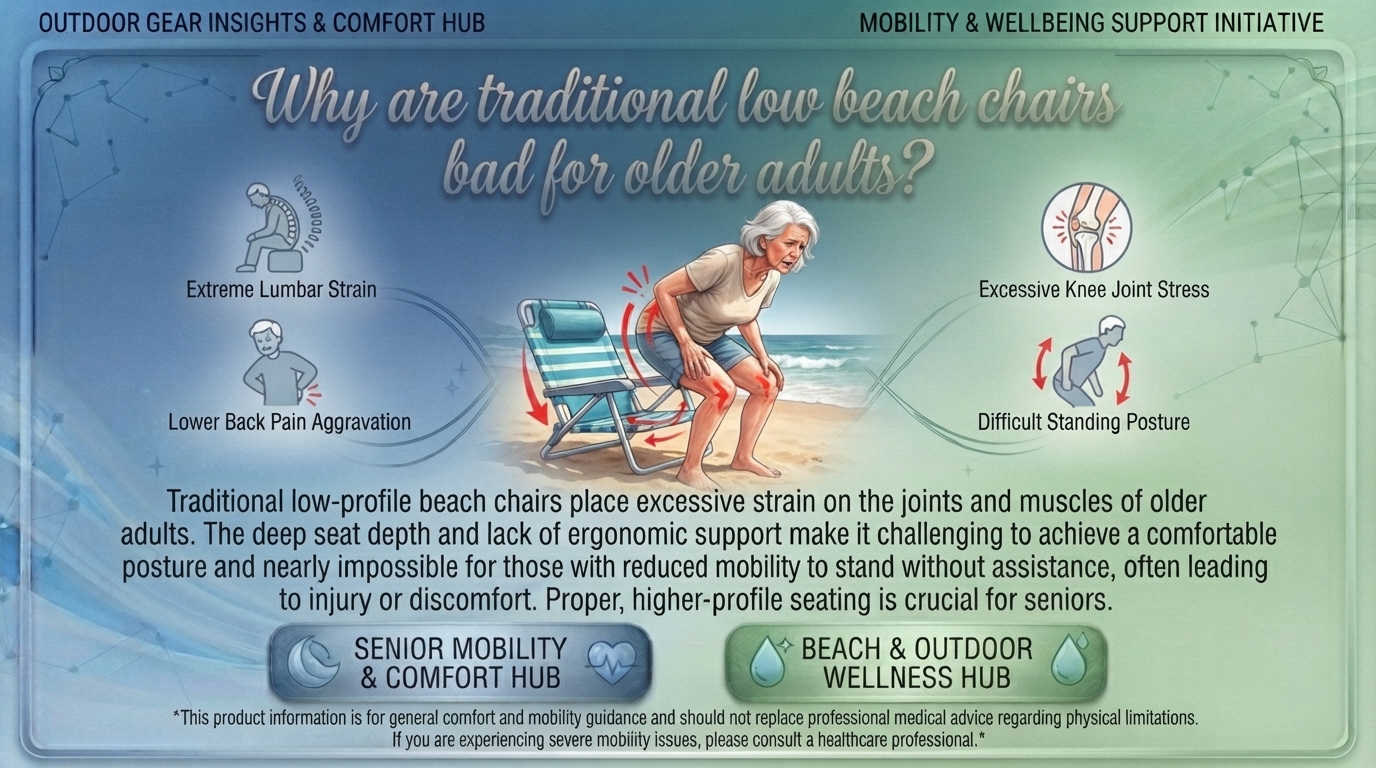
Why are traditional low beach chairs bad for older adults? There is nothing quite like packing up a cooler, grabbing your favorite sun hat, and heading down to the coastline for a relaxing day by the water. Whether you are enjoying the iconic Pacific shores of California, San Francisco, or Washington, the Atlantic breezes of New York, or the sun-drenched gulf coasts of Texas, a day at the beach is a cherished ritual for millions of Americans.
For decades, the undisputed king of coastal relaxation has been the traditional low-profile beach chair. These classic loungers sit low to the sand, offering a relaxed recline that lets you stretch your legs out over the dunes.
However, while these chairs might look idyllic in vacation brochures, they present a hidden, significant hazard for older adults and seniors. If you have ever watched an aging parent or grandparent struggle to hoist themselves out of a low-slung sling seat, you have witnessed firsthand why these chairs are increasingly discouraged by physical therapists and geriatric care specialists.
Welcome to itemguides.com. In this comprehensive, data-driven, extra-large optimized guide, we examine the biomechanical reasons why traditional low beach chairs are harmful to older adults, review safer senior-friendly alternatives, provide comparison tables, share expert tips, and answer your most detailed questions.
1. The Biomechanics: Why Low Beach Chairs Strain the Body
To understand why traditional low beach chairs are bad for seniors, we must look at basic human biomechanics. Traditional beach chairs typically sit a mere 6 to 9 inches off the sand. This ultra-low seating position forces the body into an unnatural physical posture that stresses fragile joints.
A. The Dangerous Deep-Squat and Knee Shear
When sitting in a chair that is only 7 inches off the ground, your knees must bend past a acute angle (often tighter than 90 degrees). To stand back up, an older adult cannot simply push up with their legs; they must execute a deep bodyweight squat from a compromised, unstable surface (shifting sand).
For seniors suffering from osteoarthritis, previous knee replacements, meniscus wear, or general joint stiffness, this deep flexion creates immense shearing force across the patella and surrounding ligaments, often resulting in sharp pain or a complete inability to rise without assistance.
B. Severe Lower Back and Spinal Flexion
Low sling seats are notorious for lacking structural rigidity. As you sit down, the canvas or nylon fabric sags deeply into a hammock shape. This forces the pelvis to tilt backward, flattening the natural lumbar curve of the spine.
Sitting in this slumped, unsupportive posture for hours puts intense pressure on the lumbar discs. For seniors with degenerative disc disease, sciatica, or chronic back pain, a day in a low beach chair can trigger days of lingering muscular spasms and spinal inflammation.
C. The Balance and Fall Hazard in Shifting Sand
Standing up from a low chair requires a sudden forward shift of your center of gravity while applying massive downward pressure. When your feet are planted in loose, shifting sand rather than a solid hardwood floor, your base of stability vanishes. This sudden torque frequently leads to stumbling, loss of balance, and terrifying beachside falls.
2. Product Reviews: The Best Ergonomic Alternatives for Seniors
Fortunately, manufacturers have designed advanced “Hi-Boy” and elevated beach chairs that eliminate these dangers entirely. Here are five top-rated ergonomic alternatives that keep seniors safe and comfortable.
1. RIO Beach Lace-Up “Hi-Boy” Suspension Chair — Best Overall Senior-Safe Choice
- Seat Height: 17 inches off the ground
- Weight Capacity: 250 lbs
- Price Range: Moderate (~$70–$90)
- Review: The RIO Hi-Boy completely solves the mobility issue by raising the seat to a standard dining chair height of 17 inches. Seniors can sit down and stand up effortlessly without bending their knees awkwardly or straining their backs. It features a sturdy steel frame, breathable lace-up suspension webbing, and convenient backpack carrying straps.
2. Parkit Voyager Ergonomic Chair — Best Premium Stability and Comfort
- Seat Height: 15 inches off the ground
- Weight Capacity: 300 lbs
- Price Range: Premium (~$160–$190)
- Review: Engineered like luxury outdoor furniture, the Parkit Voyager sits at a comfortable 15 inches, providing easy exit leverage. It features rigid marine-grade wooden armrests (vital for seniors to push off from), a posture-friendly taut backrest, and an innovative detachable cooler box mounted underneath the seat.
3. GCI Outdoor Wilderness Backpacker Reclining Chair — Best Mid-Height Option
- Seat Height: 12 inches off the ground
- Weight Capacity: 250 lbs
- Price Range: Moderate (~$65–$80)
- Review: Striking a middle ground, the GCI Wilderness sits at 12 inches—higher than traditional loungers but low enough to maintain a relaxed posture. Its patented auto-fold mechanism prevents pinched fingers, and its mesh-backed recline keeps air circulating on hot summer afternoons.
4. Tommy Bahama 5-Position Classic Lay Flat Chair — Best for Low-Profile Traditionalists
- Seat Height: 8.5 inches off the ground (Note: Low profile, requires good knee strength)
- Weight Capacity: 300 lbs
- Price Range: Moderate (~$80–$100)
- Review: If an older adult still insists on a classic low lounger that lays completely flat for sunbathing, the Tommy Bahama Deluxe is the industry gold standard. While it requires more leg strength to exit due to its 8.5-inch height, it compensates with thick backpack straps, an insulated cooler pouch, and an adjustable head pillow.
5. Rio Beach Classic 4-Position Backpack Chair — Best Lightweight Value Model
- Seat Height: 11 inches off the ground
- Weight Capacity: 250 lbs
- Price Range: Budget-Friendly (~$45–$60)
- Review: Weighing under 7 pounds, this aluminum-framed chair sits at an 11-inch clearance. While slightly lower than an ideal Hi-Boy, its molded plastic armrests and secure backpack straps provide a reliable, budget-friendly compromise for active seniors.
3. Comprehensive Comparison Table: Low Chairs vs. Elevated Senior Chairs
| Evaluation Metric | Traditional Low Beach Chair (7–9 in) | Elevated “Hi-Boy” Beach Chair (15–17 in) |
| Ease of Standing Up | Extremely Difficult (Requires deep squat & core strain) | Effortless (Natural step-up motion) |
| Knee & Joint Stress | High (Acute joint flexion & shearing force) | Minimal (Natural 90-degree leg angle) |
| Spinal Support | Poor (Fabric sags, flattening lumbar curve) | High (Rigid frames and supportive suspension) |
| Fall Risk in Sand | High (Unstable leverage on shifting ground) | Low (Firm footing and solid armrest push-off) |
| Armrest Usability | Low or fabric straps (Useless for pushing up) | Solid molded or wood arms (Designed for weight-bearing) |
4. Essential Tips for Making Beach Days Safer for Older Adults
If you are planning a coastal family outing to beaches across Texas, California, or New York with elderly loved ones, follow these expert safety protocols:
- Invest in Solid Armrests: Never buy a beach chair with fabric sling armrests for a senior. They need rigid, sturdy wooden or molded plastic armrests to safely push their body weight upward when standing.
- Bring a Beach Mat or Wooden Board: If you already own low chairs and cannot replace them immediately, place a rigid plastic beach mat or thin plywood board beneath the chair’s legs. This prevents the legs from sinking into deep sand, keeping the chair slightly more stable.
- Limit Continuous Sitting Time: Encourage seniors to stand up, stretch, and walk along the shoreline every 45 to 60 minutes to prevent muscle stiffness and joint locking.
- Prioritize Lightweight Portability: Even if a chair is comfortable, if it weighs over 12 pounds, it will strain a senior’s shoulders and back during the walk across the sand. Look for models featuring balanced backpack straps.
5. Frequently Asked Questions (FAQs)
1. Why are traditional low beach chairs bad for older adults?
Traditional low beach chairs sit only 6 to 9 inches off the sand, forcing older adults into a deep, painful knee squat and an unsupportive slumped posture. Standing up from them requires immense leg and core strength on unstable sand, creating a high risk of falls and joint strain.
2. What is the ideal seat height for a senior-friendly beach chair?
The ideal seat height for seniors is 15 to 17 inches off the ground (often marketed as “Hi-Boy” chairs). This height matches standard dining chairs, allowing older adults to sit down and stand up naturally without joint distress.
3. Can traditional low beach chairs cause long-term back pain?
Yes. Low sling chairs lack lumbar support and cause the fabric to sag into a hammock shape, flattening the spine’s natural curve and putting excessive pressure on the lumbar discs, leading to muscle spasms and lingering backaches.
4. Are there beach chairs with solid armrests specifically for seniors?
Yes. Quality senior chairs like the RIO Hi-Boy and Parkit Voyager feature rigid, weight-bearing armrests made of solid wood or heavy molded plastic that seniors can safely lean on to push themselves up.
5. Do elevated beach chairs still recline and provide comfort?
Absolutely! Modern elevated chairs combine high-clearance frames with multi-position reclining backs, adjustable head pillows, and footrests, offering the exact same relaxation angle as low chairs without the mobility struggles.
6. How do shifting sand conditions affect getting out of a low chair?
Sand is an unstable surface that absorbs downward pressure. When a senior tries to push up from a low chair, their feet sink into the sand instead of finding a solid foundation, which frequently causes stumbling or loss of balance.
7. Are “Hi-Boy” beach chairs heavier to carry than low chairs?
While slightly taller, most quality elevated chairs use lightweight anodized aluminum or steel frames, keeping total weights between 8 and 11 pounds, which is easily managed using dual backpack straps.
8. What medical conditions make low beach chairs especially dangerous?
Seniors suffering from osteoarthritis, recent knee or hip replacements, severe osteoporosis, degenerative disc disease, or balance disorders should strictly avoid low sling beach chairs to prevent injury.
9. Can lightweight folding camping chairs be used at the beach instead?
Standard camping chairs sit high up, but their narrow, pointed feet sink instantly into soft beach sand. You must look for beach-specific wide-footed chairs or umbrella chairs designed for sandy terrain.
10. Where can I find more senior mobility guides and outdoor product reviews?
You can explore comprehensive buying guides, safety breakdowns, and product comparisons tailored for outdoor enthusiasts right here at itemguides.com.
6. Conclusion
A day by the ocean should be filled with peace, relaxation, and fond family memories—not physical dread and joint pain. While traditional low-profile beach chairs have been a coastal staple for decades, their ultra-low seats, unsupportive sagging fabric, and treacherous exit angles make them fundamentally unsuitable for older adults.
By upgrading to an ergonomic, elevated “Hi-Boy” backpack beach chair with solid armrests and proper lumbar support, seniors can reclaim their independence, protect their joints, and enjoy the coastline in total comfort. Explore more expert outdoor gear reviews and safety guides across Texas, New York, California, Washington, San Francisco, and beyond at itemguides.com!