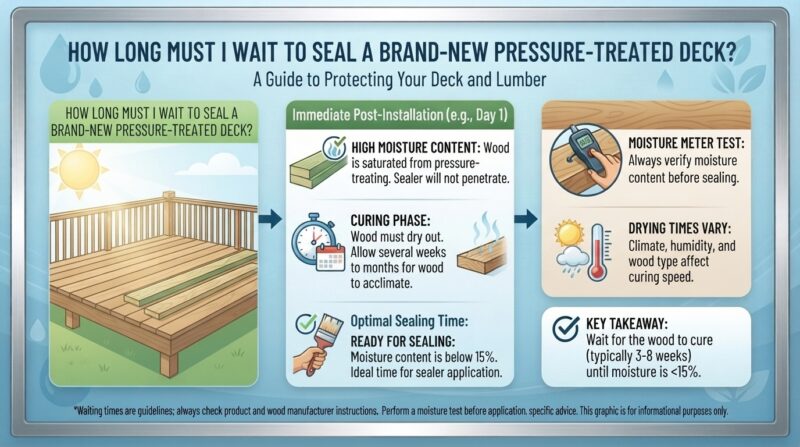
Installing a brand-new pressure-treated wood deck is one of the most rewarding home improvement projects you can undertake. It adds immediate outdoor living space, elevates curb appeal, and increases property value. However, one critical question confuses almost every homeowner once construction finishes: How long must you wait before applying a sealer or stain?
If you seal too soon, you lock in deep internal moisture, leading to peeling, rotting, mold growth, and total finish failure within months. If you wait too long, exposure to ultraviolet (UV) radiation and fluctuating weather will cause the unprotected lumber to warp, cupping, split, and turn gray.
The general rule of thumb is to wait 30 to 90 days for standard pressure-treated lumber, but the exact timeline ranges anywhere from 30 days to 6 months depending on lumber type, local climate, sun exposure, and relative humidity.
Why Pressure-Treated Wood Requires a Waiting Period
To understand why you cannot seal a new deck immediately, you have to look at how pressure-treated lumber is manufactured.
Lumber mills place wood (typically Southern Yellow Pine or Douglas Fir) into a high-pressure cylinder. Air is evacuated to create a vacuum, and liquid chemical preservatives—such as Micronized Copper Azole (MCA), Alkaline Copper Quat (ACQ), or Copper Azole (CA)—are forced deep into the wood fibers under intense hydraulic pressure. This process renders the wood resistant to rot, fungal decay, termites, and wood-boring insects.
+-----------------------------------------------------------------------+
|                       THE PRESSURE-TREATING PROCESS                   |
|                                                                       |
|   1. Raw Lumber placed in vessel                                      |
|   2. Vacuum removes air from wood pores                               |
|   3. Vessel flooded with liquid chemical preservative & water         |
|   4. High pressure forces fluid deep into core of lumber              |
|   5. Excess liquid drained; wood remains saturated ("wet lumber")     |
+-----------------------------------------------------------------------+
When this lumber arrives at your home or local lumberyard, it is often saturated with water. In fact, a fresh 2×6 board can carry up to several gallons of water weight when first delivered.
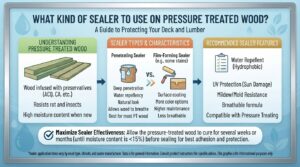
Key Rule of Chemistry: Water and oil-based finishes (or water-repellent polymers) do not mix. If the moisture content inside the wood pores exceeds 15% to 19%, any topical sealer or stain you apply forms a surface skin over trapped water. As the sun warms the board, that trapped water evaporates, expands into steam pressure, and pushes the sealer right off the wood, causing blistering and peeling.
Standard Waiting Timelines by Wood Type
Not all pressure-treated wood is processed or dried the same way. The time you must wait depends heavily on the specific grade of lumber you purchased:
| Wood Category | Description | Average Moisture Level at Purchase | Recommended Wait Time |
| Standard Wet Pressure-Treated | Standard off-the-rack lumber at big-box home improvement stores. Saturated with water during treatment. | 30% to 50%+ | 60 to 90 Days (up to 6 months in damp climates) |
| KDAT (Kiln-Dried After Treatment) | Factory kiln-dried after chemical treatment to reduce moisture down to stable levels. | 12% to 15% | 0 to 30 Days (Can often be sealed immediately) |
| Water-Repellent Treated | Treated with chemical preservatives plus built-in paraffin wax or silicone water repellent. | 20% to 30% | 90 to 180 Days (Wait until factory wax wears down) |
| Cedar / Redwood (Non-PT comparison) | Naturally rot-resistant hardwoods/softwoods (not pressure-treated with fluid). | 15% to 25% | 30 to 60 Days |
Regional Climate Impacts: Texas, New York, California, Washington & San Francisco
A blanket “wait 60 days” recommendation fails because weather plays a massive role in evaporation rates. The drying speed of pressure-treated lumber varies dramatically across different microclimates and states across the U.S.
1. Texas (Austin, Dallas, Houston, San Antonio)
- Climate Dynamic: Intense heat, high UV exposure, extremely hot summers, variable humidity in Gulf regions.
- Impact on Drying: Wood dries out very rapidly—sometimes too fast. Sun-drenched decks in Texas summers can dry to an ideal moisture level within 30 to 45 days.
- Warning: Hot, direct Texas sunlight can bake the top surface while leaving internal cores wet, raising the risk of severe checking (cracking) and warping. Consider using a semi-transparent stain with UV blockers early once moisture drops below 15%.
2. New York (NYC, Upstate, Long Island)
- Climate Dynamic: High humidity summers, wet autumns, freezing winters with snow accumulation.
- Impact on Drying: Spring or early summer builds generally dry in 60 to 90 days.
- Warning: If you build a deck in late autumn (September/October in NY), temperature drops will halt evaporation. Never seal a deck when temperatures consistently fall below 50°F (10°C). You will need to wait out the winter and seal the deck the following May or June.
3. Southern California (Los Angeles, San Diego)
- Climate Dynamic: Arid, dry heat, low rainfall, consistent mild temperatures year-round.
- Impact on Drying: Excellent drying conditions. Standard wet lumber usually cures fully in 30 to 60 days.
- Pro Tip: Because UV radiation in Southern California is relentless, do not leave dried wood unsealed past 90 days, or wood fibers will turn gray and split.
4. Washington State (Seattle, Tacoma, Olympia) & Pacific Northwest
- Climate Dynamic: Cool, damp, frequent rainfall, high relative humidity, limited direct sunlight for 8 months of the year.
- Impact on Drying: Wet treated lumber dries very slowly in WA. Expect a waiting period of 90 days to 6 months.
- Strategy: If a deck is built in Seattle during late autumn or winter, it will likely stay saturated until July. Utilize a digital moisture meter before attempting to seal, and look for a 4- to 5-day dry forecast window.
5. San Francisco & Bay Area Microclimates
- Climate Dynamic: Fog, marine moisture layers, mild temperatures, damp mornings with afternoon sun.
- Impact on Drying: Coastal fog slows moisture evaporation considerably. Bay Area decks usually take 60 to 90 days to cure.
- Pro Tip: Pay close attention to shaded deck sections near structures or under tree canopies. While sunny parts of the deck might be ready in 45 days, shaded or north-facing boards may take 90+ days. Always test multiple spots.
How to Test If Your Deck Is Ready to Seal (2 Methods)
Never guess or rely strictly on calendar days. Always perform one or both of the following objective tests before applying sealer or stain.
Method 1: The Water Drop / Sprinkle Test (Free & Simple)
- Find 3 to 4 distinct areas on your deck (including full sun and full shade areas).
- Pour a few drops or a small teaspoon of clean water onto the wood surface.
- Observe what happens over the next 5 to 10 minutes:
- If the water beads up into tight droplets: The wood is still too wet or factory water-repellent is active. DO NOT SEAL. Wait 2 to 3 weeks and test again.
- If the water slowly absorbs into the wood within 1 to 2 minutes: The wood fibers are open and dry enough to absorb sealer. READY TO SEAL.
Method 2: Digital Pin-Type Moisture Meter (Most Accurate)
For total peace of mind, purchase a digital wood moisture meter (available for $20–$35 at hardware stores).
  +--------------------------------------------+
  |  DIGITAL MOISTURE METER READOUT GUIDE      |
  |                                            |
  |   > 19% Moisture : DO NOT SEAL (Too wet)   |
  |  15% - 18%       : Acceptable (Water-based)|
  |   < 15% Moisture : IDEAL ZONE (Oil or Water) |
  +--------------------------------------------+
- Insert the two metal pins about 1/16th of an inch into the wood grain.
- Check reading across multiple boards (sun vs. shade, deck floor vs. railings).
- Results:
- Above 19%: Stop. The wood contains too much internal water.
- 12% to 15%: Ideal range for both oil-based and water-based sealers.
Choosing the Right Sealant or Stain for New Pressure-Treated Wood
Once your pressure-treated deck is dry, choosing the correct protective coating determines how long your deck will last before needing maintenance.
                      DECK FINISH TYPES & PROTECTION

  CLEAR SEALER          SEMI-TRANSPARENT           SOLID STAIN
  +----------------+    +----------------+        +----------------+
  | No Color       |    | Mild Tint      |        | Opaque Coat    |
  | Shows Grain    |    | Visible Grain  |        | Hides Grain    |
  | Minimal UV Prot|    | High UV Prot   |        | Max UV Prot    |
  | Re-apply: 1 yr |    | Re-apply: 2-3 yr|       | Re-apply: 4-5 yr|
  +----------------+    +----------------+        +----------------+
1. Clear Water Repellents
- Pros: Enhances natural wood color without altering wood grain or tone.
- Cons: Offers little to no UV protection. Wood will eventually weather to gray under bright sun.
- Lifespan: 1 year. Requires annual re-application.
2. Semi-Transparent Stains (Recommended)
- Pros: Contains ground pigments that absorb UV radiation, preventing wood graying while highlighting natural wood grain.
- Cons: Alters natural wood color slightly (available in cedar, redwood, walnut tones).
- Lifespan: 2 to 3 years. Best overall balance of aesthetics and protection.
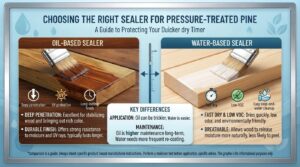
3. Water-Based vs. Oil-Based Penetrating Sealers
- Oil-Based (Penetrating Alkyd/Natural Oils): Deeply penetrates wood pores, condition wood fibers, highly water-resistant. Requires longer cure times (24-48 hrs).
- Water-Based (Acrylic/Silicone Hybrids): Low VOCs, fast drying (under 4 hrs), easier soap-and-water cleanup. Can often be applied to wood at slightly higher moisture levels (up to 18%).
Step-by-Step Guide: How to Prep and Seal Your New Deck
Applying sealer directly over dirty or mill-glazed wood will cause premature coating failure. Follow this exact workflow:
+-------------------------------------------------------------------------+
|                        DECK SEALING WORKFLOW                            |
|                                                                         |
|  [Step 1] Dryness Check  -->  [Step 2] Clean & Remove Mill Glaze        |
|  [Step 3] Sand (Optional)-->  [Step 4] Apply Sealer (Thin Coats)       |
|  [Step 5] Curing Time    -->  [Step 6] Maintenance Schedule             |
+-------------------------------------------------------------------------+
Step 1: Prep and Clean the Wood Surface
Even new lumber gathers dirt, pollen, foot traffic, and mill glaze (a smooth, shiny burnished layer created by high-speed planer blades at the lumber mill).
- Apply a dedicated Deck Cleaner / Wood Cleaner.
- Scrub lightly with a stiff synthetic-bristle brush.
- Rinse thoroughly with a garden hose or low-pressure washer (keep pressure below 1,200 PSI to avoid gouging soft pressure-treated wood).
Step 2: Neutralize with Wood Brightener
- Apply an oxalic-acid-based Wood Brightener. This opens up wood pores, neutralizes alkaline cleaner residues, restores natural color, and optimizes sealer absorption.
- Let sit for 10 minutes, then rinse completely and let the deck dry for 24 to 48 hours.
Step 3: Check Weather Forecast & Apply
- Verify ambient temperature is between 50°F and 90°F (10°C to 32°C).
- Ensure no rain is forecasted for at least 24 to 48 hours after application.
- Avoid direct mid-day sun, which causes sealer to dry on the surface before penetrating into the wood.
- Application Technique: Use a natural bristle brush, stain pad, or pump sprayer followed immediately by back-brushing to push the sealer into the wood grain.
- Crucial Rule: Apply thin coats. Wipe away any pooled sealer after 15 minutes. Excess sealer creates a sticky, tacky film that peels off under foot traffic.
Pro Tips for Maximum Deck Longevity
- Don’t Forget the Underside & End-Grains: Cut ends of boards absorb water up to 20 times faster than face grain. Apply sealer to cut ends during construction if possible.
- Mind the Gap: Clear out leaves and debris between deck boards to allow proper airflow and drainage. Trapped moisture under deck boards accelerates wood rot.
- Avoid High-Pressure Power Washing: High pressure tears wood fibers apart and creates fuzzy, splintered surfaces. Always rely on chemical deck cleaners and light scrubbing over sheer water pressure.
- Maintain Proper Ventilation: Ensure the under-deck area has at least 12 to 18 inches of ground clearance and open perimeter ventilation so moisture underneath can escape freely.
Frequently Asked Questions (FAQ)
1. What happens if I seal my pressure-treated deck too early?
Sealing too early traps internal water inside wood pores. As solar heat warms the board, the trapped water turns into steam pressure that pushes against the underside of the sealer film. This results in widespread blistering, bubbling, flaking, black mildew under the finish, and wood rot.
2. Can I paint a brand-new pressure-treated deck instead of sealing it?
Yes, but paint requires an even longer dry time. Wood moisture content must be below 12% to 15% before applying oil or acrylic latex paint primers. Furthermore, paint creates a solid film that easily cracks and peels under foot traffic and thermal expansion. A penetrating stain or sealer is always superior for deck floors.
3. Is KDAT (Kiln-Dried After Treatment) wood worth the extra money?
Yes. KDAT lumber has been dried back down to 12-15% moisture in a commercial kiln after chemical pressure treatment. It minimizes post-installation warping, shrinking, and cupping, and allows you to clean and seal the deck almost immediately after construction.
4. How long can I leave pressure-treated wood unsealed before it damages the deck?
You should not leave pressure-treated wood unsealed for longer than 6 months. Beyond 6 months, unfiltered UV rays break down lignin (the structural glue inside wood fibers), turning the wood gray, opening large splits/checks, and causing boards to warp or twist.
5. Does the sprinkle test work on all wood types?
Yes. The water sprinkle test works universally on pressure-treated pine, Douglas fir, cedar, redwood, and tropical hardwoods. If water absorbs within 1-2 minutes, the wood pores are open and receptive to sealers.
6. Should I sand a new pressure-treated deck before sealing?
Sanding is generally not mandatory for new decks unless there is severe mill glaze (smooth, shiny burnished surface from mill planers) or raised wood splinters. If you do sand, use 60 to 80-grit sandpaper; finer grits (100+) close off wood pores, preventing stain absorption. Always sweep and clean away all wood dust before sealing.
7. Can I apply water-based stain over an oil-based sealer?
No. Water-based finishes cannot bond over oil coatings. If your deck previously had an oil sealer, you must let it weather away completely or use a chemical stain stripper before switching to a water-based formula.
8. What is the best temperature range for sealing a deck?
The optimal temperature range is 50°F to 85°F (10°C to 29°C) with low relative humidity. Avoid applying stain in direct, intense sunlight, as the product will dry too rapidly on the surface before deeply penetrating the wood.
9. How many coats of sealer should I apply to a new pressure-treated deck?
For new pressure-treated wood, one to two thin coats are usually sufficient. Wet-on-wet application (applying the second coat while the first is still damp, within 20–30 minutes) yields best results for penetrating finishes. Avoid over-applying; wood can only absorb a finite amount of oil or resin.
10. How often will I need to re-seal my deck in coastal climates like San Francisco or Seattle?
In humid, coastal, or damp Pacific Northwest microclimates, clear sealers typically last 1 year, while high-quality semi-transparent penetrating stains last 2 to 3 years. Inspect your deck annually each spring using the water sprinkle test to determine if re-application is necessary.
Conclusion
Determining when to seal a brand-new pressure-treated deck comes down to one core factor: moisture content.
While the general rule is to wait 30 to 90 days, your timeline should be dictated by wood type (standard vs. KDAT) and local weather conditions—whether you are dealing with the dry heat of Texas and Southern California, the freezing seasons of New York, or the damp fog of Washington and San Francisco.
Always perform a water sprinkle test or check with a digital moisture meter to ensure internal wood moisture drops below 15% to 18%. By giving your new pressure-treated lumber adequate time to dry and following proper surface cleaning and prep steps, your deck will maintain its structural integrity and beauty for decades to come.