Medical Disclaimer: The information in this article is for educational purposes only and is not a substitute for professional dental advice, diagnosis, or treatment. If you experience severe facial swelling, high fever, difficulty swallowing, or pain lasting longer than 48 hours, seek emergency dental care immediately.
When dealing with a throbbing toothache or inflamed gums, 3% hydrogen peroxide is one of the most effective antimicrobial solutions available in your medicine cabinet.
When used correctly, a diluted hydrogen peroxide rinse helps kill surface bacteria, break down organic debris, and soothe irritated oral tissues. However, because hydrogen peroxide is an oxidizing agent, using high concentrations or undiluted solutions can cause severe chemical burns to your gums and tongue.
1. The Science: How Hydrogen Peroxide Helps Dental Pain
Hydrogen peroxide ($\text{H}_2\text{O}_2$) works through an oxidation process. When it contacts organic tissue and the bacterial enzyme catalase in your mouth, it rapidly releases oxygen atoms, creating the familiar white foaming action.
This foaming process delivers three main benefits:
- Anaerobic Bacterial Neutralization: Many harmful oral bacteria thrive in oxygen-deprived environments (like deep gum pockets and cavity crevices). The release of oxygen creates an environment where anaerobic bacteria cannot survive.
- Mechanical Debridement: The physical bubbling action lifts trapped food particles, dead cells, and plaque away from inflamed gum tissue and exposed dentin.
- Mild Hemostasis & Disinfection: It helps reduce minor bleeding from inflamed gums (gingivitis) and cleans minor mouth sores or canker sores.
2. Step-by-Step Guide: How to Use Hydrogen Peroxide Safely
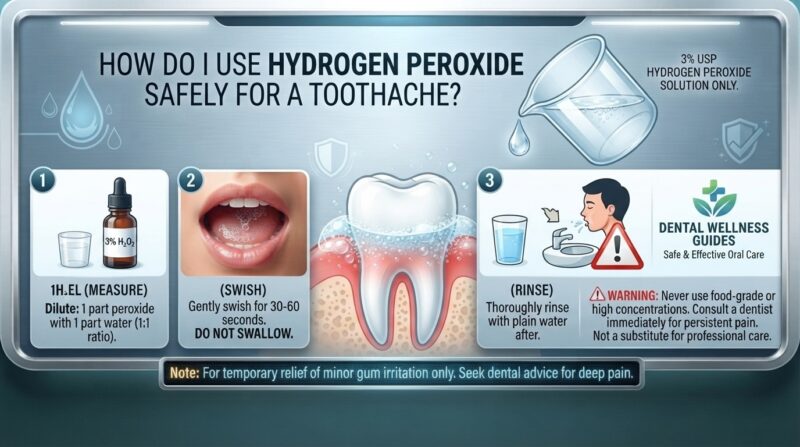
To safely use hydrogen peroxide for temporary toothache relief, follow this exact protocol:
┌────────────────────────────────┐     ┌────────────────────────────────┐     ┌────────────────────────────────┐
│      1. Select Concentration   │     │        2. Dilute 1:1 Ratio     │     │       3. Swish & Spit          │
│   Must be STANDARD 3% H₂O₂     │ ──► │  Equal parts H₂O₂ and Water    │ ──► │ Swish 30 sec, NEVER swallow,   │
│   (Never food-grade 35%)       │     │  (e.g., 1 tbsp + 1 tbsp)       │     │ rinse mouth with plain water   │
└────────────────────────────────┘     └────────────────────────────────┘     └────────────────────────────────┘
Step 1: Check the Bottle Label
Verify that you are using standard 3% Concentration Household Hydrogen Peroxide (typically found in the brown bottle at pharmacies). Never use industrial or food-grade 35% hydrogen peroxide, which can cause catastrophic chemical burns even in small amounts.
Step 2: Mix a 1:1 Ratio (Equal Parts Water)
- Combine 1 tablespoon (15 mL) of 3% hydrogen peroxide with 1 tablespoon (15 mL) of plain warm water.
- Diluting the mixture drops the concentration to an optimal 1.5%, which is strong enough to kill bacteria without burning delicate oral mucosa.
Step 3: Swish for 30 to 60 Seconds
- Take the diluted mixture into your mouth.
- Gently swish the liquid around the painful tooth and affected gum area for 30 to 60 seconds.
- Tilt your head so the solution reaches the back molars if necessary.
Step 4: Spit Completely (Do NOT Swallow)
- Spit the solution out completely into the sink.
- Never swallow hydrogen peroxide. Ingesting it can irritate your stomach lining, cause nausea, vomiting, or internal foaming.
Step 5: Final Water Rinse
- Immediately rinse your mouth with plain warm water for 15–20 seconds to wash away any remaining peroxide residue.
3. Safe Usage Limits vs. Overuse Risks
Hydrogen peroxide should be treated as a short-term intervention, not a daily mouthwash replacement.
| Usage Parameter | Recommended Safe Practice | Risk of Overuse / Violation |
| Concentration | 1.5% (3% H₂O₂ diluted 1:1 with water) | Tissue irritation, enamel weakening, chemical burns |
| Frequency | 1 to 2 times daily (Max 3 days) | Black hairy tongue, disruption of healthy oral microbiome |
| Duration | 30 to 60 seconds per rinse | Mucosal sloughing (peeling of inner cheek skin) |
| Ingestion | 0% (Spit out completely) | Gastrointestinal distress, stomach upset, vomiting |
4. Comparing Hydrogen Peroxide to Other Home Toothache Rinses
| Mouth Rinse | Active Mechanism | Best Suited For | Numbing Effect | Antibacterial Power |
| 1.5% Diluted Hydrogen Peroxide | Oxidation / Bubbling debridement | Bleeding gums, infected pockets, debris removal | Low | High |
| Warm Salt Water Rinse | Osmotic pressure / Fluid reduction | Swollen tissues, post-extraction healing | Low | Moderate |
| Clove Oil (Eugenol) | Local nerve block / Anesthetic | Sharp, throbbing pulp/nerve pain | Very High | High |
| Peppermint Tea Rinse | Menthol cooling / Tannin astringent | Minor gum irritation, heat sensitivity | Mild | Low |
5. What Hydrogen Peroxide Can and Cannot Fix
Understanding the limits of hydrogen peroxide is essential for keeping your teeth healthy:
- What it CAN do: It lowers surface bacterial counts, cleans food debris out of deep gum pockets, reduces gum tissue inflammation, and provides short-term comfort while you wait for a dental appointment.
- What it CANNOT do: It cannot fix structural tooth damage. It will not repair a cavity, heal a cracked tooth root, re-attach a loose crown, or eliminate a deep pulp infection (root abscess).
10 Frequently Asked Questions (FAQ)
1. How quickly does a hydrogen peroxide rinse relieve toothache pain?
A peroxide rinse typically provides a sense of relief within 10 to 15 minutes by cleansing the area and reducing localized gum inflammation. However, it does not numb nerves directly like clove oil or benzocaine.
2. Can I use 3% hydrogen peroxide without diluting it with water?
It is strongly recommended to dilute it 1:1 with water. Using undiluted 3% hydrogen peroxide directly in the mouth can lead to tissue irritation, tongue stinging, and peeling of the delicate inner cheek lining (mucosal sloughing).
3. What happens if I accidentally swallow a small amount of diluted hydrogen peroxide?
Accidentally swallowing a small sip of diluted 1.5% hydrogen peroxide may cause mild stomach upset, a burning sensation in the throat, or light nausea. Drink a glass of plain water to dilute it further in your stomach. Seek medical guidance if large amounts were swallowed.
4. How many times a day can I rinse with hydrogen peroxide for a toothache?
Rinse no more than 1 to 2 times per day for a maximum of 2 to 3 consecutive days. Prolonged daily use can disrupt the healthy bacterial flora in your mouth and irritate oral tissues.
5. What is “black hairy tongue,” and can hydrogen peroxide cause it?
“Black hairy tongue” is a harmless, temporary condition where the tiny bumps on your tongue (papillae) elongate and collect discoloration from bacteria and food. Overusing hydrogen peroxide rinses over several weeks is a known trigger for this condition.
6. Is hydrogen peroxide or salt water better for a toothache?
Both are helpful, but they serve different purposes. Salt water is gentler and best for reducing tissue swelling via osmosis. Hydrogen peroxide is stronger against anaerobic bacteria and excellent at bubbling out trapped debris.
7. Can I soak a cotton ball in hydrogen peroxide and leave it on my tooth?
No. Leaving a peroxide-soaked cotton ball pressed against your tooth or gums for an extended period concentrates the oxidizing action, leading to localized tissue burns and severe gum irritation. Always stick to swishing and spitting.
8. Is food-grade 35% hydrogen peroxide safe if I dilute it myself?
No. Industrial or food-grade 35% hydrogen peroxide is extremely volatile and hazardous. A tiny measuring error can result in severe chemical burns to your esophagus and mouth. Stick exclusively to standard 3% pharmaceutical-grade bottles.
9. Will hydrogen peroxide weaken my tooth enamel if used for a toothache?
Short-term use of 1.5% diluted hydrogen peroxide (2–3 days) will not harm enamel. However, long-term daily exposure to high concentrations can soften enamel and increase dentin sensitivity over time.
10. When should I stop using home remedies and see a dentist immediately?
Stop using home remedies and seek emergency dental care if your toothache lasts longer than 48 hours, or if you develop facial swelling, fever, difficulty opening your mouth, trouble swallowing, or severe bleeding.
Conclusion
Using 3% hydrogen peroxide diluted 1:1 with warm water is a safe, effective, and budget-friendly way to clean an infected dental area and reduce gum pain. Remember to swish for no more than 60 seconds, spit completely, and follow up with a plain water rinse.
While hydrogen peroxide helps manage your symptoms, it is only a temporary bridge. Schedule an appointment with a licensed dentist to address the root cause of your tooth pain.