Selecting the right sealer for your concrete driveway, patio, walkway, or masonry structure can mean the difference between decades of surface protection and an expensive, peeling failure. When shopping for a penetrating sealer—such as a silane, siloxane, or siliconate formula—one fundamental choice dictates application safety, environmental compliance, and performance: Water-Based vs. Solvent-Based.
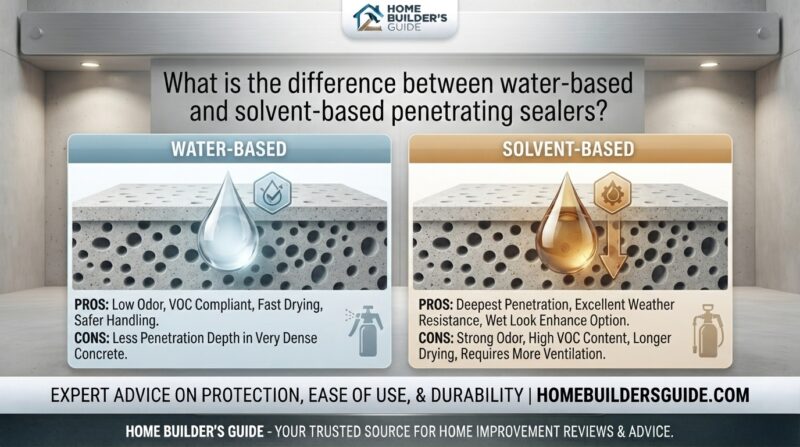
While both carrier types deliver active hydrophobic active ingredients deep into concrete capillaries, they behave completely differently during application, drying, and environmental exposure.
Direct Comparison: Water-Based vs. Solvent-Based Penetrating Sealers
To quickly evaluate which carrier aligns with your project goals, regional regulations, and surface type, review the comprehensive comparison table below:
| Feature / Metric | Water-Based Penetrating Sealers | Solvent-Based Penetrating Sealers |
| Primary Carrier Solution | Clean Water | Chemical Solvents (Acetone, Xylene, Mineral Spirits) |
| Volatile Organic Compounds (VOCs) | Very Low (< 50 g/L) | Moderate to High (> 250 g/L to 400+ g/L) |
| Environmental & Safety Rating | Eco-friendly, non-flammable, virtually odorless | Flammable, strong fumes, requires respirator |
| Penetration Depth | Moderate to Deep (Slightly larger particle emulsion) | Deepest (Smaller molecular size in liquid) |
| Substrate Moisture Tolerance | Applied to dry or slightly damp concrete | Concrete must be bone dry before application |
| Appearance & Color Impact | 100% Invisible, zero gloss, natural matte finish | Natural matte finish; may slightly darken some substrates |
| Regional Regulation Compliance | Compliant in all 50 US States (including CA/SCAQMD) | Restricted in high-VOC regions (CA, NY, WA) |
| Clean-Up Method | Warm soap and water | Mineral spirits or Xylene solvent |
| Shipping & Handling Constraints | Non-hazardous goods | Hazardous material fees (HAZMAT) may apply |
| Typical Lifespan | 5 to 10 Years | 5 to 10 Years |
How Penetrating Chemistry Works: The Role of Carriers
To understand the core difference between these two products, you must understand how a penetrating sealer functions.
Unlike topical coatings (like acrylics or polyurethanes) that form a film on top of the surface, penetrating sealers enter the open capillary pores of concrete. Once inside, the active chemical solids—such as silane or siloxane molecules—react with the silica and free lime within the concrete matrix, cross-linking to form a hydrophobic (water-repellent) silicone structure.
                  [ SUBSTRATE PORE MATRIX ]

    WATER-BASED CARRIER                  SOLVENT-BASED CARRIER
 (Larger Emulsion Molecules)           (Tiny Molecular Penetration)
  ~~~~~~~~~~~~~~~~~~~~~~~~~             .........................
  | Water evaporates      |             | Solvent evaporates    |
  | Water-repellent solid |             | Deepest capillary     |
  | remains in pores      |             | reaction achieved     |
  -------------------------             -------------------------
The carrier—whether water or solvent—is simply the transport vehicle. Its sole job is to keep the active silane/siloxane solids liquid until they reach depth within the concrete. Once inside, the carrier evaporates, leaving the hydrophobic barrier suspended in the surface pores.
1. Water-Based Carriers (Micro-Emulsions)
In water-based sealers, microscopic droplets of silane or siloxane are suspended in a water base using specialized emulsifiers. As the water evaporates after application, the active ingredients fuse together and bind chemically to the pore walls.
2. Solvent-Based Carriers
In solvent-based sealers, active chemical solids are dissolved directly into an organic solvent like Xylene, Acetone, or mineral spirits. Because solvent molecules are extremely small and have low surface tension, they can carry active solids slightly deeper into tight, dense substrates like smooth-troweled concrete or natural stone.
Regional Environmental Regulations: CA, NY, WA, TX & San Francisco
Where you live heavily dictates which sealer you can legally buy and apply. The United States EPA enforces national Volatile Organic Compound (VOC) guidelines, but regional air-quality management districts set far stricter limits.
1. California & San Francisco (SCAQMD Rules)
- The Rule: California enforces the strictest VOC restrictions in the United States, governed largely by the South Coast Air Quality Management District (SCAQMD) and Bay Area Air Quality Management District (BAAQMD).
- Impact: Most traditional solvent-based sealers exceeding 50 g/L or 100 g/L VOC are banned from sale and application in San Francisco and across California.
- Best Choice: Water-based penetrating sealers are the gold standard in CA, offering total regulatory compliance without compromising water repellency.
2. New York & Northern States (OTC Regulations)
- The Rule: New York belongs to the Ozone Transport Commission (OTC), which enforces strict limits on architectural and industrial maintenance coatings.
- Impact: Many high-solids solvent sealers are restricted unless reformulated using exempted solvents like Acetone.
- Best Choice: Water-based silane/siloxane micro-emulsions handle New York freeze-thaw cycles reliably while complying with regional VOC caps.
3. Washington State
- The Rule: Washington enforces clean air regulations requiring low-emitting materials, especially in urban environments around Seattle and Tacoma.
- Best Choice: Due to frequent rainfall and damp ambient weather, water-based penetrating sealers are favored because they tolerate minor surface dampness better during application than solvent alternatives.
4. Texas (High Heat & Standard VOC Limits)
- The Rule: Texas follows federal EPA guidelines, allowing wider availability of solvent-based sealers.
- Application Warning: In extreme Texas summer heat (above 90°F / 32°C), solvent-based sealers can flash off (evaporate) too quickly, leaving solids drying on top of the driveway as white powder before penetrating.
- Best Choice: Water-based sealers applied in early morning hours, or low-VOC solvent sealers in cooler seasons.
Application Guide: Step-by-Step Workflow
Whether choosing a water-based or solvent-based formula, achieving professional-grade results requires disciplined surface prep and application technique.
1.Inspect & Test Surface Porosity:Required Equipment Setup.
Pour 1/4 cup of water onto the concrete. If the water darkens the surface within 3–5 minutes, the pores are open and ready to absorb a penetrating sealer. If water beads up, an old coating exists and must be stripped first.
2.Clean & Degrease Substrate:Deep Cleaning Phase.
Pressure wash the surface (2500–3000 PSI) using a quality concrete cleaner or degreaser. Eliminate grease, oil, moss, and dirt. Penetrating sealers cannot cross-link through oil or organic residue.
3.Verify Moisture Content:Moisture Check.
For solvent-based sealers, wait 24–48 hours until concrete is bone dry. For water-based sealers, a slightly damp (touch-dry) surface is acceptable, provided no standing puddles remain.
4.Apply First & Second Coats:Wet-on-Wet Technique.
Using a low-pressure chemical sprayer, apply an even coat until the concrete is thoroughly saturated. Within 15–20 minutes (while the first coat is still wet), apply a second coat “wet-on-wet.”
5.Back-Roll Puddles & Cure:Back-Rolling Excess.
Inspect low spots for liquid pooling. Back-roll excess sealer using a dry paint roller within 10 minutes. Allow 6 hours for foot traffic and 24 hours for passenger vehicles.
Pro Tips & Critical Application Rules
- Always Apply Wet-on-Wet: Penetrating sealers function by repelling liquid. If you let the first coat dry completely before applying a second coat hours later, the second coat will be repelled by the first, drying on top as a white, flaky crust.
- Watch Temperature Limits: Apply between 50°F and 85°F (10°C to 29°C). High temps cause premature evaporation; freezing temps disrupt chemical bonding.
- Protect Neighboring Surfaces: Mask off glass windows, polished metal, and painted finishes. Silane and siloxane active ingredients can permanently etch glass if left to dry.
10 Frequently Asked Questions (FAQs)
1. Does a water-based penetrating sealer last as long as a solvent-based one?
Yes. Once cured inside concrete capillaries, the active silane or siloxane chemical structure is identical regardless of whether it was delivered via water or solvent. Both offer a 5 to 10-year lifespan.
2. Why are solvent-based sealers restricted in states like California and New York?
Solvent-based sealers emit higher levels of Volatile Organic Compounds (VOCs) during drying. VOCs react with sunlight and nitrogen oxides in the atmosphere to form ground-level ozone and smog.
3. Can I apply a solvent-based penetrating sealer over damp concrete?
No. Solvents and water do not mix. Applying a solvent-based sealer to damp concrete creates a cloudy barrier, prevents deep penetration, and leads to application failure.
4. Can I apply a water-based penetrating sealer over a surface previously treated with a solvent-based sealer?
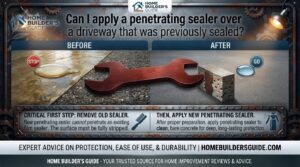
Yes, but only if the previous sealer has worn down completely and the concrete absorbs water freely during a porosity test.
5. Will a water-based penetrating sealer make my driveway look shiny or wet?
No. Penetrating sealers work inside the concrete pores rather than on the surface. They do not alter surface texture or create gloss, maintaining a natural, unsealed look.
6. How do I clean up after applying a water-based vs solvent-based sealer?
Water-based sealers clean up easily with warm water and soap before drying. Solvent-based sealers require mineral spirits, Xylene, or Acetone to clean sprayers and tools.
7. Which carrier is safer for indoor applications or garage floors?
Water-based penetrating sealers are significantly safer indoors because they are non-flammable and produce zero harsh solvent fumes. Solvent-based formulas require explosion-proof ventilation and organic vapor respirators.
8. What happens if it rains shortly after applying a penetrating sealer?
Rain within 12–24 hours of application can wash unreacted silane/siloxane compounds out of open concrete pores. Always check for a clear 24-hour weather window before starting.
9. Which sealer is better for dense surfaces like smooth-troweled concrete or granite?
Solvent-based penetrating sealers historically perform slightly better on extremely dense, low-porosity surfaces because solvent molecules penetrate tight pores faster than water droplets.
10. How can I remove white residue caused by over-application?
If excess penetrating sealer dries on the surface and turns white, scrub it vigorously with a stiff bristle brush and Xylene (for solvent-based) or a concrete stripper/heavy degreaser (for water-based).
Conclusion
Both water-based and solvent-based penetrating sealers deliver outstanding long-term protection against freeze-thaw damage, salt scaling, and moisture intrusion. However, water-based penetrating sealers have emerged as the clear industry standard for most residential and commercial projects. They offer complete VOC compliance across all 50 states (including California, New York, and Washington), easy soap-and-water cleanup, and safe application without dangerous solvent fumes—all while providing the exact same 5 to 10-year lifespan as solvent-based alternatives.