Concrete driveways are a major investment, yet they face constant exposure to weather and chemical damage. Rain, freeze-thaw cycles, road salts, vehicle fluid leaks, and harsh UV rays cause pitting, spalling, and cracking over time.
Replacing a damaged concrete driveway can cost upwards of $7 to $12 per square foot. Applying a high-performance penetrating concrete sealer costs a fraction of that—typically between $0.15 and $0.50 per square foot—while extending your driveway’s lifespan by up to 10 years.
What Is a Penetrating Concrete Sealer and How Does It Work?
Unlike film-forming topical sealers (such as acrylics, epoxies, or polyurethanes) that sit on top of the surface to create a glossy coat, penetrating sealers absorb deep into the capillaries of the concrete.
Once inside, the active chemical compounds (silanes, siloxanes, siliconates, or silicates) chemically react with the free lime and calcium hydroxide in the concrete. This reaction creates a permanent hydrophobic (water-repellent) barrier beneath the surface without altering the driveways natural appearance, texture, or slip resistance.
TOPICAL FILM SEALER (Acrylic / Epoxy)      PENETRATING SEALER (Silane / Siloxane)
┌─────────────────────────────────┐        ┌─────────────────────────────────┐
│     Surface Coating (Glossy)    │        │     Unaltered Natural Surface   │
├─────────────────────────────────┤        ├─────────────────────────────────┤
│  Concrete Base (Pores Open)     │        │  ████ Hydrophobic Chemical ████ │
│                                 │        │  ████ Barrier Reacts Inside ███ │
└─────────────────────────────────┘        └─────────────────────────────────┘
* Traps moisture, can peel/yellow           * Breathable, non-slip, won't peel
The Three Main Penetrating Sealer Chemistries
- Silanes: Microscopic molecules that penetrate deeply (up to 1/4 inch) into dense concrete. High volatility means they require high solids content (40%+) to perform effectively.
- Siloxanes: Larger molecular structures that form a strong surface-level barrier in porous, aged concrete. Less volatile and highly cost-effective.
- Silane-Siloxane Blends: The gold standard for residential driveways. The silane molecules penetrate deep into the core, while siloxane molecules seal near the surface, providing dual-layer protection.
Consumer Testing Benchmarks: Top Penetrating Driveway Sealers Compared
Our consumer performance evaluations rate driveway sealers across five primary metrics: Water Absorption Reduction, Freeze-Thaw Resistance, Salt/Deicer Protection, Coverage Efficiency, and Expected Lifespan.
| Product Name | Chemical Base | VOC Status | Coverage per Gal | Expected Lifespan | Best Overall For |
| Ghostshield Siloxa-Tek 8500 | Water-Based Silane/Siloxane | Low VOC (50-State) | 250 sq. ft. | 8–10 Years | All-Climate & Salt Protection |
| Foundation Armor SX5000 | Solvent-Based Silane/Siloxane | Standard / Low VOC available | 175 sq. ft. | 7–10 Years | Deep Penetration & Harsh Winters |
| MasonryDefender Driveway Sealer | Water-Based Silane/Siloxane | Eco-Friendly Low VOC | 125 sq. ft. | 3–5 Years | Budget DIY Projects |
| Super Seal-M | Water-Based Silicone Hybrid | Low VOC | 200 sq. ft. | 5–8 Years | Value & High Breathability |
| RadonSeal Plus | Water-Based Silicate Densifier | Zero VOC | 200 sq. ft. | Permanent / Lifetime | Soft, Weak, or Crumbling Concrete |
| Prosoco Concrete Protector SB | Solvent-Based Penetrating | Commercial Standard | 200 sq. ft. | 8–10 Years | Heavy Vehicle Traffic & Oil Repellency |
Detailed Consumer Product Reviews
1. Ghostshield Siloxa-Tek 8500 — Best Overall Penetrating Sealer
Ghostshield’s Siloxa-Tek 8500 consistently ranks at the top of independent laboratory tests and consumer reviews for long-term concrete protection. Its advanced water-based silane/siloxane micro-emulsion penetrates deep into concrete pores, blocking water and chloride ions (deicing salts) without trapping internal moisture vapor.
- Performance: Reduces water absorption by up to 98%.
- Appearance: Completely invisible; leaves a 100% natural matte finish without sheen or color darkening.
- Application: Easy low-pressure pump sprayer application; dry to touch in 2 to 4 hours.
- Pros: Highly resistant to freeze-thaw spalling, deicing salt pitting, and efflorescence. 50-state VOC compliant.
- Cons: Higher upfront cost per gallon compared to retail store brands.
2. Foundation Armor SX5000 — Best Industrial-Grade Solvent-Based Sealer
Foundation Armor SX5000 is a high-solids, department-of-transportation (DOT) approved silane/siloxane penetrating sealer designed for extreme environmental durability. Available in both solvent-based and water-based (SX5000 WB) formulations, it creates a deep chemical cross-link inside the concrete matrix.
- Performance: Exceptional barrier against deicing salts, road chemical runoff, and freeze-thaw fracturing.
- Appearance: Natural finish with negligible color shift.
- Application: Apply 2 wet-on-wet coats using a solvent-resistant sprayer.
- Pros: Penetrates up to 3/8 inch deep; resists mold, mildew, and chemical staining.
- Cons: Solvent version requires proper respiratory protection during spray application and has higher VOC odors.
3. MasonryDefender Concrete Driveway Sealer — Best Bang for the Buck
For homeowners seeking reliable protection on a budget, MasonryDefender provides an accessible, water-based silane/siloxane formula. It delivers solid resistance to water intrusion and salt damage at half the cost of premium commercial sealers.
- Performance: Reduces surface absorption to protect against winter pop-outs and cracking.
- Appearance: Clear, non-yellowing matte finish.
- Application: Simple broadcast spray or roller application.
- Pros: Non-toxic, low odor, easy cleanup with soap and water.
- Cons: Shorter lifespan (3–5 years) requiring more frequent re-application.
4. RadonSeal Plus — Best for Strengthening & Densifying Soft Concrete
Unlike silane/siloxane water repellents, RadonSeal Plus is a deep-penetrating sodium silicate/siliconate reaction formula. It reacts chemically with matrix minerals inside the concrete to form a glass-like crystalline matrix. This process hardens soft or chalky concrete while sealing micro-capillaries against water and gas transmission.
- Performance: Hardens concrete by up to 40% while stopping capillary moisture rise.
- Appearance: Natural finish (must flush excess sealer during application to prevent white residue).
- Application: Sprayer or squeegee on unsealed, clean concrete.
- Pros: Permanent reaction that never degrades or wears away.
- Cons: Does not provide immediate surface water-beading unless paired with a silane topcoat.
Regional Climate & Buying Considerations
Different parts of the country pose unique environmental hazards to concrete driveways. Here is how geographic factors across key regions should dictate your choice of penetrating sealer:
🤠 Texas (Dallas, Houston, Austin, San Antonio)
- Primary Environmental Threat: Intense UV exposure, high thermal expansion/contraction, and torrential rains.
- Sealer Recommendation: Water-based silane/siloxane blends like Ghostshield 8500 or Super Seal-M. Solvent-based sealers can dry too quickly during hot Texas summers, leading to uneven absorption.
🌉 California & San Francisco Bay Area
- Primary Environmental Threat: Marine fog/humidity, coastal salt air, and strict environmental air quality limits.
- VOC Regulations: California has strict Volatile Organic Compound (VOC) regulations (CARB standards), especially in the Bay Area (BAAQMD).
- Sealer Recommendation: Choose zero-VOC or ultra-low VOC water-based penetrating formulas (under 50 g/L VOC) such as Siloxa-Tek 8500 or MasonryDefender.
🗽 New York & Mid-Atlantic
- Primary Environmental Threat: Severe freeze-thaw cycles, heavy snowfall, and heavy application of chemical deicers and rock salt.
- Sealer Recommendation: Heavy-duty silane-siloxane sealers with at least 40% active solids (such as Foundation Armor SX5000 or Ghostshield 8500) to prevent salt pitting and surface scaling.
🌲 Washington State & Pacific Northwest (Seattle, Tacoma)
- Primary Environmental Threat: Sustained dampness, continuous rainfall, moss, algae, and lichen growth.
- Sealer Recommendation: Look for silane/siloxane penetrating sealers containing integrated biocide properties (or densifiers like Lithi-Tek 9500) that repel standing moisture and prevent biological growth inside concrete pores.
Step-by-Step DIY Application Guide for Maximum Longevity
Even the highest-rated consumer reports sealer will fail if applied over poorly prepared concrete. Follow this step-by-step application protocol for professional results:
Step 1: Surface Cleanliness (Crucial)
- Remove oil and grease stains using a dedicated concrete degreaser or poultice.
- Pressure wash the entire driveway at 2,500–3,000 PSI to remove embedded dirt, moss, and loose debris.
- Allow the concrete to dry thoroughly for at least 24 to 48 hours. Penetrating sealers cannot absorb into water-saturated pores.
Step 2: Weather Verification
- Apply when ambient temperatures are between 50°F and 85°F.
- Ensure no rain is forecasted for 24 hours post-application.
- Avoid applying in direct, intense midday sunlight to prevent premature drying.
Step 3: Application Technique (“Wet-on-Wet”)
- Pour sealer into a heavy-duty, solvent-resistant garden pump sprayer.
- Spray in a uniform pattern using a fan tip nozzle.
- Apply a second coat “wet-on-wet” within 15–20 minutes of the first coat (before the first coat dries). Once a penetrating sealer fully dries, it repels subsequent coats.
Step 4: Curing Time
- Foot Traffic: Safe after 4 to 6 hours.
- Vehicle Traffic: Keep vehicles off the driveway for 24 to 48 hours to allow full chemical cross-linking.
10 Frequently Asked Questions (FAQs)
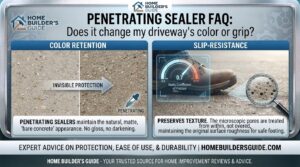
1. Does a penetrating sealer change the color or slip-resistance of my driveway?
No. High-quality penetrating silane/siloxane sealers do not form a surface film or shine. They leave the natural color, texture, and traction of the concrete completely unaltered while providing invisible protection underneath.
2. How often do I need to re-apply a penetrating concrete sealer?
Top-tier silane/siloxane sealers typically last 5 to 10 years depending on climate, traffic volume, and salt exposure. You can perform a simple “water drop test”: if water beads up on the surface, the sealer is still working; if it darkens and absorbs immediately, it is time to re-seal.
3. Can I apply a penetrating sealer over a driveway that was previously sealed?
Penetrating sealers can only be applied over concrete that has open pores. If the existing sealer is a film-forming acrylic, epoxy, or paint, it will block the penetrating sealer from absorbing. Previous film coatings must be chemically stripped or mechanically ground off first.
4. What is the difference between water-based and solvent-based penetrating sealers?
Water-based sealers have lower odor, low VOCs, easier soap-and-water cleanup, and comply with strict state regulations (like California CARB). Solvent-based sealers penetrate slightly deeper and dry faster in high humidity, but require chemical solvents for cleanup and carry stronger fumes.
5. How soon can I seal a newly poured concrete driveway?
Newly poured concrete must cure for at least 28 days before applying a penetrating silane/siloxane sealer. Applying too early traps hydration water and interferes with the chemical curing process.
6. Will a penetrating sealer stop existing concrete cracks from expanding?
A penetrating sealer protects against freeze-thaw damage that causes new cracking, but it cannot bridge or fill existing structural cracks. Existing cracks larger than hairline width should be filled with an elastomeric concrete crack sealant prior to sealing.
7. Does penetrating sealer protect against engine oil stains?
While penetrating sealers dramatically slow down oil absorption, pure silane/siloxane water repellents are primarily designed to repel water and salts. For maximum oil and grease resistance, choose a specialized fluorinated penetrating sealer or fluoropolymer-infused formula.
8. Is high active solids percentage important in a penetrating sealer?
Yes. The percentage of active silane or siloxane resins determines how much protective material remains inside the pores after the liquid carrier evaporates. Look for products with at least 20% to 40% active solids for long-lasting residential driveway protection.
9. Can I apply penetrating sealer with a paint roller instead of a sprayer?
Yes, you can use a 3/8-inch or 1/2-inch nap roller, but a low-pressure pump sprayer is strongly recommended. Sprayers distribute the liquid more evenly across porous concrete surfaces and ensure proper saturation without puddling.
10. Why is water beading dropping off after 1 year, even if the sealer is rated for 7 years?
Surface water beading is caused by surface tension, which naturally diminishes over time as traffic and dirt wear down the outermost micron of concrete. However, the chemical barrier created inside the pores remains active and continues to repel subsurface water and salt for years.
Conclusion: Protect Your Concrete Investment
Choosing the right penetrating concrete sealer comes down to your climate, budget, and local VOC regulations.
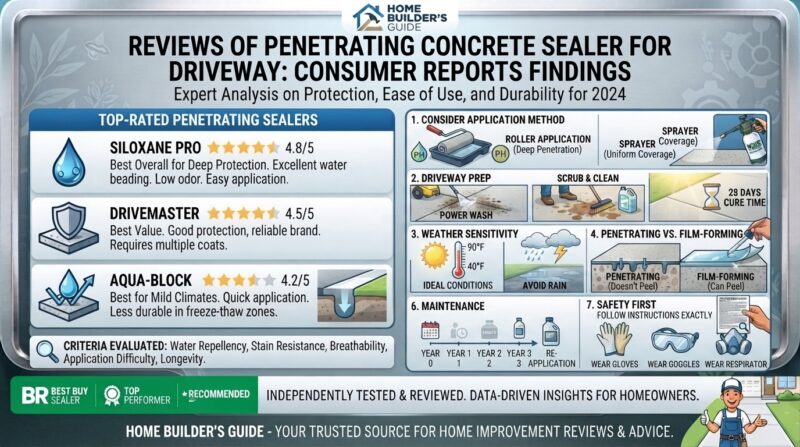
- For all-around durability, freeze-thaw defense, and salt resistance, Ghostshield Siloxa-Tek 8500 and Foundation Armor SX5000 lead consumer ratings.
- For economical DIY protection, MasonryDefender offers solid value.
- For soft, deteriorating concrete, a silicate densifier like RadonSeal Plus strengthens the underlying structure.
By thoroughly washing your driveway, allowing adequate dry time, and applying two “wet-on-wet” coats, you will protect your concrete against winter weather, water damage, and costly repairs for years to come.