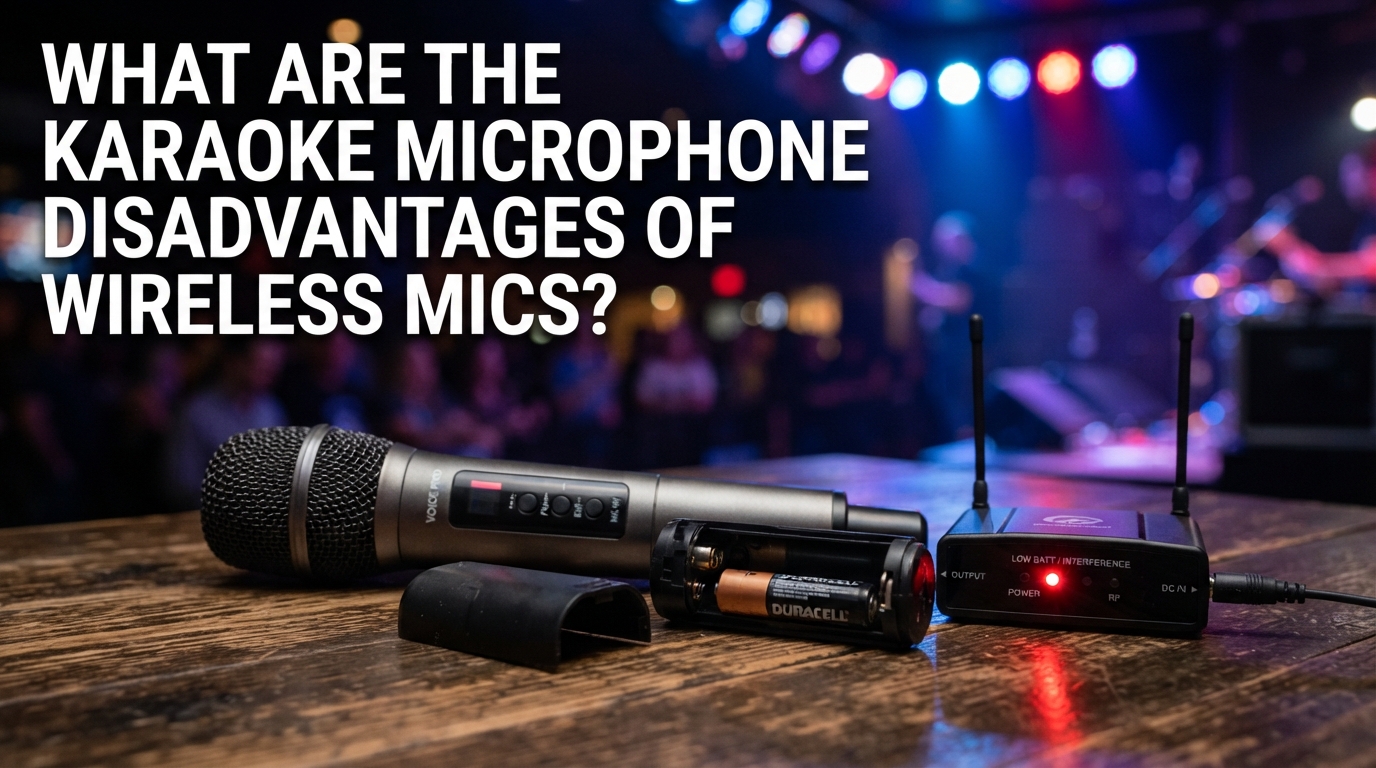
What are the karaoke microphone disadvantages of wireless mics? When upgrading a home entertainment system or planning a high-energy living room party across urban hubs like New York, San Francisco, or Austin, cutting the cord feels like a natural upgrade. Wireless karaoke microphones promise absolute freedom, allowing singers to dance, pass the mic, and belt out high notes without tripping over tangled wires. However, beneath the marketing gloss and clean aesthetics lie several operational hurdles that can derail a performance.
Understanding the technical and practical drawbacks of wireless systems helps buyers make informed choices before investing in new audio hardware.
The Core Disadvantages of Wireless Karaoke Microphones
While convenience drives the popularity of cordless setups, several persistent vulnerabilities separate them from traditional wired alternatives.
1. Audio Latency and Compression Artifacts
Unlike direct physical connections, wireless transmission requires audio signals to be converted, compressed (in digital models), transmitted via radio frequency (RF) or Bluetooth, and decoded by a receiver. This multi-step process introduces microscopic delays known as latency. While high-end professional setups minimize this lag, budget-friendly consumer wireless mics often suffer from a noticeable audio delay. For singers, hearing their voice fractionally out of sync with the backing track makes staying on rhythm remarkably difficult.
2. Signal Dropouts, Interferences, and Dead Zones
Wireless signals are inherently volatile. Interference from residential Wi-Fi routers, Bluetooth devices, microwave ovens, and neighboring cellular networks can disrupt the transmission band.
- Multipath Interference: In dense urban apartments or rooms with heavy architectural elements, signals bounce off walls and metal surfaces, creating phase cancellation and sudden audio dropouts.
- Frequency Congestion: In densely populated metropolitan regions—such as downtown Manhattan or central San Francisco—the local airwaves are flooded with competing RF signals, increasing the risk of static bursts and sudden cut-outs.
3. Battery Anxiety and Power Management
Wired microphones draw continuous power from the soundboard or amplifier, meaning they are always ready for use. Wireless mics, conversely, rely on internal rechargeable packs or disposable alkaline batteries.
- Sudden Power Loss: Running out of power mid-chorus abruptly cuts off the performance.
- Degrading Capacity: Rechargeable internal lithium-ion batteries degrade over hundreds of charge cycles, shortening operational windows over time.
- Voltage Drop: Standard rechargeable NiMH batteries output 1.2V instead of an alkaline battery’s 1.5V, which can trigger low-battery warnings prematurely or weaken RF output strength.
4. Higher Initial Cost and Complex Maintenance
Quality engineering costs money. A dependable wireless microphone system that resists interference, maintains stable frequency allocation, and delivers clean vocal pre-amplification requires a much higher financial outlay than a comparable wired model. Furthermore, complexity scales with components: users must manage receivers, power adapters, antenna alignment, and synchronization channels alongside the microphones themselves.
Comparative Analysis: Wireless vs. Wired Karaoke Systems
To visualize how these drawbacks impact day-to-day usability, consider the structural trade-offs between the two technologies:
| Performance Metric | Wireless Karaoke Microphones | Wired Karaoke Microphones |
| Signal Stability | Susceptible to interference, dropouts, and walls | Rock-solid, direct physical connection |
| Audio Latency | Minor to noticeable delay based on codec/processing | Zero perceptible latency (instantaneous transmission) |
| Power Source | Requires regular battery swaps or recharging | Plug-and-play; draws power from the host system |
| Mobility & Freedom | High range of motion; ideal for active performers | Restricted by cable length (typically 10 to 20 feet) |
| Long-Term Durability | Prone to drop damage; battery degradation risks | High longevity; fewer internal electronic failure points |
Product Review Breakdown: Common Wireless Mic Pitfalls
Consumer feedback across major US retail markets highlights several real-world design flaws found in popular consumer-grade wireless karaoke products:
- Budget Bluetooth Sing-Along Mics (All-in-One Handhelds): Popular inexpensive units featuring built-in speakers often suffer from terrible feedback loops. Because the speaker sits inches from the mic capsule, raising the volume triggers high-pitched squealing. Their Bluetooth chips also struggle with latency, making duet synchronization frustrating.
- Dual-Channel VHF/UHF Home Systems: Mid-tier dual microphone sets often cut corners on antenna quality. Users in suburban Washington or sprawling California homes frequently report that stepping behind a partial room divider causes one channel to completely mute due to weak line-of-sight tracking.
Expert Tips to Mitigate Wireless Microphone Flaws
If your performance style demands the freedom of a wireless mic, implementing strategic safeguards can bypass many of these structural disadvantages:
- Optimize Line-of-Sight Placement: Position your wireless receiver out in the open, elevated, and facing the performance area. Avoid hiding receivers inside enclosed wooden or metal entertainment centers.
- Isolate from Wi-Fi Routers: Keep your microphone receiver at least 3 to 6 feet away from dual-band Wi-Fi routers and smart home hubs to reduce localized 2.4GHz/5GHz band congestion.
- Commit to a Battery Routine: Ditch cheap generic batteries. Use high-capacity professional alkaline cells or pre-tested low-self-discharge rechargeable batteries, and replace them before hosting large gatherings.
- Keep a Wired Backup Handy: Maintain an affordable dynamic wired microphone in your setup. If wireless interference ruins a session, plugging in a wired backup instantly restores flawless audio reliability.
Frequently Asked Questions
Why does my wireless karaoke microphone make a high-pitched squealing noise?
This is acoustic feedback caused when the microphone capsule picks up sound waves coming directly out of the room speakers and loops them infinitely. Lowering the master microphone volume, stepping away from the speaker cones, or turning down the system’s built-in echo effect usually resolves the issue.
Do wireless microphones compress or degrade vocal quality?
Lower-cost digital and analog wireless systems utilize data compression or noise gating that can strip warmth and dynamic range from vocals. Premium UHF systems minimize this loss, but entry-level models often sound thinner than a direct-line wired microphone.
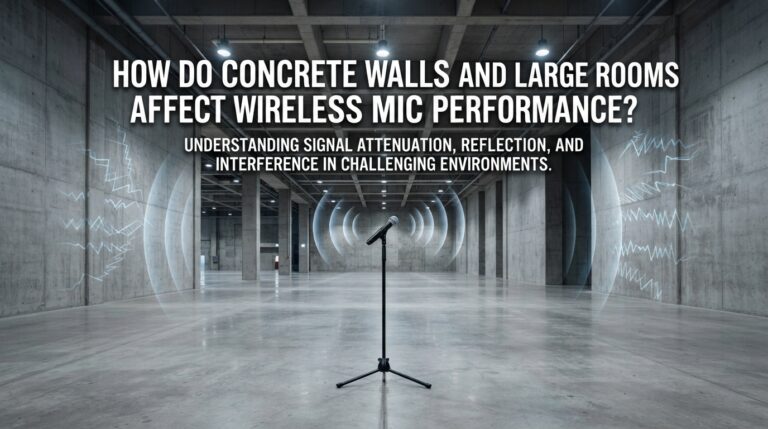
How do concrete walls and large rooms affect wireless mic performance?
Physical obstructions like concrete walls, brick, and large metal appliances block radio frequency signals, drastically shortening the functional operating range and triggering sudden signal dropouts.
Can local Wi-Fi networks interfere with my wireless karaoke mic?
Yes. Many digital wireless microphones operate on the crowded 2.4GHz frequency band—the exact same spectrum utilized by residential home Wi-Fi routers, Bluetooth speakers, and microwave ovens, causing intermittent static noise.
Why is there a noticeable delay when I sing into my wireless mic?
Audio delay (latency) occurs when digital wireless setups spend extra milliseconds encoding, transmitting, and decoding your voice signal before sending it to the speakers.
Are UHF wireless systems better than Bluetooth karaoke microphones?
Generally, yes. UHF (Ultra High Frequency) systems are purpose-built for low-latency audio transmission with dedicated receivers, whereas Bluetooth mics are compressed general-purpose consumer devices prone to noticeable latency.
How long do batteries typically last in a wireless karaoke microphone?
Standard alkaline batteries generally deliver 4 to 8 hours of continuous performance, while rechargeable lithium-ion handheld units average 5 to 10 hours depending on LED display usage and transmission power.
Why does my wireless mic cut out when I walk across the room?
This indicates you have exceeded the reliable operating range, or physical objects are blocking the direct radio path between the microphone transmitter and the base receiver.
Do I need a license to use wireless microphones in the United States?
Most consumer-grade karaoke wireless microphones operate on license-free industrial, scientific, and medical (ISM) bands or unassigned UHF blocks, requiring no special Federal Communications Commission (FCC) licensing for home use.
Is it possible to completely eliminate wireless interference in a busy city apartment?
While you cannot control outside airwaves in crowded urban environments, switching to a digital system with automatic frequency hopping or choosing a wired alternative completely bypasses local RF congestion.
Conclusion
Wireless karaoke microphones offer unmatched room mobility and eliminate messy cord clutter, making them an appealing choice for casual family gatherings and lively parties. However, their reliance on battery power, vulnerability to radio frequency interference, susceptibility to audio latency, and elevated price points represent clear operational trade-offs. Weighing your performance habits, room layout, and reliability expectations will ensure you choose the ideal audio configuration for your space.