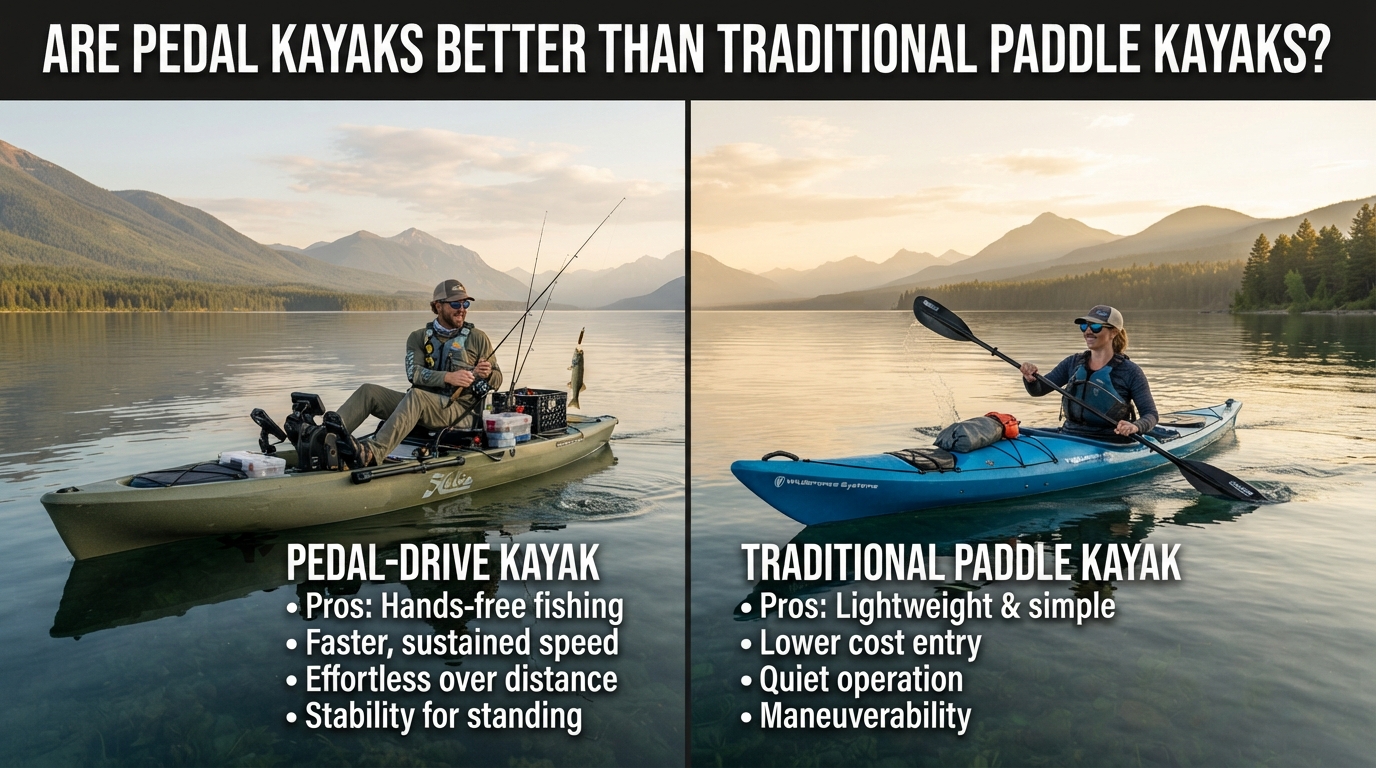
When looking to purchase a watercraft for angling or recreational cruising, the modern debate inevitably comes down to a single choice: Are pedal kayaks better than traditional paddle kayaks?
The short answer is nuanced. For dedicated kayak fishing, covering large distances, and maintaining position against wind or current, pedal kayaks are generally superior. However, for budget-conscious buyers, shallow-water creeks, and minimalist transport, traditional paddle kayaks remain unmatched.
Whether you are targeting largemouth bass on the sprawling lakes of Texas, navigating tidal currents in New York, launching through heavy surf along the coast of California, tracking salmon in Washington, or battling wind and chop around San Francisco, understanding the operational differences between these two propulsion styles will help you choose the ideal rig for your waters.
Direct Comparison: Pedal Kayaks vs. Traditional Paddle Kayaks
Evaluating performance metrics side-by-side reveals where each style excels.
+------------------------+----------------------------------+----------------------------------+
| Feature / Metric       | Pedal-Drive Kayaks               | Traditional Paddle Kayaks        |
+------------------------+----------------------------------+----------------------------------+
| Propulsion Source      | Leg muscles (Prop or Fin drive)  | Upper body (Paddle strokes)      |
| Hands-Free Operation   | Yes (hands free for rods/reels)  | No (hands occupied paddling)     |
| Average Cruise Speed   | 3.5 to 4.5 mph     | 2.0 to 3.0 mph     |
| Minimum Water Depth    | 12 to 24 inches| 4 to 8 inches                    |
| Upfront Investment     | High ($1,200 to $4,000+)         | Low to Moderate ($400 to $1,200) |
| Hull Weight            | Heavier (75 to 130 lbs)          | Lighter (45 to 75 lbs)           |
+------------------------+----------------------------------+----------------------------------+
Detailed Breakdown: Why Choose a Pedal Kayak?
Pedal-drive systems—using either a rotating propeller or flutter fins—shift the physical workload from your shoulders and arms to your legs, which are significantly stronger and possess greater endurance.
The Core Advantages of Pedal Kayaks
- True Hands-Free Fishing: The ultimate selling point for anglers. You can hold your fishing rod, tie knots, manage electronics, or fight a fish while dynamically maintaining your position or drifting slowly forward.
- Superior Speed and Efficiency: Pedal kayaks cruise comfortably at 3.5 to 4.5 mph, allowing you to cover vast expanses of water in a fraction of the time it takes to paddle.
- Wind and Current Resistance: Trying to paddle against a heavy headwind while keeping a boat straight is exhausting. Pedal systems allow you to push continuous torque into the water, keeping your bow pointed where you want it.
The Drawbacks of Pedal Kayaks
- Higher Cost: Mechanical gear boxes, precision hull engineering, and drive units command a steep price tag, often doubling or tripling the cost of standard models.
- Increased Weight: Rigged pedal kayaks are heavy, making solo car-topping a challenge and requiring a kayak cart or truck bed setup.
- Maintenance Requirements: Moving parts require regular fresh-water rinses, occasional lubrication, and inspection for weed fouling or wear.
Detailed Breakdown: Why Choose a Paddle Kayak?
The traditional paddle is the time-tested foundation of human-powered watercraft. Millions of paddlers worldwide rely on its elegant simplicity.
The Core Advantages of Paddle Kayaks
- Skinny-Water Access: Without a mechanical drive hanging beneath the hull, paddle kayaks can glide effortlessly across shallow grass flats, rocky creeks, and stump-filled backwaters where pedal drives cannot go.
- Simplicity and Reliability: There are no cables to snap, no shear pins to break, and no mechanical housings to service. If you keep the paddle in your hand, the boat moves.
- Lighter Weight and Budget-Friendly: Paddle kayaks cost substantially less upfront and weigh much less, making them ideal for quick grab-and-go trips or budget-conscious buyers.
The Drawbacks of Paddle Kayaks
- Upper Body Fatigue: Paddling for six to eight hours places intense strain on your shoulders, back, and core, leading to cumulative fatigue.
- Constant Multitasking Struggle: Every time you want to make a cast, adjust your drift, or grab a drink, you must stop paddling, secure your paddle, and pick up your rod.
Regional Context: Which Style Fits Your Local Waters?
Water conditions across the United States dictate whether a pedal or paddle platform makes the most sense.
+--------------------+--------------------------------+---------------------------------+
| Region             | Primary Water Profile          | Recommended Choice              |
+--------------------+--------------------------------+---------------------------------+
| Texas              | Shallow marshes, windy bays    | Pedal (with shallow lift)       |
| New York           | Deep glacial lakes, rivers     | Pedal for distance / Paddle for rivers|
| California         | Open ocean swells, kelp beds   | Pedal (Fin-drive with kick-up)  |
| Washington         | Swift rivers, alpine lakes     | Paddle for rivers / Pedal for lakes|
| San Francisco      | Heavy bay chop, strong tides   | High-torque Pedal system        |
+--------------------+--------------------------------+---------------------------------+
- Texas: Coastal redfish flats and windy bays demand efficient propulsion. Pedal kayaks excel at fighting the constant Texas coastal winds, provided you can lift your drive over shallow oyster bars.
- New York: From the expansive Finger Lakes to narrow upstate rivers, pedal kayaks rule the big water, while traditional paddles remain popular for narrow stream smallmouth fishing.
- California & San Francisco: Open ocean swells and kelp forests require seaworthy hulls. High-end pedal kayaks with kick-up fin systems or robust propellers provide the muscle needed to navigate shifting marine tides.
- Washington: Cold alpine lakes favor the long-distance cruising speed of pedal setups, whereas fast-moving river systems often necessitate traditional paddles for instant maneuverability.
10 Comprehensive FAQs
1. Are pedal kayaks better than traditional paddle kayaks?
For fishing and covering long distances, yes, pedal kayaks offer unmatched hands-free efficiency and speed. For tight, shallow waters, simple transport, and lower budgets, traditional paddle kayaks are better.
2. Can pedal kayaks go in reverse?
Propeller-driven pedal kayaks can reverse instantly by simply pedaling backward. Traditional fin-drive systems require a manual hand-shift lever or a 360-degree steering vector to move backward.
3. How much more expensive are pedal kayaks than paddle kayaks?
Entry-level fishing paddle kayaks typically cost between $500 and $1,000, whereas entry-level pedal-drive kayaks generally start around $1,300 to $1,800, with elite models exceeding $4,000.
4. Do pedal kayaks work well in shallow water?
Pedal drives require a minimum water depth of 12 to 24 inches to operate safely without dragging bottom. In very skinny water, you must pull or flip the drive up and use a paddle.
5. Are pedal kayaks heavier to carry?
Yes. Due to the mechanical drives, reinforced framing, and heavy-duty stadium seats, pedal kayaks usually weigh between 85 and 130 pounds, compared to 45 to 75 pounds for typical paddle models.
6. Can you still use a paddle with a pedal kayak?
Yes. Every pedal kayak owner should carry a standard backup paddle in case of mechanical failure, heavy vegetation clogging, or navigating extremely shallow shoreline entry points.
7. Which kayak type provides a better workout?
Paddle kayaks provide a comprehensive upper-body and core workout. Pedal kayaks provide a powerful lower-body workout akin to cycling, which many anglers find easier to sustain over long durations.
8. Do pedal drives require a lot of maintenance?
They require basic routine care, such as rinsing salt or grit with fresh water after every trip and occasionally lubricating internal moving parts as outlined in the owner’s manual.
9. Which kayak is better for windy conditions?
Pedal kayaks handle wind significantly better because your hands stay free to control the rod while your legs continuously correct your drift and position against gusts.
10. Can I convert a paddle kayak into a pedal kayak later?
Some modular kayak models allow you to purchase a base paddle version and drop in a pedal drive later. However, most standard paddle kayak hulls lack the scupper wells required to house a pedal unit, meaning you cannot easily convert them.
Conclusion
Deciding whether pedal kayaks are better than traditional paddle kayaks depends entirely on your budget, physical needs, and the specific bodies of water you frequent. If you prioritize effortless cruising, hands-free fishing efficiency, and long hours on big open water, investing in a pedal kayak transforms the on-the-water experience. If your adventures center around tight creeks, budget-conscious exploring, and lightweight simplicity, the classic paddle kayak remains a dependable companion.