If you are dealing with a flaky, tight, and intensely itchy scalp—whether you are braving the freezing winter air in New York City, surviving an intense, dry summer heatwave in Austin, Texas, fighting the foggy microclimates of San Francisco, or navigating the perpetual mist in Seattle, Washington—you have likely turned to natural remedies for relief.
When you see dry skin flakes dusting your shoulders, the most intuitive instinct in the world is to slather the area in a rich, natural moisturizer. And across the wellness blogosphere, coconut oil is universally praised as the ultimate cure-all for dry hair and irritated skin.
So, you reach for that jar of organic virgin coconut oil in your pantry, warm a dollop in your palms, and massage it deeply into your scalp.
Stop right there.
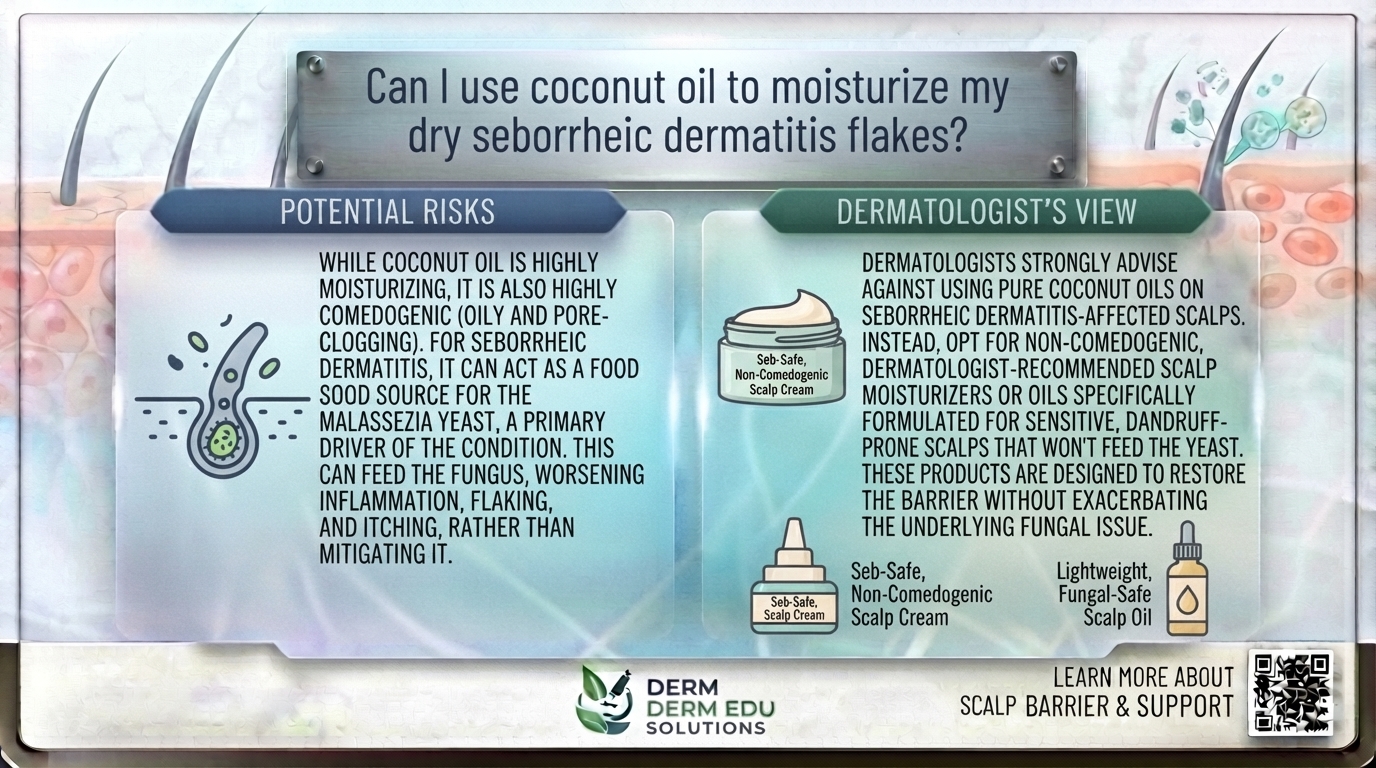
If your flakes are being driven by seborrheic dermatitis, using coconut oil is one of the worst things you can possibly do.
The short answer: No, you should never use coconut oil to moisturize seborrheic dermatitis flakes. While coconut oil will temporarily soften hard crusts and make your hair feel silky, it acts as a high-octane fertilizer for the yeast that causes seborrheic dermatitis. Within 24 to 48 hours of application, coconut oil will typically trigger a massive fungal explosion, leading to severe inflammation, intense burning, and a worsening of your flaking.
This comprehensive, evidence-based guide breaks down the biological science of why coconut oil feeds seborrheic dermatitis, distinguishes between dry scalp and fungal scaling, reviews safe alternative moisturizers, and provides an actionable protocol for achieving a truly flake-free scalp.
1. The Fungal Feast: Why Coconut Oil Worsens Seborrheic Dermatitis
To understand why coconut oil is disastrous for seborrheic dermatitis, you have to look at the microscopic ecosystem living on your scalp.
                  COCONUT OIL TO SEBORRHEIC DERMATITIS PIPELINE
                                       │
      ┌────────────────────────────────┴────────────────────────────────┐
      ▼                                                                 ▼
[ Coconut Oil Application ]                                     [ Malassezia Yeast Ingestion ]
• Rich in lauric acid (C12) & medium-chain triglycerides          • Yeast feeds exclusively on specific fatty acids
• Softens outer crusts temporarily                              • Rapidly metabolizes lauric and myristic acids
      │                                                                 │
      └────────────────────────────────┴────────────────────────────────┘
                                       │
                                       ▼
                       [ Massive Fungal Population Boom ]
                 • Excretion of toxic inflammatory oleic acids
                 • Severe flare-up: intense burning, redness & heavy scaling
The Malassezia Equation
Seborrheic dermatitis is not a simple dry skin issue; it is a chronic inflammatory skin condition driven by an overgrowth of Malassezia globosa, a harmless yeast that naturally resides on human skin.
- Malassezia does not feed on water; it feeds exclusively on lipids (fats).
- Specifically, this yeast requires carbon chain lengths ranging from C11 to C24 to survive and multiply.
The Fatty Acid Profile of Coconut Oil
What makes coconut oil unique—and uniquely dangerous for seborrheic dermatitis—is its chemical structure. Virgin coconut oil is composed of roughly 50% lauric acid (a C12 carbon chain fatty acid), alongside caprylic (C8) and capric (C10) acids.
Because lauric acid (C12) falls squarely inside the C11–C24 window, it is the absolute favorite food source for Malassezia yeast. When you apply coconut oil to a seborrheic dermatitis plaque, you are essentially pouring an all-you-can-eat buffet directly into a fungal colony. The yeast rapidly metabolizes the lauric acid, multiplies exponentially, and excretes inflammatory byproducts that trigger severe redness, itching, and scaling.
2. Dry Scalp vs. Seborrheic Dermatitis: Why Misdiagnosis Leads to Disaster
The confusion surrounding coconut oil stems from a widespread misdiagnosis. People assume that because their scalp is flaking, they have a dry scalp. In reality, they have seborrheic dermatitis (fungal dandruff).
Using the wrong treatment for the wrong condition will make your symptoms exponentially worse.
| Diagnostic Feature | True Dry Scalp (Dehydration) | Seborrheic Dermatitis (Fungal Overgrowth) |
| Root Cause | Lack of moisture, depleted sebum, environmental drying | Malassezia yeast overgrowth + immune reaction |
| Flake Appearance | Small, fine, white, powdery dust | Large, clumpy, yellowish, greasy flakes |
| Scalp Sensation | Tight, chapped, dry like winter hands | Intensely itchy, sore, inflamed, red patches |
| Reaction to Coconut Oil | Improves temporarily (locks in surface moisture) | Worsens dramatically (feeds yeast, increases scaling) |
| Ideal Remedy | Hyaluronic acid, squalane, aloe vera, gentle washes | Ketoconazole, zinc pyrithione, C8 MCT oil |
3. Regional Climate Impacts on Scalp Flaking
Environmental factors across the United States heavily influence how your skin reacts to oils and dry air:
- New York City, NY: Brutal winter winds and indoor radiator heat strip skin moisture, leading many residents to slather heavy oils (like coconut or olive oil) onto their scalps. In NYC apartments, this mistake routinely converts a mild winter dryness into full-blown seborrheic dermatitis.
- Austin & Houston, TX: High humidity and scorching heat cause heavy sweating. When Texans combine sweat with heavy natural plant oils, they create a warm, lipid-rich trap that accelerates fungal growth along the hairline.
- San Francisco, CA: The Bay Area’s shifting coastal microclimates and hard water mineral buildup often leave hair feeling brittle, prompting misguided DIY oil treatments that trigger stubborn scaling.
- Seattle, WA: The damp, overcast Pacific Northwest climate keeps outdoor humidity high, creating an environment where Malassezia thrives naturally. Adding coconut oil to this equation supercharges the yeast.
4. Product Reviews: Safe Alternatives & Effective Treatments
If your scalp is flaking and you need deep hydration or yeast control without causing a flare-up, skip the coconut oil and utilize these four expert-vetted products evaluated by itemguides.com:
1. Bulletproof Brain Octane C8 MCT Oil (Yeast-Safe Moisturizer)
- Best For: Deeply moisturizing tight, flaky scalps without feeding Malassezia yeast.
Unlike coconut oil (which contains C12 lauric acid that feeds yeast), C8 MCT oil contains exclusively Caprylic Acid (C8). Because C8 has a carbon chain length below C11, Malassezia yeast cannot metabolize it. It is entirely invisible to the fungus, making it the holy-grail natural moisturizer for seborrheic dermatitis.
- Key Specifications:
- Active Ingredient: 100% Purified Caprylic Acid (C8).
- Source: Derived from pure coconut/palm sustainably.
- Texture: Lightweight, clear oil.
- Pros: Intensely moisturizes dry winter skin; 100% yeast-safe; softens stubborn crusts gently without triggering inflammation.
- Cons: Must be washed out with shampoo if applied heavily; premium pricing for pure C8 fraction.
2. Nizoral A-D Anti-Dandruff Shampoo (1% Ketoconazole)
- Best For: Killing the underlying Malassezia yeast driving clinical flaking and scaling.
When scaling gets out of hand, natural oils won’t cut it. Nizoral uses 1% Ketoconazole, a potent clinical antifungal that binds to scalp proteins to destroy fungal cell walls and eliminate the root cause of seborrheic dermatitis.
- Key Specifications:
- Active Ingredient: Ketoconazole 1%.
- Usage: 2 times per week for 4 weeks.
- Scent: Fresh, clean clinical lather.
- Pros: Clinically proven efficacy; stops intense itching fast; clears greasy yellow crusts.
- Cons: Can be drying to hair shafts; requires a yeast-safe conditioner on hair ends.
3. DermaZen Calming Seborrheic Serum
- Best For: Instant leave-in relief for itchy, red, inflamed scalps and facial flare-ups.
This specialized serum is formulated specifically for seborrheic dermatitis sufferers. It uses xylitol to break down the protective biofilm that yeast hides behind, alongside soothing agents to calm redness.
- Key Specifications:
- Key Ingredients: Colloidal Silver, Xylitol, Urea, Aloe Leaf Juice.
- Application: No-rinse daily spot treatment.
- Formulation: 100% yeast-safe, fragrance-free.
- Pros: Absorbs instantly; breaks down fungal biofilms; eliminates itching within minutes; non-greasy.
- Cons: High cost per ounce; requires consistent application.
4. Biossance 100% Squalane Oil (Sugarcane-Derived)
- Best For: Featherlight, non-comedogenic hydration for sensitive facial and scalp skin.
Derived sustainably from sugarcane, this pure squalane oil mimics your skin’s natural sebum perfectly. Because it lacks the long-chain fatty acids that fungi feed on, it provides silky hydration without triggering a breakout or a seborrheic flare-up.
- Key Specifications:
- Active Ingredient: 100% Plant-Derived Squalane.
- Texture: Ultra-lightweight dry oil.
- Pros: Non-comedogenic; absorbs in seconds; completely yeast-safe; excellent for dry facial skin around the nose and eyebrows.
- Cons: Does not soften thick, hardened crusts as effectively as C8 MCT oil.
5. Comparison Matrix: Oil & Treatment Evaluation
| Product Name | Category | Primary Function | Yeast-Safe? | Best Suited For |
| Virgin Coconut Oil | Natural Oil | Heavy moisturization | NO (Feeds yeast) | Body skin only (Avoid scalp/face) |
| C8 MCT Oil | Safe Moisturizer | Deep barrier hydration | YES | Softening scalp crusts safely |
| Nizoral A-D Shampoo | Medical Wash | Kills fungal overgrowth | N/A (Antifungal) | Clearing active scaling & itching |
| Biossance Squalane | Facial/Scalp Oil | Lightweight barrier repair | YES | Daily facial & hairline hydration |
6. Actionable Tips: How to Moisturize Without Fueling Yeast
If your scalp is flaking and you want to avoid making your seborrheic dermatitis worse, follow these rules:
- Audit Your Bathroom Shelf: Check the ingredients of your current hair oils, leave-in conditioners, and face lotions. If you see Cocos Nucifera (Coconut) Oil, Olea Europaea (Olive) Oil, Prunus Amygdalus Dulcis (Sweet Almond) Oil, or Polysorbates, throw them out or keep them off your head and face.
- Use the “Patch Test” Rule: Before applying any new oil to your scalp, verify its carbon chain length. Stick exclusively to C8 MCT oil or Squalane oil.
- Never Pick at Scalp Crusts: Picking at flaky scales creates micro-tears in the skin barrier, inviting bacterial infections and worsening inflammation. Use C8 MCT oil to gently loosen crusts overnight, then wash them out safely the next morning.
- Wash Your Hair Regularly: Do not fall into the trap of low-poo or no-poo trends if you have seborrheic dermatitis. You must wash your hair frequently (every 1 to 2 days during flare-ups) to manually remove excess oil and prevent yeast accumulation.
7. Frequently Asked Questions (FAQ)
1. Why does coconut oil feel like it helps my hair, but hurts my scalp?
Coconut oil has a small molecular structure that penetrates the hair cuticle exceptionally well, making hair strands feel soft and shiny. However, on the living skin of your scalp, those exact same fatty acids act as food for Malassezia yeast, triggering inflammation underneath.
2. Are there any natural oils that are safe for seborrheic dermatitis?
Yes. Oils containing short-chain or odd-chain fatty acids that fungi cannot digest are safe. These include pure C8 MCT oil (Caprylic Acid) and squalane oil. Avoid all long-chain plant oils (coconut, olive, argan, jojoba, castor).
3. Can I use mineral oil instead of coconut oil?
Yes. Refined mineral oil (baby oil) is a hydrocarbon that is entirely synthetic and contains no fatty acids. Malassezia yeast cannot digest mineral oil, making it safe to use for softening stubborn scales, though it can feel heavy and greasy on hair.
4. How can I check if a cosmetic product is safe for seborrheic dermatitis?
You can copy and paste the ingredient list of any lotion, shampoo, or oil into free online checker tools like Sezia.co or Folliculitisscout.com. These databases scan the formula for ingredients that feed Malassezia yeast and instantly flag unsafe items.
5. Why does my seborrheic dermatitis flake look so much like dry skin?
When skin cells shed rapidly due to fungal irritation, they clump together before they are fully mature. Without enough natural, balanced sebum, these clumps dry out on the surface, mimicking the appearance of dry, powdery skin even though the underlying root cause is excess oil and yeast.
6. Will washing my hair with anti-dandruff shampoo dry out my scalp?
Clinical shampoos like Nizoral or Zinc Pyrithione can be slightly drying to hair strands. To prevent this, apply the medicated shampoo only to your scalp, let it sit for 3 to 5 minutes, rinse thoroughly, and then apply a yeast-safe conditioner exclusively to the mid-lengths and ends of your hair.
7. Can I use MCT oil on my face if I have seborrheic dermatitis around my nose and eyebrows?
Yes. C8 MCT oil is fantastic for facial seborrheic dermatitis. Apply 2 to 3 drops to clean, damp skin to soothe flaky patches around the eyebrows, nostrils, and beard area without triggering a fungal flare-up.
8. Does drinking more water stop my seborrheic dermatitis from flaking?
Systemic hydration is essential for overall health and supports general skin elasticity, but drinking water will not stop seborrheic dermatitis. Because the condition is driven by yeast and oil overproduction rather than pure water dehydration, topical management and antifungal care are required.
9. Why does my seborrheic dermatitis flare up when I use heavy hair styling products?
Many pomades, gels, and styling creams contain oils, waxes, and fatty alcohols that provide a rich food source for Malassezia yeast. If you use styling products, ensure they are water-based, non-comedogenic, and certified yeast-safe.
10. When should I see a dermatologist for my flaking scalp?
You should consult a board-certified dermatologist if your flaking is accompanied by severe raw weeping skin, intense pain, significant hair thinning, or if your symptoms fail to improve after 4 weeks of consistent over-the-counter antifungal treatment.
Conclusion
While coconut oil is a legendary staple in natural beauty routines, it is public enemy number one for anyone suffering from seborrheic dermatitis. Slathering virgin coconut oil onto a fungal scalp flare-up is equivalent to throwing gasoline on a fire, feeding the Malassezia yeast and guaranteeing increased inflammation, itching, and scaling.
To finally conquer your flakes, ditch the coconut oil, audit your hair products using yeast-safe databases, and switch to targeted solutions like C8 MCT oil for safe moisture, Nizoral for antifungal control, and Biossance Squalane for lightweight barrier repair.
For more science-backed dermatological guides, product reviews, and wellness tips, continue exploring itemguides.com!