Homeowners, organic landscapers, and property managers across the United States are increasingly questioning the safety of synthetic chemical herbicides. In major suburban and urban markets—from the coastal landscapes of California and Washington to the distinct microclimates of Texas, New York, and San Francisco—the push toward eco-friendly land management has reached an all-time high.
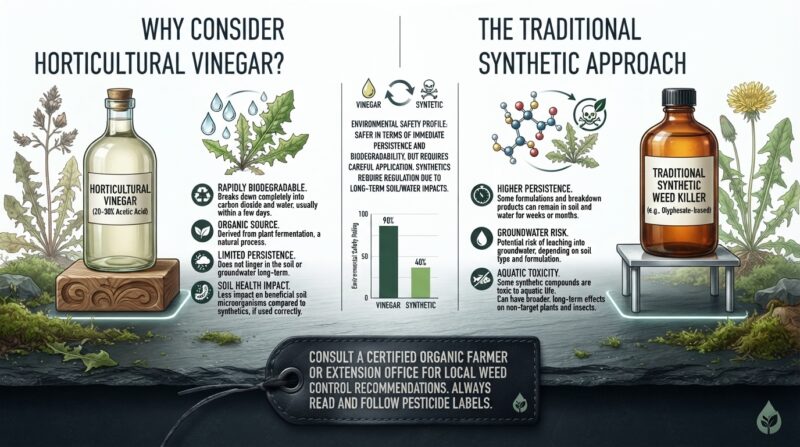
At the center of this transition sits horticultural vinegar (20%–30% acetic acid concentration). Long marketed as the “natural, non-toxic answer” to synthetic weed killers like glyphosate, 2,4-D, and dicamba, horticultural vinegar is often assumed to be 100% safe simply because it carries an organic label.
However, the real science reveals a far more nuanced story. Is horticultural vinegar truly safer for the environment than traditional synthetic weed killers?
The short answer is yes, in terms of long-term soil persistence, bioaccumulation, aquatic systemic contamination, and bio-persistence. However, no, if misapplied or evaluated strictly on acute user toxicity and immediate local soil pH impacts.
This comprehensive guide breaks down the chemical mechanisms, environmental trade-offs, soil biology impacts, user safety considerations, and regional application strategies for property owners aiming to make informed, science-backed weed management choices.
Understanding the Chemistry: Horticultural Vinegar vs. Synthetic Herbicides
To evaluate environmental safety, we must first examine how these two classes of herbicides operate at a chemical and cellular level.
+-----------------------------------------------------------------------------------+
|                                 HERBICIDE MODES OF ACTION                         |
+-----------------------------------------------------------------------------------+
|                                                                                   |
|  [ HORTICULTURAL VINEGAR ]                      [ SYNTHETIC (GLYPHOSATE) ]        |
|  (20%-30% Acetic Acid)                          (Systemic Compound)               |
|            |                                                 |                    |
|            v                                                 v                    |
|  Desiccates Plant Cuticle                       Absorbed through Leaves           |
|            |                                                 |                    |
|            v                                                 v                    |
|  Rapid Cell Wall Collapse                       Translocates to Root System       |
|            |                                                 |                    |
|            v                                                 v                    |
|  Top-Growth Burn (Contact Only)                 Blocks EPSP Synthase Enzyme       |
|            |                                                 |                    |
|            v                                                 v                    |
|  Roots Remain Intact                            Kills Whole Plant Systemically    |
+-----------------------------------------------------------------------------------+
1. Horticultural Vinegar (20%–30% Acetic Acid)
Unlike standard household culinary vinegar—which contains only 5% acetic acid—horticultural vinegar is concentrated to 20% to 30% acetic acid.
- Mode of Action: Contact herbicide (burn-down). It dissolves the waxy leaf cuticle and strips cellular membranes of moisture, causing rapid desiccation and death of foliage within hours.
- Systemic Mobility: Zero. Acetic acid does not translocate into the root system. It only destroys plant tissue directly contacted by the spray.
- Breakdown Rate: Rapidly metabolized by soil microbes into carbon dioxide ($CO_2$) and water ($H_2O$) with a half-life of 1 to 3 days.
2. Traditional Synthetic Herbicides (Glyphosate, 2,4-D, Dicamba)
Synthetic herbicides are engineered for systemic transport and persistent foliage-to-root eradication.
- Mode of Action: Systemic enzyme inhibition. For instance, glyphosate inhibits the EPSP synthase enzyme pathway (shikimate pathway), stopping essential amino acid synthesis needed for plant survival.
- Systemic Mobility: High. The chemical enters the vascular tissues (phloem and xylem) and travels down to the root tips, killing the entire plant organ system.
- Breakdown Rate: Moderate to persistent. Half-lives vary from 2 to 197 days depending on soil type, moisture, and microbial activity.
Environmental Impact Analysis: Comprehensive Comparison
When evaluating ecological footprint, environmental scientists analyze four primary categories: Soil Health, Water & Aquatic Ecosystems, Non-Target Wildlife, and Air/Atmospheric Persistence.
+-------------------------------------------------------------------------------------------------------+
|                                ENVIRONMENTAL IMPACT MATRIX                                            |
+--------------------------+-------------------------------------+--------------------------------------+
| IMPACT CATEGORY          | HORTICULTURAL VINEGAR (20%-30%)     | SYNTHETIC HERBICIDES (Glyphosate/2,4-D)|
+--------------------------+-------------------------------------+--------------------------------------+
| Soil Microbiome          | Temporary local acid drop           | Long-term residue binds to minerals  |
| Aquatic Toxicity         | Low risk via rapid dilution         | High toxicity (due to surfactants)   |
| Persistence / Half-Life  | 1-3 Days                            | 2 to 197+ Days                       |
| Root System Eradication  | Poor (Requires repeat sprays)       | High (Single application)            |
| Mammalian Toxicity (LD50)| Higher Acute Oral/Dermal Toxicity   | Lower Acute Toxicity                 |
| Bioaccumulation          | Zero                                | Low to Moderate                      |
+--------------------------+-------------------------------------+--------------------------------------+
1. Soil Health and Microbiome Impact
- Horticultural Vinegar: Upon application, acetic acid temporarily drops the localized topsoil pH. While this shock can kill surface-level soil microbes and mycorrhizal fungi immediately on contact, the effect is short-lived. Soil microbes quickly consume acetic acid, converting it into harmless metabolic byproducts within days.
- Synthetic Herbicides: Compounds like glyphosate bind tightly to soil minerals. While this prevents deep ground-leaching, it allows chemical residues to accumulate over repeated applications. High residual concentrations can alter soil fungal-to-bacteria ratios, suppress beneficial earthworm reproduction, and disrupt nutrient chelation (specifically iron and manganese uptake).
2. Aquatic Life & Water Contamination
- Horticultural Vinegar: Acetic acid is highly water-soluble and degrades almost instantly in surface runoff. To cause acute harm to fish or aquatic invertebrates, concentrations must reach roughly 1 teaspoon of 20% vinegar per liter of water—a concentration almost impossible to achieve via standard landscape runoff.
- Synthetic Herbicides: Synthetic formulations frequently combine active ingredients with polyethoxylated tallowamine (POEA) surfactants to help chemicals penetrate leaf cuticles. These surfactants disrupt the respiratory membrane of fish gills, tadpoles, and aquatic insects, leading to significant amphibian mortality during heavy rainfall events.
3. Non-Target Wildlife & Pollinators
- Horticultural Vinegar: Direct contact during application can injure delicate soft-bodied beneficial insects (like caterpillars and juvenile predatory mites) or burn foraging bees. However, because it leaves no toxic chemical residue on leaf surfaces after drying, foraging pollinators are safe hours after application.
- Synthetic Herbicides: Systemic herbicides penetrate internal plant fluids. Foraging bees can carry trace residues back to hives, which research suggests can alter the gut microbiome of honeybees, reducing their resistance to pathogen infection and cold exposure.
Human & Applicator Safety: The Surprising Paradox
A major misconception among property managers is that “organic” automatically equates to “non-hazardous to humans.” When comparing acute toxicity, horticultural vinegar requires far stricter personal protective equipment (PPE) during application than standard glyphosate formulations.
Toxicity Metric (LD50): $LD_{50}$ represents the lethal dose of a substance required to kill 50% of a test population. A lower $LD_{50}$ number indicates higher toxicity.
+---------------------------------------------------------------------------------------+
|                               ACUTE TOXICITY PARADOX                                  |
+---------------------------------------------------------------------------------------+
|                                                                                       |
|   Substance                         Oral LD50 (Rat)           Signal Word / Risk      |
|   ---------------------------------------------------------------------------------   |
|   Horticultural Vinegar (20%)       ~3,310 mg/kg              DANGER (Severe Burns)   |
|   Glyphosate (Concentate)           ~5,600 mg/kg              CAUTION (Mild Irritant) |
|                                                                                       |
|   * Horticultural vinegar carries higher acute burn risks to human skin and eyes,     |
|     whereas synthetic herbicides present higher potential long-term, systemic risks.   |
+---------------------------------------------------------------------------------------+
- Skin and Eye Hazards: 20%–30% acetic acid is corrosive. Contact with skin can cause chemical burns, while eye splash contact can lead to permanent corneal damage or blindness. Product labels strictly mandate the word “DANGER” on horticultural vinegar, whereas glyphosate often carries the lower-tier signal word “CAUTION.”
- Respiratory Protection: Inhaling high concentrations of mist from 20%+ acetic acid irritates the respiratory tract, throat, and lungs.
Regional Performance & Real-World Application Guidelines
For property owners operating across diverse climate zones—such as the coastal regions of California, the wet maritime forests of Washington, the arid zones of Texas, or the seasonal extremes of New York—the physical environment dictates how effectively horticultural vinegar performs.
+-----------------------------------------------------------------------------------+
|                               REGIONAL APPLICATION STRATEGIES                     |
+-----------------------------------------------------------------------------------+
|                                                                                   |
|  [ REGION ]                   [ WEED PRESSURES ]              [ SUCCESS KEYS ]    |
|  -------------------------------------------------------------------------------  |
|  California & San Francisco   Broadleaf weeds, hardscapes     Apply midday (>75°F)|
|  Washington (Pacific NW)      Deep perennial invasives        Pair with mulch layer|
|  Texas                        Sun-scorched driveways          Add organic surfactant|
|  New York & Northeast         Spring annual weed surges       Catch weeds under 3"|
|                                                                                   |
+-----------------------------------------------------------------------------------+
1. California & San Francisco Bay Area
- Environmental Driver: High environmental compliance standards, strict local chemical prohibitions, and heavy hardscape weeds (patios, walkways, gravel borders).
- Strategy: Horticultural vinegar is highly effective on sunny days along sun-heated pavers. High ambient temperatures accelerate tissue breakdown. Apply midday when temperatures exceed $70^\circ\text{F}$ ($21^\circ\text{C}$) for maximum burn-down speed.
2. Washington State & Pacific Northwest
- Environmental Driver: High rainfall, dense moss growth, persistent damp soils, and deep-rooted invasive perennials (such as Himalayan blackberry and field bindweed).
- Strategy: Acetic acid works exceptionally well against surface mosses and annual broadleaf weeds. However, high rainfall can quickly rinse away contact sprays. Apply during a minimum 24-hour dry window. Combine vinegar applications with organic wood mulch (3-inch depth) to prevent perennial root regrowth.
3. Texas & Arid Southwest
- Environmental Driver: Intense heat, rapid evaporation rates, and drought-hardened weed cuticles.
- Strategy: High temperatures increase acetic acid efficacy, but rapid evaporation can prevent the acid from fully penetrating thick leaf surfaces. Add an organic surfactant (such as yucca extract or a few drops of natural liquid soap) to lower surface tension and ensure the acid coats the entire leaf surface.
4. New York & Northeast Region
- Environmental Driver: Seasonal surges of spring annuals (crabgrass, chickweed, dandelion seedlings) followed by freezing winters.
- Strategy: Timing is critical. Spray young annual weeds early in spring when plants are less than 3 inches tall. Young annuals lack deep root energy reserves, enabling horticultural vinegar to kill the entire plant in a single pass.
Pro Application Tips for Maximum Vinegar Efficacy
To achieve results comparable to synthetic weed killers without environmental lingering, follow these operational best practices:
- Target Young Annuals First: Focus vinegar sprays on freshly sprouted annual weeds. Established deep-rooted perennials (like Canada thistle or dandelion) will sprout new leaves from root reserves after their foliage burns off.
- Always Use an Organic Surfactant: Combine 1 gallon of 20% horticultural vinegar with 1 tablespoon of natural liquid soap or yucca extract. This prevents spray droplets from rolling off waxy leaves.
- Avoid Lawn Turf Areas: Acetic acid is a non-selective herbicide. It will kill desired lawn grasses (Kentucky Bluegrass, Bermuda, Zoysia) just as quickly as weeds. Restrict use to driveways, mulch beds, gravel zones, and sidewalk cracks.
- Wear Complete PPE: Always wear goggles, nitrile gloves, long sleeves, pants, and closed-toe shoes when mixing or spraying 20%–30% acetic acid.
- Spray in Direct Sunlight: Thermal stress combined with acetic acid drastically speeds up plant desiccation. Spray during full sun exposure above $70^\circ\text{F}$.
Frequently Asked Questions (FAQ)
1. Does horticultural vinegar ruin soil permanently?
No. While horticultural vinegar temporarily lowers soil pH at the surface, soil microbes quickly break down acetic acid into carbon dioxide and water within a few days. Soil pH naturally neutralizes shortly after application.
2. Can I use grocery store 5% white vinegar to kill weeds?
5% household vinegar can damage very small, soft-tissue weeds, but it generally lacks the acidity needed to destroy mature weeds. Horticultural vinegar (20%–30% strength) is necessary for consistent agricultural and landscape weed burn-down.
3. Will horticultural vinegar kill perennial weeds like dandelions down to the root?
No. Vinegar is a contact herbicide that destroys only above-ground leaf tissue. Perennial weeds with deep taproots will re-sprout foliage. Multiple applications combined with manual weeding are required to starve the root system.
4. Is horticultural vinegar safe to use around dogs and cats?
Once completely dry, treated foliage poses minimal risk to pets. However, wet 20% acetic acid can cause severe skin irritation, eye burns, or paw pad burns. Keep pets out of treated areas until the spray has completely dried (typically 1–2 hours).
5. Why does horticultural vinegar carry a “DANGER” warning if it’s organic?
The “DANGER” signal word reflects acute applicator danger—specifically severe skin burns and eye damage caused by high acidity (pH ~2). It does not indicate long-term ecological persistence or cancer risk.
6. Can I mix horticultural vinegar with salt and dish soap?
While popular online, adding high amounts of salt (sodium chloride) creates persistent soil toxicity. Salt does not break down rapidly and can poison soil, preventing any plant growth for extended periods. Stick to vinegar and an organic surfactant alone.
7. Does horticultural vinegar run off into local water systems?
Because acetic acid breaks down rapidly in soil and aquatic environments, normal landscape runoff poses virtually zero risk to municipal watersheds or local streams.
8. Will horticultural vinegar harm beneficial insects like bees and ladybugs?
Direct wet spraying can harm soft-bodied insects. Spray early in the morning before pollinators become active, or target spot-weeds directly to avoid flowering plants visited by bees.
9. How often do I need to reapply horticultural vinegar compared to synthetic sprays?
Because vinegar does not kill root systems, established weeds may require re-application every 2 to 3 weeks during peak growing season. Synthetics generally require fewer applications due to their systemic action.
10. Is horticultural vinegar approved for certified organic operations?
Yes, most 20%–30% acetic acid formulas derived from natural fermentation are OMRI Listed (Organic Materials Review Institute) for organic crop production and sustainable landscaping. Always check the product label for the OMRI logo.
Conclusion
When evaluating whether horticultural vinegar is safer for the environment than traditional synthetic weed killers, the evidence provides a clear answer:
From an ecological perspective, horticultural vinegar is significantly superior for long-term land stewardship. It leaves zero toxic residues, breaks down rapidly in soil and water, poses virtually no aquatic toxicity risks, and does not bioaccumulate in food chains.
However, from an applicator safety and labor perspective, it presents two clear trade-offs: it requires strict PPE to prevent severe skin and eye burns during application, and it requires more frequent applications on established perennial weeds because it lacks systemic root-killing capabilities.
For property owners in Texas, New York, California, Washington, and San Francisco, adopting horticultural vinegar alongside organic mulching, proper timing, and physical weeding offers a sustainable path forward—protecting local water systems, soil microbiomes, and community health.