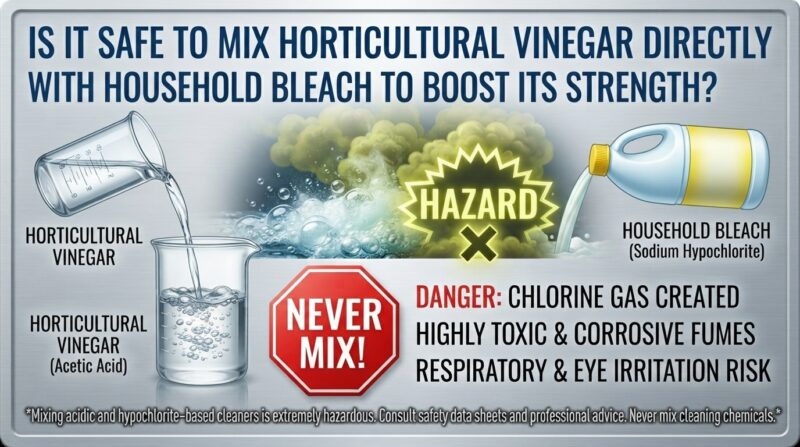
No, it is extremely dangerous and strictly unsafe to mix horticultural vinegar directly with household bleach.
Combining horticultural vinegar (which contains 20% to 30% acetic acid) with sodium hypochlorite (household liquid bleach) triggers an immediate chemical reaction that releases toxic chlorine gas ($\text{Cl}_2$) and chloramine fumes. Inhaling these invisible vapors causes rapid airway burns, severe lung irritation, coughing fits, loss of consciousness, and in concentrated amounts, fatal chemical pneumonia.
Whether you are treating stubborn weeds in Texas, removing patio moss in Washington, or cleaning outdoor stonework in California, New York, or San Francisco, this combination must be completely avoided.
The Chemistry: What Happens When Acid Meets Bleach?
Household liquid bleach contains sodium hypochlorite ($\text{NaOCl}$), which is stabilized in an alkaline solution (pH around 11 to 13). Horticultural vinegar is a strong organic acid ($\text{CH}_3\text{COOH}$) with a concentration 4 to 6 times higher than grocery store culinary vinegar, maintaining a low pH of approximately 2.0.
When the acidic vinegar neutralizes the alkaline bleach solution, hypochlorous acid ($\text{HOCl}$) breaks down rapidly into chlorine gas:
$$\text{NaOCl} + \text{CH}_3\text{COOH} \longrightarrow \text{HOCl} + \text{CH}_3\text{COONa}$$
$$\text{HOCl} + \text{HCl} \rightleftharpoons \text{H}_2\text{O} + \text{Cl}_2 \uparrow$$
Why Chlorine Gas Is So Dangerous Outdoors
- Water Reaction on Contact: When breathed into the throat or lungs, chlorine gas reacts with moisture in the respiratory mucosa to form hydrochloric acid ($\text{HCl}$) and hypochlorous acid ($\text{HOCl}$) directly inside lung tissue.
- Rapid Onset: Symptoms begin in seconds, starting with intense eye watering, burning in the throat, severe chest tightness, and shortness of breath.
- Heavy Vapor Density: Chlorine gas is approximately 2.5 times heavier than air. Even in outdoor yards or open driveways, the gas pools close to the ground, concentrating in low-lying spots, garden beds, and ground-level breeze zones.
Chemical Profile Comparison
| Chemical Property | Household Liquid Bleach | Horticultural Vinegar | Mixed Solution (Danger) |
| Active Ingredient | Sodium Hypochlorite ($\text{NaOCl}$, 5%–7.5%) | Acetic Acid ($\text{CH}_3\text{COOH}$, 20%–30%) | Chlorine Gas ($\text{Cl}_2$) + Chloramines |
| pH Level | Very Alkaline (11.0 – 13.0) | Highly Acidic (2.0 – 2.5) | Rapidly shifts toward acidic release |
| Primary Risk | Surface bleach burns, skin irritation | Eye damage, tissue contact burns | Respiratory tissue damage, chemical pneumonia |
| Primary Use | Disinfecting, mold control, stain removal | Non-selective contact weed killer | NEVER MIX — Severe Hazard |
Regional Environmental Factors Across Key States
Understanding local climate conditions across targeting regions helps illustrate why chemical mixing risks escalate outdoors:
1. California & San Francisco Bay Area
- Local Context: Foggy microclimates and lingering morning dew slow gas dispersal. In closed yards or small patio spaces typical of urban San Francisco, heavy chlorine fumes linger longer in damp morning air.
- Environmental Impact: Coastal runoff regulations strictly monitor household chemical wash-off into storm drains.
2. Texas
- Local Context: Summer heat frequently exceeds 95°F–100°F. High heat speeds up chemical reaction rates, releasing higher volumes of chlorine gas almost instantly upon mixing.
- Safety Risk: Inhaling toxic gas while already dealing with heat stress dramatically increases the risk of immediate collapse or respiratory distress.
3. Washington State (Pacific Northwest)
- Local Context: Heavy tree canopy and damp, low-wind conditions are common.
- Safety Risk: Ground-level pooling of heavy chlorine vapors is particularly problematic around thick foliage, mossy walkways, and shaded perimeter walls where air circulation is low.
4. New York
- Local Context: Dense suburban homes with narrow alleys and compact outdoor patios.
- Safety Risk: Wind tunnels between brownstones or close-neighbor property lines can sweep heavy fumes straight into neighboring open windows or pet enclosures.
Safe, Effective Alternatives to Boost Weed-Killing Power
If you are looking to enhance weed control without creating toxic chemical hazards, use these proven, non-hazard combinations:
1. The Safe Household Organic Recipe
Instead of bleach, mix the following in a garden pump sprayer:
- 1 Gallon Horticultural Vinegar (20% concentration)
- 1 Cup Epsom salt or coarse table salt (acts as an osmotic dehydrator)
- 1 Tablespoon Liquid dish soap (acts as a surfactant to help the liquid stick to waxy leaves)
2. Thermal Heat Treatment (Flame Weeding)
- Uses a propane weed torch to burst plant cell walls instantly.
- Works exceptionally well on driveway cracks, gravel paths, and brick walkways with zero toxic residual chemical vapors.
3. Mechanical & Barrier Controls
- Polymeric Joint Sand: Sweeping polymeric sand into paver joints locks out air, moisture, and seeds naturally.
- Targeted Systemic Applications: For stubborn perennials with deep taproots (like dandelions or bindweed), spot-treating with EPA-registered herbicides according to label instructions is far safer than unapproved chemical mixtures.
Emergency Action Protocol: What to Do in Case of Exposure
If an accidental mix occurs, take immediate action:
- Evacuate the Area: Step upwind and at least 30–50 feet away immediately. Do not stay to clean up the container while fumes are active.
- Seek Fresh Air: Move to an elevated or well-ventilated outdoor spot.
- Flush Eyes & Skin: If splash contact occurs, rinse eyes or exposed skin with clean water for at least 15 minutes.
- Contact Poison Control: Call the U.S. Poison Control Hotline at 1-800-222-1222 or dial 911 if experiencing chest tightness, wheezing, or difficulty breathing.
Frequently Asked Questions (FAQ)
1. Can I apply bleach a day after spraying horticultural vinegar on the same spot?
No, wait until the area has been thoroughly washed down with water and completely dried. Applying bleach over unrinsed vinegar residue on pavers or soil will still trigger localized chlorine gas release.
2. Is standard 5% kitchen vinegar safe to mix with bleach?
No. Even mild 5% white vinegar releases chlorine gas when mixed with liquid bleach. High-strength 20%–30% horticultural vinegar simply accelerates and intensifies the toxic gas release.
3. Does mixing bleach with vinegar create a stronger weed killer?
No. Neutralizing sodium hypochlorite with acetic acid breaks down both active ingredients rapidly, reducing their effectiveness while creating dangerous gases.
4. What color is chlorine gas, and can you always see it?
At high concentrations, chlorine gas appears as a pale green-yellow mist. However, dangerous, toxic concentrations are frequently invisible to the naked eye. Rely on smell (a sharp, harsh, suffocating bleach-like odor) and physical symptoms rather than visual cues.
5. What should I do if I accidentally mixed vinegar and bleach in a bucket?
Do not try to cap or seal the container, as gas buildup can cause it to burst. Walk upwind away from the bucket immediately, keep pets and family indoors, and let the reaction exhaust itself in an open, well-ventilated outdoor area.
6. Can inhaling small amounts of this mixture cause permanent lung damage?
Brief exposure to low concentrations causes temporary burning and coughing, but higher concentrations or prolonged exposure can cause pulmonary edema (fluid in the lungs) and long-term airway hyper-reactivity.
7. Why do some online DIY blogs suggest mixing bleach and vinegar?
Many DIY articles confuse basic chemical surfactants with reactivity. Mixing bleach with acids is a well-documented safety hazard flagged by the EPA, OSHA, and the American Association of Poison Control Centers.
8. Is dish soap safe to add to horticultural vinegar?
Yes. Mild liquid dish soap acts as a non-reactive surfactant, breaking the surface tension of the liquid so the acetic acid spreads across waxy weed leaves instead of rolling off.
9. Will rain neutralize leftover chlorine gas on my lawn?
Rain water helps dilute liquid residue on hard surfaces, but chlorine gas itself dissipates into the surrounding atmosphere. Rain does not prevent fumes from rising while the chemical reaction is actively occurring.
10. What is the safest way to dispose of old horticultural vinegar?
Dilute it heavily with plain water before pouring it out onto non-vegetated gravel or soil away from storm drains, ponds, and waterways. Always check local waste disposal guidelines in your municipality.
Conclusion
Mixing horticultural vinegar directly with household bleach is a severe safety hazard that releases hazardous chlorine gas. Rather than boosting cleaning or weed-killing performance, it destroys the active properties of both products while posing an immediate risk to human respiratory health, pets, and surrounding wildlife.
To safely eliminate tough weeds along driveways, lawns, and walkways, rely on targeted horticultural vinegar mixtures (boosted only with soap or salt), thermal weeding tools, or dedicated EPA-approved lawn products. Always read chemical labels carefully and prioritize proper ventilation and protective gear during any outdoor maintenance project.