The internet is packed with viral gardening hacks promoting white distilled vinegar as a cheap, non-toxic, miracle alternative to synthetic chemical weed killers. Homeowners across social media channels routinely film themselves drenching entire garden beds, gravel paths, and vegetable patches with vinegar to wipe out unwanted weeds.
Because vinegar is a natural product found right in your kitchen pantry, it is incredibly easy to assume that any liquid overflowing onto the ground is completely harmless. However, before you fill up a garden pump sprayer and soak your yard, you must step back and ask the critical ecological question: What happens if I spray vinegar on my garden soil?
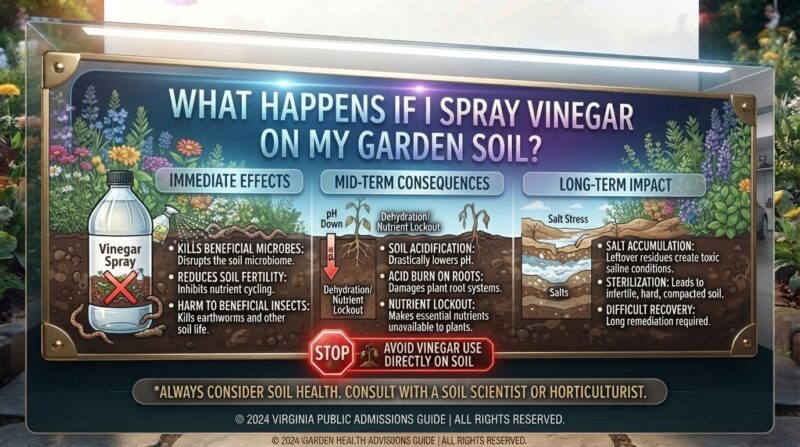
The direct answer is that spraying vinegar on your garden soil causes an immediate, temporary drop in the soil’s pH layer, creating a highly acidic surface environment that can scorch delicate roots and disrupt beneficial surface microbes. However, standard 5% kitchen vinegar breaks down rapidly within 48 to 72 hours, meaning it will not permanently ruin your soil quality.
The real danger occurs if you use industrial-strength 20% to 30% horticultural vinegar or mix the liquid with table salt. These variations can cause long-term soil sterilization, long-lasting nutrient deficiencies, and the death of essential earthworm populations.
This comprehensive guide serves as the ultimate soil science manual for itemguides.com readers, breaking down the exact chemical footprint of acetic acid below the surface, the structural risks to your plants, and how to safely navigate natural property maintenance.
The Underground Science: How Acetic Acid Interacts with Earth Chemistry
To understand exactly what happens below the surface when you spray vinegar, we have to look past the visible green leaves and examine the delicate, invisible web of soil chemistry and biology.
1. The Immediate pH Shockwave
Standard household white vinegar is composed of roughly 5% acetic acid ($CH_3COOH$) and 95% water, carrying a highly acidic pH value of approximately 2.4. When this liquid hits your garden beds, it instantly floods the top layer of soil with hydrogen ions.
This triggers a sudden, sharp drop in the local pH level. For a brief window, the surface soil becomes far too acidic for most traditional garden plants, flowers, and vegetables, which generally prefer a balanced, slightly neutral pH range between 6.0 and 7.0.
2. The Rapid Microbial Breakdown
Fortunately, unlike persistent synthetic chemicals, acetic acid is a basic organic compound. The moment it enters healthy, living soil, it is immediately targeted by native soil bacteria and microscopic fungi. These beneficial microbes consume the acetate, breaking it down into simple water ($H_2O$) and carbon dioxide ($CO_2$).
- The Recovery Timeline: If you are using a standard 5% household white vinegar solution, the soil’s natural buffering capacity and active microbial life will typically neutralize the acid and return the ground to its baseline pH level within 24 to 72 hours.
Direct Impacts of Vinegar on Soil Systems
To help you visualize how different applications alter underground environments, look over this chemical performance breakdown:
| Application Profile | Impact on Soil Microbes | Root Zone Safety Level | Long-Term Structural Damage |
| 5% Kitchen Vinegar (Light Mist) | Minor surface shock; recovers within 48 hours. | High Safety (if kept away from root flares). | None. Liquid breaks down into water and carbon dioxide quickly. |
| 5% Kitchen Vinegar (Heavy Drench) | Temporarily suppresses beneficial bacteria. | Moderate Risk; can cause root tip chemical burns. | Low. Soil chemistry usually stabilizes completely within a week. |
| 20%–30% Horticultural Acid | Severe disruption to local microbial life. | High Danger; strips root hairs and blocks nutrient intake. | Moderate. Requires water flushing to restore balance. |
| Vinegar Mixed with Table Salt | Extensively kills earthworms and beneficial biology. | LETHAL; causes total root dehydration. | Severe & Permanent. Renders the soil toxic and completely sterile. |
Step-by-Step Soil Protection and Remediation Protocol
If you have accidentally oversprayed vinegar onto prized garden beds, or if you want to apply an organic contact herbicide without harming the earth below, follow this systematic procedure to keep your soil safe.
1.Evaluate the Specific Formula and Concentration Level:Phase 1: Chemical Assessment.
Identify the exact strength of the vinegar you used. If it was standard 5% kitchen vinegar without any salt additions, you can generally let nature take its course. If you applied industrial 20% to 30% horticultural vinegar or mixed in table salt, you must take active containment steps immediately.
2.Execute a Deep-Drench Fresh Water Flush:Phase 2: Hydric Neutralization.
If you accidentally sprayed a highly prized planting zone, grab a garden hose immediately. Direct a gentle, heavy stream of fresh water over the affected soil for 5 to 10 minutes. This dilutes the concentrated acetic acid and flushes the hydrogen ions down past the delicate root zones.
3.Apply a Calcitic Limestone or Compost Buffer:Phase 3: Substrate Restoration.
For areas that received a heavy drench of industrial acid, spread a thin layer of well-aged organic compost or a light dusting of calcitic agricultural limestone over the soil. This introduces rich organic materials and calcium carbonate, which actively neutralizes residual acidity and stabilizes the pH.
4.Introduce Fresh Organic Materials to Restore Microbes:Phase 4: Biological Re-inoculation.
Wait 48 hours after flushing the area, then scratch a generous handful of worm castings or fresh, healthy organic soil into the surface layer. This replenishes the beneficial soil bacteria and fungi that may have been harmed by the initial acid shockwave.
5 Essential Tips for Protecting Your Soil from DIY Spray Damage
- Keep Table Salt Completely Out of Your Gardens: Adding table salt (sodium chloride) to a vinegar spray makes it incredibly lethal to weeds, but it ruins your soil. Sodium ions bind tightly to soil particles, preventing water absorption and stripping away essential plant nutrients like potassium and magnesium. This creates a toxic, sterile zone where no plants can grow for years. Never use salt mixtures in active garden beds.
- Account for Your Regional Climate Dynamics: Your local environment plays a huge role in how quickly soil recovers from an acid treatment. In hot, dry regions like Texas or parts of California, the lack of regular rainfall means vinegar residues can linger longer on dry soil surfaces. In contrast, the frequent rains of Washington State or New York will naturally dilute and flush away vinegar overspray much faster. Always adjust your watering routine to match your local climate.
- Use Focused Directional Spray Shields: When applying a natural vinegar weed killer near valued ornamental flowers or vegetable patches, never use a wide, misting spray nozzle. Cut the top off a plastic soda bottle and fit it over your spray wand tip to act as a physical shield. Place the hood directly over the weed before spraying to ensure every drop hits the weed leaves and stays off the surrounding soil.
- Protect Vulnerable Acid-Sensitive Plants: While acid-loving plants like azaleas, blueberries, and hydrangeas can easily handle a slight, temporary drop in soil pH, alkaline-loving plants will struggle immensely. Keep vinegar sprays far away from vegetables like tomatoes, cucumbers, and spinach, as well as popular landscape flowers like clematis and lavender.
- Switch to Targeted Mechanical Weeding in Rich Edible Beds: In your primary raised vegetable beds and herb gardens, bypass liquid herbicides entirely. Stick to manual hand-pulling, standalone weeding tools, or a thick layer of organic straw or wood mulch. This preserves the complex, delicate soil food web that directly feeds your edible crops.
Frequently Asked Questions (FAQ)
1. Will spraying kitchen vinegar permanently ruin my garden soil?
No. Standard 5% white distilled kitchen vinegar will not permanently ruin your soil. Soil microbes break down the basic acetic acid molecule incredibly fast, allowing the ground’s natural pH balance to restore itself completely within a few days.
2. Can I plant new vegetables or flowers immediately after spraying vinegar?
It is best to wait at least 3 to 4 days after a vinegar application before planting new seedlings or sowing seeds. This short window allows the temporary surface acid shockwave to clear out, ensuring your new plants’ delicate root tips won’t get chemical burns.
3. Does vinegar kill beneficial earthworms living in the soil?
A light, topical mist of 5% vinegar rarely harms underground earthworms. However, if you pour a heavy, concentrated drench into the dirt, the low pH will irritate and can kill surface-level earthworms. Furthermore, adding salt to the mixture is highly lethal to earthworms through direct dehydration.
4. What is the difference between kitchen vinegar and horticultural vinegar?
Kitchen vinegar is a mild 5% acetic acid solution meant for cooking and cleaning. Horticultural vinegar is a highly concentrated industrial-strength product containing 20% to 30% acetic acid. It is much more corrosive, dangerous to handle, and causes far greater temporary disruption to soil biology.
5. Can I use vinegar to purposefully lower the pH of alkaline soil?
You should avoid using it for this purpose. Because vinegar breaks down so quickly in the soil, any drop in pH it causes is incredibly short-lived. To safely and permanently lower your soil’s pH for acid-loving plants, use reliable, slow-release amendments like elemental sulfur or iron sulfate.
6. Will vinegar overspray run off and damage the roots of nearby trees?
A standard foliar spray on weeds will not harm large, deep tree roots. Tree roots are buried deep underground and protected by thick bark. The small amount of vinegar that reaches the soil will be neutralized by microbes long before it can penetrate deep enough to cause damage.
7. Is it safe to use apple cider vinegar instead of white vinegar on weeds?
Yes. Apple cider vinegar carries a similar 5% acidity level and has a matching impact on soil chemistry. The only real difference is that apple cider vinegar contains residual fruit sugars, which can occasionally attract curious ants or insects to the treated area.
8. How long do soil microbes take to neutralize industrial 20% vinegar?
Because 20% horticultural vinegar introduces a much higher concentration of acid, it can take anywhere from 1 to 2 weeks for native soil bacteria to fully break down the chemical load and restore the ground to its natural baseline pH, depending on how warm and active the soil is.
9. Why did the soil turn white or crusty after I sprayed a DIY weed killer?
If you notice a white, powdery crust on your soil days after spraying, it means your DIY mixture contained a high concentration of table salt. That crust is a layer of accumulated sodium chloride crystals, indicating that the zone has become heavily salinized and dangerous for future plant growth.
10. Can I safely rinse vinegar out of my soil if I accidentally spill a gallon?
Yes. If you experience an accidental spill, act quickly by drenching the entire spill area with large volumes of fresh water from a garden hose. Diluting the acid minimizes the shock to local plants and allows your soil’s natural microbes to safely process the liquid.
Conclusion
Using vinegar as a natural weed killer is a highly effective way to manage your property without relying on heavy synthetic chemicals, as long as you treat the underlying soil with respect. By remembering that vinegar is a powerful contact asset that creates a brief, temporary drop in surface pH, keeping harmful table salts completely out of your garden beds, and using precise spraying techniques, you can easily protect your soil’s natural health. Keep your applications focused, let your soil’s beneficial microbes do their work, and maintain a beautiful, flourishing landscape across every season.