Walk down the lawn and garden aisle of any major home improvement store or independent nursery in Austin, Seattle, or Los Angeles, and you will find jugs of horticultural vinegar proudly displayed on the shelves. Sold as a natural, eco-friendly alternative to synthetic herbicides, this liquid has exploded in popularity among homeowners looking to transition away from glyphosate-based weed killers.
Yet, turn the jug around, and you will be greeted by severe, high-contrast hazard warnings. The labels feature explicit commands: “DANGER: CAUSES IRREVERSIBLE EYE DAMAGE,” “CORROSIVE,” and “KEEP OUT OF REACH OF CHILDREN.”
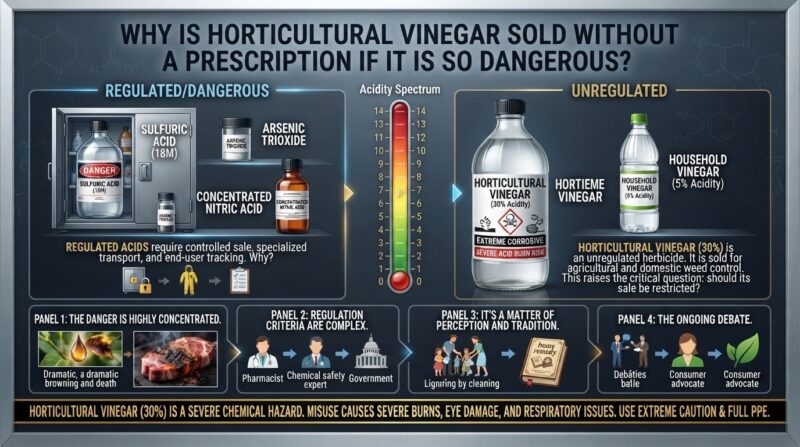
This stark contrast raises a glaring regulatory question for property owners and amateur gardeners alike: If horticultural vinegar poses such a severe, immediate threat to human health and property, why is it sold completely unrestricted without a prescription, license, or permit?
At itemguides.com, we dive deep into product science, consumer safety, and material care. This comprehensive, long-form guide breaks down the legal frameworks, chemical realities, agricultural loopholes, and regional safety challenges that allow this high-strength acid to remain widely accessible to the public.
The Core Expert Verdict
Horticultural vinegar is sold without a prescription or special permit because consumer chemical regulations distinguish between acute physical hazards (like acid burns) and chronic systemic toxicity (like long-term environmental poisoning or cancer risks). Because horticultural vinegar is made of acetic acid, it leaves behind zero toxic residues in the soil and poses no long-term threat to the wider water supply or food chain. Consequently, federal regulatory bodies like the EPA classify it as a low-risk environmental substance, leaving the management of its immediate, severe physical burning risks up to consumer personal protective equipment (PPE) and label compliance.
Unlike controlled agricultural poisons or prescription-strength pharmaceuticals, a high-strength acid doesn’t poison biological systems over time—it damages them instantly on contact. Regulators assume that clear warning labels and standard consumer safety gear are enough to manage these immediate physical risks.
1. The Chemistry of Concentration: Kitchen Vinegar vs. Horticultural Acid
To understand the regulatory landscape, we must first look at the chemical starkness between cooking ingredients and agricultural-grade sprays. Both fluids share the exact same active molecular compound—acetic acid ($CH_3COOH$)—but their concentrations alter their physical properties entirely.
Standard White Vinegar (5% Acetic Acid) ──> Safe for consumption, mild sanitizer
Horticultural Vinegar (20%-30% Acetic Acid) ──> Destroys plant tissue, strips skin, corrodes metals
Household White Vinegar (5% Concentration)
The vinegar in your kitchen pantry is a weak, food-grade solution containing 5% acetic acid and 95% water. It is safe enough to eat, mild on human skin, and can be handled safely without any protective gear. While it can kill tiny, weak weeds if sprayed on a hot summer day, its low acid level isn’t strong enough to break down established weeds or mature moss.
Horticultural Vinegar (20% to 30% Concentration)
Horticultural and industrial vinegars are highly concentrated, unbuffered solutions containing 20% to 30% pure acetic acid. This makes them four to six times stronger than cooking vinegar.
At this level, the liquid becomes a non-selective, caustic herbicide. It doesn’t use complex cellular poisons to kill plants; instead, it uses raw chemical power to destroy organic tissues on contact.
2. The Three Regulatory Pillars That Keep It Unrestricted
The availability of high-strength vinegar comes down to how federal agencies like the Environmental Protection Agency (EPA) and the Food and Drug Administration (FDA) evaluate consumer risks. Their framework rests on three main concepts:
1. Acute Physical Hazards vs. Chronic Systemic Toxicity
The most critical factor in chemical regulation is the difference between acute and chronic risks:
- Chronic Systemic Toxicity: Substances that can cause long-term health issues, genetic mutations, or cancer risks (like certain heavy industrial chemicals or synthetic pesticides) are strictly controlled. Because their dangers are hidden and can accumulate over time, they require licenses, applicator permits, or prescriptions.
- Acute Physical Hazards: Concentrated acetic acid poses an immediate physical risk. If you spill it on your hand, it burns instantly; if it splashes into your eye, it damages the tissue right away. Regulators group these immediate risks with items like gasoline, muriatic pool acid, and drain cleaners—products that are highly dangerous if mishandled but are sold freely because their hazards are obvious and immediate.
2. The EPA’s Low-Risk Exemption Loophole
Under Section 25(b) of the Federal Insecticide, Fungicide, and Rodenticide Act (FIFRA), the EPA maintains a list of minimum-risk active ingredients. Because acetic acid breaks down rapidly into harmless water and carbon dioxide upon hitting the ground, it leaves behind no toxic residues in the soil.
Since it doesn’t build up in the food chain or threaten local wildlife populations, the federal government classifies it as an environmentally safe substance, removing the need for strict purchase permits.
3. The “Assumption of Consumer Responsibility”
Consumer protection laws operate on the assumption that a literate consumer can read, understand, and follow printed product warnings. The inclusion of a clear, legally mandated signal word—like DANGER—shifts the legal liability onto the buyer.
As long as the manufacturer clearly lists the required safety gear (like chemical-resistant gloves and protective eyewear), the law permits the unrestricted sale of the product.
3. Comparative Safety Analysis: Consumer Chemical Risk Profiles
To see how horticultural vinegar fits into your home maintenance routine, it helps to compare its risks against other common household and agricultural products:
| Chemical Agent | Active Ingredient | Open Market Status | Primary Human Health Risk | Long-Term Soil & Eco Impact | Required Safety Gear (PPE) |
| Horticultural Vinegar | 20%–30% Acetic Acid | Unrestricted | Immediate skin blistering, permanent eye blindness. | None (Breaks down into water and $CO_2$ within hours). | Goggles, heavy nitrile gloves, long sleeves. |
| Household Vinegar | 5% Acetic Acid | Unrestricted | Mild eye stinging, minor skin irritation. | None (Completely eco-safe). | None required for standard use. |
| Commercial Drain Cleaner | Sodium Hydroxide / Lye | Unrestricted | Deep caustic tissue burns, dissolves organic matter. | Low (Dilutes quickly in waste systems). | Heavy rubber gloves, face shield. |
| Muriatic Pool Acid | Hydrochloric Acid | Unrestricted | Severe respiratory track burns, deep skin ulcers. | Moderate (Can alter soil and water pH if spilled). | Acid-resistant apron, respirator, goggles. |
| Restricted Pesticides | Synthetic Neurotoxins | License Required | Chronic nerve damage, systemic organ issues. | High (Bioaccumulates in food chains and water tables). | Full chemical suit, specialized training. |
4. Professional Field Safety and Application Protocol
If you choose to use horticultural vinegar to clear weeds or outdoor moss from your paths, driveways, or patios, you must treat it with the same respect as a commercial chemical. Follow this strict safety and preparation protocol:
1.Put on High-Level Personal Protective Equipment:Block Direct Contact Risks.
Never open a jug of industrial acid in casual clothes. Put on tight-fitting, indirect-vent chemical splash goggles, heavy-duty nitrile gloves that extend past your wrists, a long-sleeved shirt, long pants, and closed-toe work boots. Keep a bottle of clean rinse water nearby in case of accidental splashes.
2.Check Outdoor Weather and Wind Patterns:Avoid Inhaling Volatile Fumes.
Only use horticultural vinegar outdoors in wide-open, well-ventilated spaces. Check the local forecast and spray only on calm, windless days. Spraying during a breeze can blow a fine mist of acid back onto your face, skin, clothes, or onto prized landscaping plants.
3.Target the Spray Close to the Soil:Prevent Runoff and Protect Materials.
Adjust your sprayer nozzle to a coarse droplet setting rather than a fine mist, which helps prevent the acid from drifting through the air. Hold the spray wand close to the target weed or moss patch and apply just enough to wet the leaves, avoiding excess runoff that could soak nearby decorative stone or concrete surfaces.
4.Clean and Neutralize Your Equipment:Flush the Sprayer to Prevent Rust.
Concentrated acetic acid will quickly corrode metal parts inside pump sprayers. Once you are finished spraying, empty any leftover acid back into its original jug. Flush the sprayer tank, hose, and wand thoroughly with clean water mixed with two tablespoons of baking soda to neutralize the remaining acid.
5. Regional Environmental Risks and Material Realities
The physical behavior, usefulness, and risks of using high-strength vinegar vary considerably based on regional climates and local building trends.
The Pacific Northwest (Seattle, Tacoma, & Western Washington)
In the damp, overcast climate of the Pacific Northwest, homeowners frequently battle persistent moss on walkways, fences, and decks. While horticultural vinegar kills moss quickly, Washington property owners must watch for acidic runoff entering backyard streams and salmon-bearing waterways. Additionally, using this strong acid on wood decks can break down the natural lignin fibers in cedar and redwood, causing the wood to weather and splinter prematurely.
The San Francisco Bay Area & Northern California
In coastal California, morning fog and mild temperatures create ideal conditions for weed and moss growth along stone paths and courtyards. Because many properties in San Francisco and Oakland feature historic architectural details—such as unsealed bluestone, decorative slate, and cast iron framing—residents must be incredibly careful. Horticultural vinegar will instantly etch natural stone and accelerate the rust cycle on historic ironwork.
Greater New York & Manhattan
In urban and suburban New York, property owners often use concentrated vinegar to clear weeds from concrete sidewalks, brick driveways, and brownstone lightwells. However, the high density of city living creates unique risks. The sharp, pungent vapor from a 20% acid spray can easily pull into neighboring windows or air intake vents, causing immediate respiratory discomfort for families living nearby.
The Texas Triangle (Austin, Dallas, Houston)
In the hot, sunny Texas climate, weeds grow fast, and the high summer heat can make spraying chemicals dangerous. Applying a 30% acetic acid spray when outdoor temperatures exceed 32°C (90°F) causes the liquid to evaporate rapidly, creating an intense, concentrated cloud of acid vapor. Texas homeowners should limit spraying to the cooler morning hours and avoid using the acid on limestone retaining walls, as it will dissolve the stone surface over time.
Comprehensive FAQ Engine: Safety, Law, and Best Practices
Q1: Is horticultural vinegar safer for the environment than traditional synthetic weed killers?
Yes, from an ecological perspective, it is much safer. Synthetic options like glyphosate can linger in the soil, run off into local water systems, and disrupt aquatic life. Horticultural vinegar, on the other hand, breaks down into harmless natural compounds within hours of hitting the soil, leaving no toxic residues behind. Its main drawback is the immediate physical burn hazard it poses to the person spraying it.
Q2: What should I do immediately if 20% vinegar splashes into my eyes?
Treat this as a major medical emergency. Flush your eye immediately with clean, lukewarm water for at least 15 to 20 minutes without stopping. Hold your eyelids open and move your eye up, down, and sideways to rinse away all traces of the acid. Once you have thoroughly rinsed the eye, seek emergency medical care right away to prevent permanent corneal scarring or blindness.
Q3: Can I use high-strength horticultural vinegar inside my home?
No, you should never use it indoors. Horticultural vinegar releases highly volatile, concentrated acid fumes that can burn your throat and lungs in an enclosed space. Furthermore, the strong acid mist will corrode internal household metals, ruin drywall, and leave behind a harsh, sour smell that is incredibly difficult to remove from carpets and furniture.
Q4: Does horticultural vinegar damage concrete driveways and brick walkways?
Yes, over time it will. The acetic acid reacts directly with the free lime and calcium carbonate found in concrete, cement mixers, and brick mortar joints. Repeatedly spraying high-strength vinegar will etch the smooth surface of your concrete, leaving it rough and powdery, while slowly weakening your mortar joints until they crumble.
Q5: Can I safely store leftover horticultural vinegar in a standard plastic container?
No, you should always keep it in its original commercial packaging. The manufacturer uses specific, heavy-duty, acid-resistant high-density polyethylene (HDPE) plastics designed to withstand strong chemicals. Moving the acid to a standard plastic bottle or storage container can cause the plastic to soften, degrade, and leak over time.
Q6: Why doesn’t OSHA ban consumers from purchasing this product without a license?
OSHA (the Occupational Safety and Health Administration) only regulates safety standards within commercial workplaces to protect employees. It has no legal authority over everyday retail consumers buying products for their own private properties. Consumer retail sales are overseen by the Consumer Product Safety Commission (CPSC) and the EPA.
Q7: Will horticultural vinegar kill poison ivy, brambles, or woody brush?
It will burn away the green leaves on contact, but it rarely kills the entire plant. Because it is a contact herbicide rather than a systemic one, the acid does not sink down into the deep root systems of tough, woody perennial weeds. These hardier plants will usually sprout new leaves within a few weeks, requiring manual root removal.
Q8: Is it safe to mix horticultural vinegar directly with household bleach to boost its strength?
No! Never mix vinegar with bleach. Combining any acid with chlorine bleach triggers a rapid chemical reaction that releases highly toxic chlorine gas. Breathing in even a small amount of chlorine gas can cause severe respiratory distress, lung damage, and can be fatal in enclosed spaces.
Q9: How long should pets and children stay away from an area treated with horticultural vinegar?
Keep children and pets completely away from the treated area until the spray has dried completely, which usually takes 1 to 2 hours depending on the weather. Once dry, the acid has bonded with the plant tissue and broken down in the soil, making the area safe for family and pets to walk on.
Q10: Can I use a standard metal garden sprayer to apply horticultural vinegar?
No, avoid using sprayers with metal tanks, brass wands, or standard rubber seals. The concentrated acetic acid will quickly corrode brass, aluminum, and steel parts, causing the sprayer to leak and fail. Always use a dedicated, heavy-duty plastic pump sprayer equipped with acid-resistant Viton seals.
Conclusion: Understanding Chemical Hazards in the Modern Home
The unrestricted availability of horticultural vinegar highlights a foundational rule of consumer chemical law: products are restricted based on their long-term, hidden environmental dangers, not their immediate physical risks. Because a 20% to 30% acetic acid solution breaks down rapidly without leaving toxic residues in the soil or poisoning local water systems, it avoids the strict regulations placed on synthetic pesticides.
However, being labeled “natural” or “eco-friendly” does not mean a product is entirely safe. Horticultural vinegar is a powerful, dangerous acid capable of causing severe skin burns, permanent blindness, and structural material damage if handled carelessly. By wearing proper personal protective equipment, following application steps carefully, and respecting local environmental conditions, you can harness its weed-clearing power effectively while keeping your home and family safe.