If you’ve just built a new deck, fence, or pergola out of pressure-treated pine, you’re likely staring at those beautiful, golden-green boards wondering how to keep them looking perfect.
Pressure treatment protects wood against rot, fungal decay, and termites. It does absolutely nothing to protect wood from the physical forces of weather.
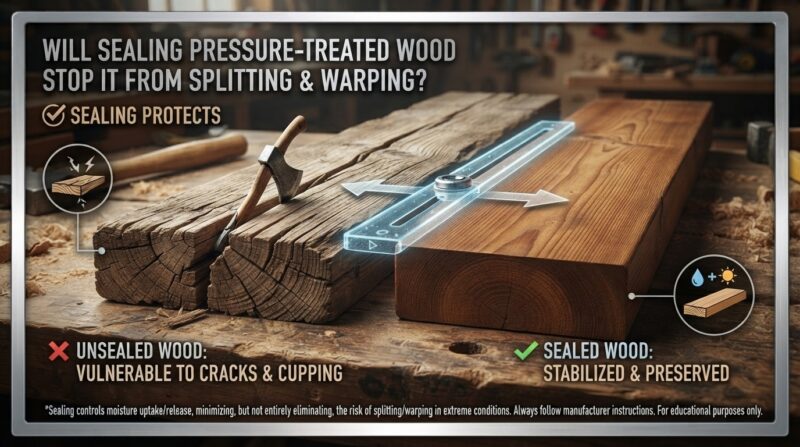
So, the golden question: Will sealing pressure-treated wood completely stop it from splitting, cracking, and warping?
The short answer is no, it won’t stop it completely—but it is your single best defense to dramatically reduce it. To understand why wood moves and how a sealer fights back, we have to look at the cellular structure of the wood itself.
The Science of Splitting: Why Pressure-Treated Pine Moves
Wood is hygroscopic. It acts like a sponge, constantly absorbing and releasing moisture to reach equilibrium with the surrounding air.
When you buy pressure-treated Southern Yellow Pine at a home center in places like New York, Texas, or Washington, it is typically saturated. The treatment process involves forcing liquid chemical preservatives deep into the wood cells under intense pressure.
Here is what happens when that saturated wood is exposed to the elements:
- Rapid Evaporation: The sun beats down on the top of the deck boards, causing the moisture near the surface to evaporate rapidly.
- Uneven Shrinkage: As the top layer loses moisture, the cells shrink. However, the bottom layer (often shaded and closer to the damp ground) remains saturated and swollen.
- Tension and Release: This uneven shrinkage creates massive internal tension. The wood literally pulls itself apart to relieve the stress.
This tension manifests in three distinct ways:
- Warping/Cupping: The board curls up at the edges (cupping) or twists along its length (warping) because one side is shrinking faster than the other.
- Checking: Small, hairline cracks appear on the surface as the outer fibers shrink around the swollen core.
- Splitting: Large cracks develop, usually starting at the ends of the boards, where moisture escapes the fastest through the exposed end-grain.
The Core Problem: The faster the moisture cycle (wetting from rain, rapid drying from the sun), the more severe the cracking and warping.
How Sealing Fights Back: The Mechanism of Protection
Sealing doesn’t freeze the wood in time, but it fundamentally changes the rate at which moisture enters and exits the cellular structure.
┌──────────────────────────────────────────────────────────┐
│              HOW SEALERS REGULATE MOISTURE               │
├──────────────────────────────────────────────────────────┤
│   [ UNSEALED WOOD ]         │  [ SEALED WOOD ]           │
│                             │                            │
│  Rain/Dew  ──> Absorbed Fast│ Rain/Dew  ──> Repelled     │
│  Sunlight  ──> Dries Fast   │ Sunlight  ──> Dries Slowly │
│                             │                            │
│  Result: High Tension,      │ Result: Low Tension,       │
│  Severe Cracking/Warping    │ Minimal Cracking/Warping   │
└──────────────────────────────────────────────────────────┘
A high-quality water-repellent sealer acts as a throttle. By slowing down the absorption of rain and drastically slowing down the evaporation of internal moisture during hot days, the sealer allows the wood to shrink and expand uniformly.
Uniform moisture transfer equals less internal stress, which means significantly less splitting, checking, and cupping.
The Role of Pigment: UV Protection is Crucial
Moisture isn’t the only enemy. Ultraviolet (UV) radiation from the sun acts like a microscopic sandblaster, destroying the lignin—the “glue” that holds wood fibers together.
When UV rays break down the surface lignin, the wood fibers detach, creating a gray, fuzzy surface that is even more porous and susceptible to rapid moisture changes.
- Clear Sealers: Repel water but offer almost zero UV protection. The wood will still gray and break down structurally over time.
- Tinted/Semi-Transparent Sealers: Contain pigments (tiny particles of color) that reflect UV rays away from the wood.
To maximize protection against splitting and warping, always choose a sealer with at least some pigment. The darker the tint, the more UV protection it provides.
Regional Climate Strategies for Maximum Protection
The climate you live in dictates the specific stresses your wood will face. Tailoring your sealing strategy to your location is essential for long-term stability.
1. The High-Heat, High-UV Zones (Texas & Southern California)
- The Threat: Relentless sun bakes moisture out of the wood at incredible speeds, leading to severe checking and cupping.
- The Strategy: UV protection is paramount. Opt for semi-transparent or semi-solid stains with high pigment loads. Apply lighter colors to reflect heat rather than dark colors that absorb it.
2. The Damp & Humid Zones (Washington State & The Pacific Northwest)
- The Threat: Constant rain and high humidity keep the wood swollen. The primary risk here isn’t rapid drying, but rather rot, mold, and algae growth pushing the fibers apart.
- The Strategy: Prioritize breathability and mildewcides. Avoid thick, film-forming sealers that can trap moisture inside the wood. Use penetrating oil or water-based sealers equipped with heavy-duty anti-fungal additives.
3. The Freeze-Thaw Zones (New York & The Northeast)
- The Threat: Water absorbs into the wood during rain or snowmelt, then freezes as temperatures drop. The expanding ice literally tears the wood fibers apart from the inside.
- The Strategy: Deep penetration is key. You need a sealer that fills the pores to prevent water from entering in the first place. High-quality penetrating oils or advanced water-based resins are best here. Avoid cheap film-formers that will quickly crack and peel when the wood expands.
4. The Coastal & Microclimate Zones (San Francisco Bay Area)
- The Threat: A mix of dry heat, coastal fog, salt air, and strict VOC (Volatile Organic Compound) regulations.
- The Strategy: You must use compliant, low-VOC products. Modern, high-grade water-based acrylics are excellent here. They meet California’s strict air quality laws while providing a flexible, breathable barrier against the alternating dry sun and damp, salty fog.
4 Pro Tips to Stop Warping Before It Starts
Sealing is only half the battle. How you handle the wood before and during construction makes a massive difference.
- Buy KDAT Lumber: Whenever possible, buy Kiln-Dried After Treatment (KDAT) pine. This wood has been slowly dried in a controlled environment, meaning most of the shrinkage and stress relief has already occurred before you build with it.
- Seal the End Cuts Immediately: Moisture escapes from the end-grain of a board 10 to 12 times faster than from the face. Every time you cut a board, immediately brush a clear sealer or end-grain preservative onto the fresh cut to prevent the ends from splitting.
- Mind the Bark Side: When laying deck boards, look at the end grain. Try to place the boards “bark side up” (the growth rings curve downward like a rainbow). If the board cups, it will generally cup downward, shedding water rather than creating a puddle.
- Wait for the Right Time to Seal: If you didn’t buy KDAT lumber, the wood is likely wet. Do not seal it immediately, or you will trap moisture inside, causing blistering and internal rot. Wait until the wood feels dry and absorbs a drop of water quickly (usually 3 to 12 weeks, depending on the weather).
Frequently Asked Questions (FAQ)
1. Can I completely stop pressure-treated wood from checking (small cracks)?
No. Minor surface checking is a natural characteristic of Southern Yellow Pine as it acclimates to its environment. Sealing drastically minimizes the severity and depth of these checks, but expecting zero checking is unrealistic for softwood exposed to the elements.
2. If a board is already severely warped, will sealing it flatten it out?
No. Once the physical structure of the wood has distorted to relieve tension, a sealer cannot pull it back into shape. Sealing is a preventative measure, not a restorative cure for warping.
3. Is a clear sealer better than a solid stain for preventing splits?
A solid stain offers vastly superior UV protection, which protects the structural integrity of the wood fibers better than a clear sealer. However, solid stains are prone to peeling and require more intensive maintenance. A semi-transparent penetrating stain often provides the best balance of UV protection and ease of maintenance.
4. How long should I wait to seal a new pressure-treated deck?
It depends entirely on the moisture content of the wood when you bought it and your local weather. Wait until the wood is visibly dry and passes the “water drop test” (water absorbs rather than beading up). This usually takes 3 to 12 weeks for standard treated pine.
5. Does painting pressure-treated wood stop it from splitting?
Paint creates a thick, solid film on the surface. While it blocks UV rays completely, it is terrible at breathing. If any moisture gets inside the wood (which it will, from the underside or through tiny cracks), the paint will trap it, leading to blistering, peeling, and accelerated rot.
6. Do I need to seal the underside of my deck boards?
While sealing all six sides of a board offers the ultimate moisture control, it is rarely practical for a deck. The top surface takes the brunt of the weather and UV damage. Focusing your efforts on a high-quality top coat and sealing all end-cuts provides the best return on investment.
7. What happens if I never seal my pressure-treated deck?
It will not rot away immediately (thanks to the chemical treatment), but it will quickly turn gray, develop severe surface checking, and eventually splinter and cup, significantly reducing its useful lifespan and aesthetic appeal.
8. Are oil-based sealers better than water-based for preventing warping?
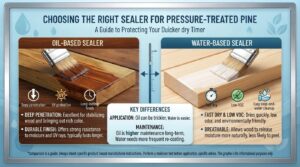
Historically, penetrating oils were considered superior because they soaked deep into the pores. However, modern advanced water-based acrylics are highly engineered to be breathable, flexible, and extremely durable. Both chemistries work well; the choice often depends more on VOC regulations in your state (like California or New York) and your preferred maintenance routine.
9. Will a waterproof sealer make the wood slippery?
Some film-forming sealers can become slick when wet, especially if over-applied. Penetrating sealers soak into the wood and generally do not alter the texture of the surface, maintaining natural traction.
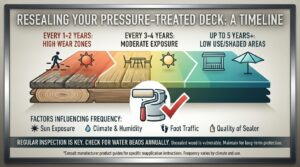
10. How often do I need to reapply sealer to maintain protection?
For a horizontal surface like a deck receiving full sun, expect to re-clean and re-seal every 2 to 3 years. Vertical surfaces like fences may last 4 to 6 years between coats.
Conclusion
Sealing pressure-treated pine is not a magic forcefield that stops all natural wood movement. Wood is an organic material that will always react to its environment.
However, a high-quality, properly applied sealer is the most critical tool you have. By regulating the rapid exchange of moisture and blocking destructive UV rays, sealing dramatically reduces the tension that causes splitting, checking, and severe warping.
If you want your deck or fence in Texas, New York, or anywhere in between to last for decades rather than a few ugly years, regular sealing is not optional—it is a requirement.