If you are looking for an alternative to traditional, synthetic chemical herbicides, you have almost certainly stumbled upon the internet’s absolute favorite yard remedy: a mixture of white vinegar, Dawn dish soap, and sometimes table salt.
Proponents across social media platforms praise it as a miracle cure—a non-toxic, cheap, and instantaneous solution to clear weeds from driveways, garden beds, and sidewalk cracks.
But before you fill up a garden pump sprayer and drench your property, it is vital to separate viral excitement from horticultural reality. Property owners frequently encounter a frustrating surprise a few weeks after spraying: the weeds grow right back.
This forces a crucial question: Will vinegar and Dawn kill weeds permanently?
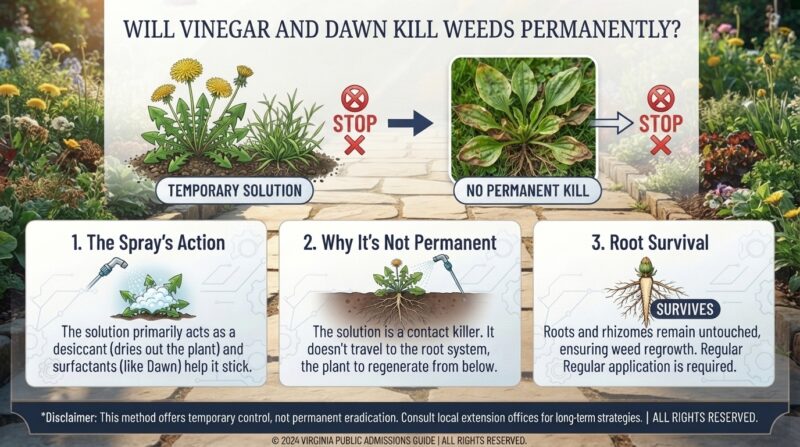
The direct answer is no, vinegar and Dawn dish soap do not kill all weeds permanently on the first application. This DIY remedy is a strictly topical contact herbicide, meaning it only burns the visible green foliage it touches.
While it will permanently eliminate young, small annual weeds with shallow root structures, it completely fails to destroy the deep, established root networks of mature perennial weeds.
To maximize this organic solution, you must understand the underlying science, the exact structural limitations of homemade sprays, and how to apply the formula strategically to achieve long-term control.
The Core Botanics: Why the DIY Mix Fails at Permanence
To understand why this solution isn’t a permanent single-use cure, it helps to examine how the mixture interacts with distinct plant biologies.
1. Contact vs. Systemic Mechanics
Commercial synthetic weed killers are typically systemic. When sprayed onto a leaf, the chemical is absorbed into the plant’s vascular system and travels all the way down to kill the taproot.
Vinegar (acetic acid) is purely a contact desiccant. It strips away the waxy, protective cuticle layer of the leaf, causing cell membranes to rupture. The moisture within the foliage rapidly evaporates in the sun, turning the exposed green growth into a shriveled brown mess within hours. However, the acid is neutralized immediately upon touching organic matter in the soil, leaving the underlying roots completely untouched.
2. Annual Weeds vs. Perennial Weeds
- Annual Weeds (Permanently Controlled): Weeds like crabgrass, chickweed, and fleabane live for only one season and rely on shallow, basic root systems. If you destroy their top growth before they drop seeds, the plant dies permanently.
- Perennial Weeds (Temporary Suppression): Hardier invasive species like dandelions, field bindweed, thistles, and poison ivy possess extensive, deep root networks or underground rhizomes that store massive amounts of energy. When vinegar scorches their leaves, the roots simply bide their time and push up fresh, new green shoots a couple of weeks later.
Comprehensive DIY Formula and Performance Matrix
Depending on where your invasive plants are actively growing, you must select an appropriate formulation strategy to balance effectiveness with soil safety.
| Formula Variation | Intended Application Target | Exact Chemical Proportions | Permanence Level Expectation |
| The Standard Foliar Burn | Young annual sprouts, surface moss, small patio weeds. | • 1 Gallon Distilled White Vinegar (5%) • 1 Tablespoon Blue Dawn Soap | Low for perennials; high for new seedlings. Will require touch-ups. |
| The Soil-Sterilizing Mix | Pavement seams, gravel paths, stone driveways only. | • 1 Gallon White Vinegar (5%) • 1 Cup Table Salt (Sodium Chloride) • 1 Tablespoon Blue Dawn Soap | High permanent prevention, but renders treated soil completely sterile. |
| The Horticultural Scorch | Established, tough, mature perennial broadleaf clusters. | • 1 Gallon Industrial Vinegar (20%–30%) • 1 Tablespoon Blue Dawn Soap | Moderate-High; strips mature leaves aggressively to starve roots over time. |
Step-by-Step Strategic Eradication Playbook
If you want to use vinegar and Dawn to manage your landscape with maximum efficiency, you cannot spray randomly. Follow this systematic process to optimize your results.
1.Align Application with Peak Solar UV Indices:Phase 1: Timing Assessment.
Open your local weather network app. Acetic acid requires direct heat and intense ultraviolet radiation to maximize its cellular drying capabilities. Schedule your spraying for a bright, cloudless morning when ambient temperatures are projected to exceed 75°F (24°C).
2.Incorporate Components into the Tank Sprayer:Phase 2: Blending Protocol.
Pour your white vinegar into a plastic pump sprayer. Add the Dawn dish soap gently at the very end to prevent a massive layer of bubbles from filling the tank. Stir or swirl lightly rather than shaking violently to ensure the surfactant dissolves smoothly.
3.Execute Direct-Contact Target Spot Spraying:Phase 3: Tactical Application.
Adjust your spray wand tip to a highly focused, concentrated stream. Approach target weeds closely and drench the leaf surfaces completely until the liquid runs off. Avoid misting wide patterns, as any overspray drifting onto neighboring turf grass will scorch your lawn.
4.Initiate the Exhaustion and Starvation Cycle:Phase 4: Root Depletion.
Monitor the treated zones over the next 48 hours as the top growth turns completely brown. For persistent perennial weeds, wait for the root system to attempt to push up weak new sprouts, then instantly spray them again. Repeating this cycle 2 to 3 times starves the root system completely, achieving permanent eradication.
5 Essential Maintenance Tips for Long-Term Control
- Keep Salt Out of Garden Beds: Adding table salt to your vinegar spray makes the treatment far more lethal, but sodium chloride binds tightly to soil particles and does not degrade. Rain will carry the salt runoff into surrounding root zones, creating permanent toxic areas where prized landscape plants cannot survive. Keep salt completely isolated to non-planting zones like asphalt or stone walkways.
- Upgrade to Industrial Acetic Acid Safely: Standard kitchen vinegar sits at a mild 5% concentration, which can easily be resisted by tough weeds. If you choose to use 20% or 30% industrial horticultural vinegar, remember that it is a corrosive acid capable of causing severe skin burns and serious eye injury. Always wear protective gloves, long sleeves, and safety eyewear.
- Deploy Organic Surfactants in Coastal Watersheds: If you are treating properties across environmentally protective areas like the San Francisco Bay Area or Washington State, minimize soap runoff near storm drains. Opt for clear, biodegradable, plant-based castile soaps instead of concentrated dish detergents to limit downstream effects on local aquatic habitats.
- Utilize Mulch Barriers Post-Treatment: Once your vinegar application has cleared out an area of seasonal annual weeds, apply a thick, 3-inch layer of organic wood mulch or gravel over the bare soil. This step blocks sunlight from reaching hidden weed seeds buried in the dirt, preventing them from germinating.
- Neutralize Accidental Overspray with Water: If a sudden wind drift blows your vinegar solution onto valued landscape flowers or expensive lawn turf, act immediately. Drench the contaminated foliage with a heavy stream of fresh water from a garden hose to dilute and rinse away the acid before it breaks down the plant’s cell membranes.
Frequently Asked Questions (FAQ)
1. Can vinegar and Dawn fully replace professional chemical weed killers?
For surface-level maintenance on driveways, walkways, and patios, yes, it serves as an excellent natural alternative. However, for large-scale agricultural clearing or eradicating deep-rooted brush like poison oak or brambles, home mixtures lack the systemic capacity to replace commercial alternatives easily.
2. Why do my weeds grow back two weeks after spraying with vinegar?
This happens because vinegar is a contact desiccant that cannot travel down into the root system. The intact roots simply utilize their stored energy reserves to grow new leaves, requiring you to spray again to gradually exhaust the plant.
3. How long does it take for vinegar and Dawn to show visible effects?
On a hot, bright, sunny day, you will typically observe dramatic wilting, curling, and distinct browning within 2 to 4 hours after the initial application.
4. Is the vinegar and Dawn mixture safe to use around my pets?
Once the sprayed area is completely dry, it is generally safe for dogs and cats. However, if you added significant amounts of table salt to the mixture, prevent pets from licking or walking on the area, as dried salt crusts can irritate sensitive paw pads.
5. Will this DIY spray ruin the soil quality of my garden beds?
Pure vinegar breaks down quickly into water and basic organic components upon contacting soil microbes, causing no long-term harm to soil health. However, if your formula contains table salt, the sodium will remain in the soil indefinitely, stripping nutrients and preventing future plant growth.
6. Can I use generic store-brand dish soap instead of name-brand Dawn?
Yes. Any functional liquid dish soap can serve as a surfactant to break the surface tension of the vinegar. Original blue Dawn is simply preferred because its high concentration makes it highly effective at stripping away the waxy protective coating on tough weed leaves.
7. Does this mixture work effectively in cold or overcast weather?
No. Acetic acid relies heavily on heat and solar UV activation to dry out plant cells. If you apply the mixture during cool, cloudy, or humid days, the chemical reaction slows down dramatically, yielding poor results.
8. Will vinegar kill mature dandelions permanently?
It will not kill them permanently on the first attempt because of their deep, thick taproots. It will burn the surface leaves away, but you must spray the spot again as soon as the root attempts to regrow to eventually starve the plant.
9. Can I use apple cider vinegar instead of white distilled vinegar?
Yes. Apple cider vinegar carries a similar 5% acidity level and works just as effectively. However, clear white distilled vinegar is much cheaper to buy in bulk, making it the practical choice for landscaping use.
10. Can I spray this solution onto my lawn to get rid of weeds?
No. Vinegar is entirely non-selective and will damage or kill any green vegetation it touches, including Kentucky Bluegrass, Bermuda, or St. Augustine turf grass. Use it strictly for targeted spot treatments.
Conclusion
While a combination of vinegar and Dawn dish soap is a powerful tool for natural yard care, it is not a single-application permanent cure for all weed varieties. By treating the mixture as a reliable contact desiccant, targeting shallow annual weeds, and executing a deliberate cycle of repeated sprayings to gradually exhaust tough perennial roots, you can achieve clean, weed-free hardscapes without relying heavily on synthetic alternatives. Track local weather patterns for hot, clear sun windows, shield your garden soils from salt tracking, and apply the spray with precision to maintain a beautiful, well-kept home landscape.