EMERGENCY MEDICAL DISCLAIMER: If you or someone nearby has just suffered a 20% horticultural vinegar splash to the eye, DO NOT WAIT TO READ THIS ARTICLE. FLUSH THE EYE IMMEDIATELY WITH COOL, RUNNING WATER FOR AT LEAST 15 TO 30 MINUTES. Have someone call Emergency Services (911) or Poison Control (1-800-222-1222) while flushing continues.
While typical household table vinegar contains roughly 4% to 5% acetic acid, 20% horticultural vinegar is four to six times more concentrated. At 20% concentration, acetic acid changes from a mild, sour food preservative into a corrosive industrial acid with a pH hovering around 2.0.
A splash of 20% vinegar in the eye is a severe chemical ocular emergency. Without immediate, continuous flushing, high-concentration acetic acid rapidly breaks down the corneal epithelium—the outermost protective cell layer of the eye—leading to tissue desiccation, corneal clouding, intense pain, and potential vision loss.
Whether you are treating weeds along a driveway in Texas, working in an urban garden in San Francisco or California, managing landscaping in Washington, or prepping yard spaces in New York, understanding how to handle high-concentration organic chemical exposures can save your sight.
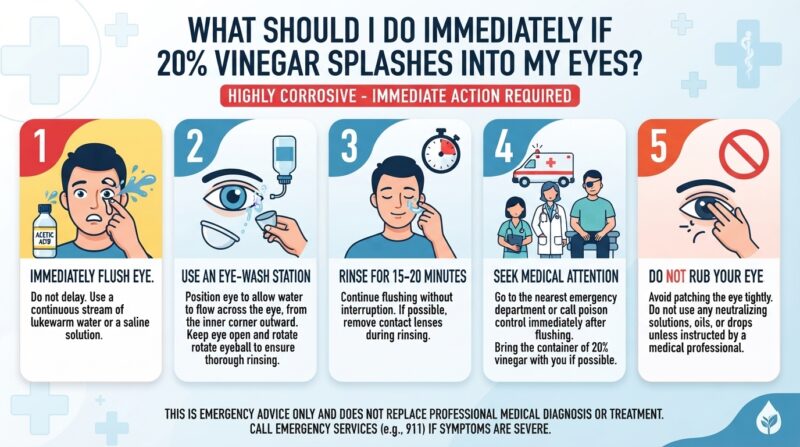
Immediate First Aid Protocol: The 4 Critical Steps
+-------------------------------------------------------------------------------------------------------+
|                                    EMERGENCY FIRST AID PROTOCOL                                        |
+-------------------------------------------------------------------------------------------------------+
|                                                                                                       |
|  STEP 1: FLUSH IMMEDIATELY (Do not look for special equipment or wait to call for help)               |
|  --> Position eye under tap, shower, or hose; use continuous running water for 15-30 minutes.         |
|                                                                                                       |
|  STEP 2: HOLD EYELIDS OPEN & REMOVE CONTACTS                                                         |
|  --> Force eyelids wide open; pull contacts out during irrigation if worn.                           |
|                                                                                                       |
|  STEP 3: CALL FOR PROFESSIONAL HELP WHILE FLUSHING                                                    |
|  --> Put 911 or Poison Control on speakerphone; DO NOT interrupt flushing to make the call.         |
|                                                                                                       |
|  STEP 4: SEEK EMERGENCY MEDICAL EVALUATION IMMEDIATELY                                               |
|  --> Proceed to the nearest ER or ophthalmology emergency clinic; bring the chemical bottle.         |
|                                                                                                       |
+-------------------------------------------------------------------------------------------------------+
Step 1: Irrigate Immediately with Running Water
Do not waste precious seconds searching for sterile eyewash saline, milk, neutralizers, or special equipment. Speed is far more critical than water purity. Grab the closest source of clean water—a kitchen sink, shower, garden hose, or water bottle—and begin rinsing the eye within seconds of exposure.
- Water Temperature: Use cool to lukewarm water. Hot water will cause additional thermal damage, while freezing water will cause severe facial spasms that make it hard to keep the eyelids open.
- Head Positioning: Tilt your head so the affected eye is downward and to the side. Water should enter near the bridge of your nose and stream outward over the eye. This prevents washing concentrated acid across your uninjured eye.
Step 2: Manually Force the Eyelids Open
Your eye’s natural reaction to severe chemical pain is blepharospasm—an involuntary, violent squeezing shut of the eyelid.
You must manually override this reflex. Use your fingers to pull both the upper and lower eyelids away from the eyeball while the water is flowing. Move your eyeball up, down, left, and right while flushing to clear acid trapped in the folds (conjunctival fornices) beneath the lids.
Contact Lens Wearers: If you wear contact lenses, do not delay flushing to take them out. Start the water stream immediately. The lens will likely slide out with the running water. If it remains trapped, gently pinch it out while flushing continues. Contact lenses trap concentrated acetic acid against the cornea, rapidly worsening the burn.
Step 3: Flush for a Full 15 to 30 Minutes
Set a timer or ask someone nearby to track the time. The eye must be continuously irrigated for a minimum of 15 to 30 minutes.
Even if the burning sensation decreases after 5 minutes, do not stop rinsing. Acid can remain trapped in ocular tissue membranes long after the surface pain subsides.
Step 4: Contact Emergency Services & Seek Immediate Medical Care
While you are actively flushing, have a family member or coworker call Emergency Services (911) or the National Poison Control Hotline (1-800-222-1222).
If you are alone, put your phone on speakerphone beside you while continuing to rinse under the faucet. Once irrigation is finished, have someone drive you directly to an Emergency Room or urgent eye care provider. Do not drive yourself.
Critical Errors: What You Must NEVER Do
When high-concentration acid enters the eye, well-intentioned mistakes can turn a treatable chemical irritation into permanent blindness.
+-----------------------------------------------------------------------------------+
|                                WHAT NOT TO DO                                     |
+-----------------------------------------------------------------------------------+
|  [ BAD ACTIONS ]                     [ RESULT / DANGER ]                          |
|  -------------------------------------------------------------------------------  |
|  Rubbing the eye                     Scrapes loosened corneal tissue off eye      |
|  Adding Baking Soda                  Thermal reaction (neutralization heat burn)  |
|  Using Visine / Redness Drops        Vasoconstrictors restrict vital healing blood|
|  Covering with a tight patch         Traps residual acid and heat against cornea  |
|  Waiting to see if it "gets better"  Allows acid to penetrate deeper layers       |
+-----------------------------------------------------------------------------------+
- NEVER Rub the Affected Eye: Acetic acid loosens the outer corneal cellular layer. Rubbing your eye creates mechanical friction that strips these delicate cells right off the eyeball, causing severe corneal abrasions.
- NEVER Attempt to “Neutralize” the Acid with Baking Soda: Chemical logic suggests putting a base (baking soda/alkali) on an acid to neutralize it. This is extremely dangerous in the eye. Neutralization produces an exothermic chemical reaction (heat). Applying baking soda creates an intense thermal burn on top of the chemical burn, causing catastrophic tissue destruction.
- NEVER Use Over-the-Counter Eye Drops: Redness-relief drops contain vasoconstrictors that shut down blood flow to surrounding ocular tissue, starving the eye of oxygen when it needs recovery fluid most.
- NEVER Delay Treatment: Hoping the pain will pass allows the acid to absorb into the deeper stromal layers of the cornea, risking permanent scarring and loss of clarity.
20% Horticultural Vinegar vs. 5% Culinary Vinegar: The Chemistry
Why is 20% vinegar so much more dangerous to eyes than regular kitchen vinegar? The answer lies in the non-linear scale of pH and concentration dynamics.
+---------------------------------------------------------------------------------------+
|                               ACIDITY COMPARISON CHART                                |
+---------------------------------------------------------------------------------------+
|  ACETIC ACID LEVEL          pH LEVEL        EYE DAMAGE POTENTIAL                      |
|  -----------------------------------------------------------------------------------  |
|  5% Culinary Vinegar        pH ~2.4 - 3.0   Mild to moderate sting, reversible redness|
|  20% Horticultural Vinegar  pH ~2.0         CORROSIVE BURN, epithelial sloughing      |
|  30% Industrial Vinegar     pH ~1.8         SEVERE CORROSIVE BURN, risk of blindness  |
+---------------------------------------------------------------------------------------+
Because pH is measured on a logarithmic scale, 20% vinegar is not merely 4 times more acidic than 5% vinegar—it carries dramatically higher concentration levels of free hydrogen ions ($H^+$).
When 5% household vinegar hits the eye, tears quickly dilute the mild solution, causing sharp stinging but rarely permanent harm.
At 20% concentration, acetic acid acts as a corrosive solvent. It instantly denatures proteins on contact, dissolving the outer cellular protective barrier of the cornea. This allows the acid to rapidly penetrate into the delicate stromal layer underneath, potentially leaving behind permanent scarring.
What Happens at the Emergency Room?
When you arrive at an ER or specialized eye clinic following a 20% acetic acid splash, medical professionals follow a strict emergency protocol:
+-----------------------------------------------------------------------------------+
|                           CLINICAL EMERGENCY WORKFLOW                             |
+-----------------------------------------------------------------------------------+
|  1. ANESTHETIZE EYE       --> Topical numbing drops applied immediately           |
|  2. CONTINUOUS IRRIGATION  --> Morgan Lens connected to IV saline (liters of fluid)|
|  3. pH STRIP TESTING      --> Tested until ocular surface pH normalizes (7.0-7.4) |
|  4. FLUORESCEIN DYE EXAM  --> Cobalt blue light reveals cell damage/scrapes       |
|  5. PRESCRIPTION CARE     --> Topical antibiotics, steroid drops, & pain control  |
+-----------------------------------------------------------------------------------+
- Topical Numbing Drops: The physician will place anesthetic drops (such as proparacaine) into your eye to stop the blinding pain and eliminate involuntary spasms.
- Morgan Lens Irrigation: Clinicians often insert a small, curved plastic device called a Morgan Lens over the eyeball. Connected to an intravenous saline bag, this lens continuously floods the eye surface with liters of sterile fluid while keeping the eyelids separated.
- Ocular Surface pH Testing: Irrigation continues until the doctor places a small strip of pH paper against the inner lower eyelid. Flushing is stopped only when the eye’s surface returns to a normal pH range between 7.0 and 7.4 and stays stable for at least 15 to 20 minutes.
- Fluorescein Stain & Slit Lamp Exam: The doctor will drop a yellow-green fluorescent dye onto the eye and examine it under a cobalt-blue light. The dye clings to damaged or dead corneal cells, highlighting epithelial abrasions and depth of burn under high magnification.
- Prescription Management: Treatment typically includes topical antibiotic eye drops (to prevent secondary bacterial infections), topical steroids (to suppress scarring inflammation), and specialized eye lubricants.
Regional Safety Protocols & Personal Protective Equipment (PPE)
Across the diverse regions where organic weed control is popular—including California, Washington, Texas, New York, and San Francisco—horticultural vinegar usage is booming.
However, because horticultural vinegar is sold without a prescription in garden centers, home users frequently skip the protective gear mandated in industrial settings.
+-----------------------------------------------------------------------------------+
|                        MANDATORY PPE FOR 20% VINEGAR USE                          |
+-----------------------------------------------------------------------------------+
|  [ EQUIPMENT ]               [ SPECIFICATION / STANDARD ]                         |
|  -------------------------------------------------------------------------------  |
|  Eye Protection              ANSI Z87.1 Approved Indirectly Vented Goggles        |
|  Face Protection             Full-face shield worn OVER safety goggles            |
|  Hand Protection             Heavy-duty Nitrile or Neoprene chemical gloves       |
|  Skin Cover                  Long-sleeve shirt, long pants, closed-toe boots     |
+-----------------------------------------------------------------------------------+
Essential Spraying Rules:
- Ditch Regular Glasses or Safety Glasses: Standard sunglasses or wrap-around safety glasses leave gaps along the top, bottom, and sides. A sudden pressure leak from a garden sprayer can easily jet acid directly behind normal lenses. Always wear ANSI-approved sealed chemical splash goggles.
- Never Spray Above Shoulder Height: Spraying weeds on high walls, elevated brick beds, or overhead fences dramatically increases the risk of wind-blown blowback or head-level drips.
- Inspect Sprayer Seals: Acetic acid degrades cheap rubber gaskets inside standard hand-pump sprayers over time. Inspect hoses and pressure relief valves before every use to prevent pressurized leaks.
- Keep an Emergency Eyewash Bottle On-Site: When spraying out in large acreage or away from indoor plumbing, keep a 32 oz portable eyewash bottle filled with clean water or sterile saline directly in your utility cart.
Frequently Asked Questions (FAQ)
1. Will a 20% vinegar splash in the eye cause permanent blindness?
It can if not flushed immediately. 20% acetic acid causes rapid chemical burns on the clear outer window of the eye (cornea). If allowed to penetrate deeply, it can create permanent clouding, severe scarring, or permanent loss of vision. Immediate flushing for 15–30 minutes drastically lowers this risk.
2. Can I use bottled mineral water or tap water to flush my eye?
Yes. Use whatever clean water is available immediately. Tap water, bottled drinking water, garden hose water, or shower water are all appropriate. Do not delay flushing to search for sterile saline or eyewash products.
3. How long after the exposure do I need to visit an eye doctor?
You should be evaluated by a medical professional immediately following your 15-to-30-minute eye flush. Even if your vision seems fine and the pain subsides, microscopically damaged corneal cells leave the eye vulnerable to severe infection and delayed ulceration.
4. Should I cover my eye with a bandage after rinsing?
No. Do not place tight patches or taped pads directly over a chemically burned eye unless instructed by a physician. Tight bandaging can trap residual acid, heat, and sloughed tissue against the cornea.
5. Why does 20% vinegar hurt so much more than normal vinegar?
Normal table vinegar contains 4% to 5% acetic acid, whereas horticultural vinegar contains 20% to 30% acetic acid. The four-to-six-times higher concentration drops the pH down near 2.0, turning the solution into a corrosive acid that chemically breaks down cell tissues on contact.
6. What if I was wearing contact lenses when the vinegar splashed?
Begin flushing immediately under running water with the contacts in place. As water flows over the eye, carefully pinch out the contact lens as quickly as possible, then resume flushing for the full 15 to 30 minutes. Throw the exposed contact lens away—never attempt to wash and reuse it.
7. What should I do if 20% vinegar splashes on my surrounding skin or eyelids?
Flush the skin immediately with running water and gentle soap for 15 minutes. Remove any clothing that absorbed the vinegar splash to prevent continuous chemical skin burns.
8. Is 20% horticultural vinegar considered a dangerous chemical by OSHA?
Yes. OSHA and global safety standards classify 20%+ acetic acid as a Category 1 Skin Corrosive and Category 1 Serious Eye Damage hazard. Product containers carry the mandatory signal word “DANGER” due to these acute burn hazards.
9. How do I know if my cornea was permanently scratched or burned?
Only an eye care professional can verify corneal damage using a specialized fluorescein dye under cobalt blue light. Symptoms of corneal burns include persistent severe pain, extreme sensitivity to light (photophobia), cloudy or blurry vision, and feeling like sand is trapped in the eye.
10. What number should I call if I am alone during a chemical eye emergency?
If you are in the United States, call 911 or the Poison Control Center at 1-800-222-1222. Put your phone on speakerphone while you continue continuously flushing your eye under the faucet.
Conclusion
Horticultural vinegar (20% acetic acid) is a popular, effective option for organic weed management across Texas, New York, California, Washington, and San Francisco. However, its “organic” status does not make it harmless.
If 20% vinegar splashes into your eyes:
- Flush immediately with running water for 15 to 30 minutes.
- Hold your eyelids open manually and remove contact lenses while flushing.
- Avoid rubbing, neutralizing, or using unprescribed eye drops.
- Seek emergency medical evaluation right away.
Always wear chemical splash goggles whenever handling or mixing high-concentration acetic acid—protecting your eyes before pulling the trigger on any spray bottle.