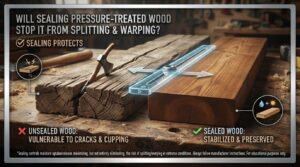
Pressure-treated wood is one of the most durable, cost-effective outdoor building materials available. The chemical treatment process protects lumber from wood-rotting fungi, termites, and structural decay. However, pressure treatment does not make wood waterproof.
Over time, exposure to rain, snow, UV rays, and fluctuating humidity causes pressure-treated wood to crack, warp, splinter, and gray out. To prevent structural damage and maintain your deck’s appearance, periodic sealing is essential.
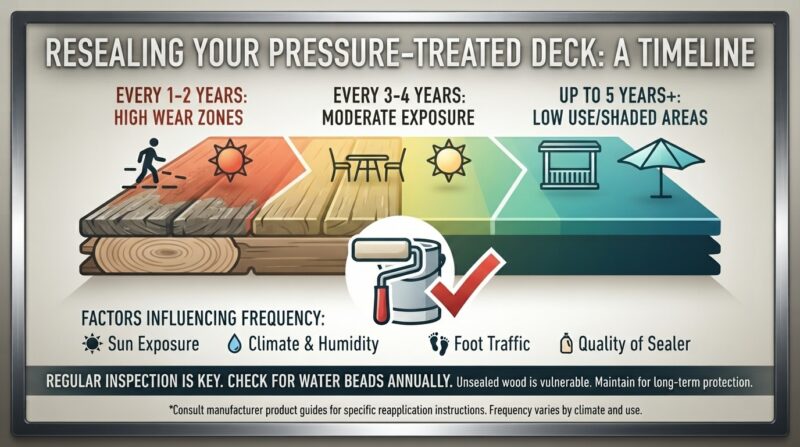
In general, you need to reapply sealer on a pressure-treated deck every 1 to 3 years.
The exact timing depends on sealer type, local climate conditions, sun exposure, and foot traffic.
Quick Summary: Reapplication Timelines by Sealer Type
| Sealer Type | Reapplication Frequency | Key Characteristics |
| Clear Water Repellent | Every 1 to 2 years | Natural wood look, minimal UV protection |
| Toner / Semi-Transparent Stain | Every 2 to 3 years | Light tint, moderate UV protection, retains grain |
| Semi-Solid Stain & Sealer | Every 3 to 4 years | Stronger pigment, higher UV protection |
| Solid / Opaque Stain & Sealer | Every 3 to 5 years | Complete color coverage, maximum protection, prone to peeling |
Key Factors That Dictate Sealer Frequency
1. Sealer Formulation (Clear vs. Tinted)
Clear sealers soak into the wood pores to repel moisture, but they offer virtually zero protection against ultraviolet (UV) radiation from sunlight. Without UV-blocking pigments, the sun breaks down wood lignin, turning the surface gray and dry within 12 months.
Tinted sealers (semi-transparent stains containing both sealer and pigment) act like sunscreen for your deck. Pigments reflect UV rays, allowing the protective barrier to last 2 to 3 times longer than a clear coat.
2. Regional Climate (State-by-State Breakdown)
Your geographic location dictates environmental stress on pressure-treated wood. Homeowners in different US regions face distinct maintenance cycles:
- Texas (Austin, Houston, Dallas, San Antonio): Extreme UV exposure, prolonged summer heat over 100°F (38°C), and intense humidity in coastal areas rapidly bake clear sealers off horizontal surfaces. Expect to reapply clear sealers every 1 year and semi-transparent sealers every 2 years.
- New York (Upstate & NYC Metro): Harsh winter freeze-thaw cycles, snow accumulation, and ice-melt chemicals expand trapped moisture within wood fibers, causing micro-fractures. Reapply every 1 to 2 years.
- California (SoCal, Inland Empire, Central Valley): Near-constant sunshine causes rapid wood drying and severe color fading. Reapply clear sealers every 1 to 2 years.
- Washington State (Seattle, Tacoma, Olympic Peninsula): Persistent rainfall, high humidity, and shade foster mold, mildew, and moss growth that degrade sealer bonds. Reapply water-repellent sealers every 1 to 2 years.
- San Francisco Bay Area: Coastal fog, ocean salt air, and dense marine layers create constant ambient moisture morning and night. Reapply sealer every 2 years.
3. Deck Orientation & Sun Exposure
Unshaded south- and west-facing decks absorb maximum UV radiation during peak afternoon hours. Horizontal deck boards on these surfaces degrade up to 50% faster than vertical railings, stairs, or shaded north-facing decks.
How to Test If Your Deck Needs Sealer Today
Do not rely solely on the calendar to decide when to reapply sealer. The simplest and most reliable way to check your deck’s sealant integrity is the Splash Test (Water Drop Test).
1.Select Test Areas:1 minute.
Choose high-traffic, sun-exposed areas on horizontal boards, plus a shaded corner for comparison.
2.Pour Water:30 seconds.
Splash 2 to 3 tablespoons of clean water directly onto the wood surface.
3.Observe Water Behavior:Wait 10 to 15 minutes.
Observe how the water reacts on the wood surface.
Interpreting Splash Test Results
- Tight Beads Form: Water beads up immediately and stays pooled for over 15 minutes. Result: Sealer is intact. No action needed.
- Flat Sheen / Slow Absorption: Water sits flat and begins soaking into the wood after 5-10 minutes. Result: Sealer is wearing thin. Plan to reapply within 3-6 months.
- Immediate Soak-In: Water darkens the wood grain and absorbs instantly (under 2 minutes). Result: Protection is completely gone. Reapply sealer immediately to prevent water damage.
Preparing Pressure-Treated Wood for Sealer Application
Applying fresh sealer over dirty, wet, or damaged wood leads to immediate flaking and peeling. Proper surface preparation accounts for 80% of final finish longevity.
Step 1: Deep Clean -> Step 2: Neutralize/Brighten -> Step 3: Dry (12-15% Moisture) -> Step 4: Apply Sealer
1. New Pressure-Treated Deck Prep (The “Dry Time” Rule)
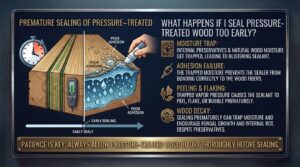
New pressure-treated wood contains high moisture levels from factory chemical injection. Sealing wet wood traps moisture inside, leading to internal rot and peeling sealer.
Crucial Rule: Allow new pressure-treated lumber to dry out for 3 to 6 months before applying your first coat of sealer. Perform the splash test to verify the wood accepts moisture drops before sealing.
2. Cleaning and Brightening
- Clear Debris: Sweep off dirt, leaves, and pine needles.
- Apply Wood Cleaner: Spray a biodegradable oxygen-bleach deck cleaner to break down dirt, mold, and old dead wood fibers. Avoid heavy chlorine bleach, which damages wood lignin structure.
- Light Pressure Wash: Wash off cleaner using low pressure (below 1,200 PSI) with a 40-degree wide-angle tip. Keep the wand at least 12 inches from the wood to avoid gouging soft pine fibers.
- Apply Wood Brightener: Apply an oxalic acid-based wood brightener to restore the natural wood tone and neutralize chemical pH.
3. Sanding & Moisture Content
- Sanding: Once dry, lightly sand raised wood grain with 80-grit sandpaper along the wood grain direction.
- Moisture Check: Use a pin-type moisture meter. Wood internal moisture content must be below 15% (ideally 12%) before applying oil- or water-based sealer.
5 Pro Tips for Maximum Sealer Longevity
- Avoid Direct Midday Sun: Apply sealer on overcast days or in shaded morning hours between 50°F and 85°F (10°C – 29°C). High temperatures dry sealer on the surface before it penetrates the wood.
- Use the “Back-Brushing” Technique: Whether using a roller or pump sprayer, always follow up immediately with a natural-bristle brush (for oil-based) or synthetic brush (for water-based) to push sealer deep into wood pores.
- Apply Thin Coats: Two thin coats penetrate and adhere far better than one thick coat. Excess sealer puddles on the surface, creating a tacky film that attracts dirt and peels off easily.
- Keep Clearance Under the Deck: Ensure adequate ventilation under elevated decks (at least 12 inches off the ground). Poor airflow traps ground moisture underneath, forcing water up through boards and pushing off top sealers.
- Maintain Regular Sweeping: Remove leaves, wet snow, and organic matter promptly. Decaying organic material holds moisture against sealed surfaces and breaks down protective coatings prematurely.
Frequently Asked Questions (FAQ)
1. What happens if I wait too long to reseal my pressure-treated deck?
Unsealed wood absorbs ambient rainwater and morning dew. As wet wood swells under moisture and shrinks under heat, deep structural cracks, board warping, and surface splinters develop. Moisture trapped long-term invites wood rot fungi (Basidiomycetes) and subterranean termites.
2. Can I apply sealer over old deck stain?
You can reapply fresh sealer over existing oil- or water-based sealer if the old coating is fully intact and clean. However, if the old finish is peeling, flaking, or a different chemical base (e.g., applying water-based sealer over old oil stain), strip or sand down to bare wood first.
3. Which is better for pressure-treated wood: oil-based or water-based sealer?
Oil-based sealers penetrate deeply into dense wood grain, offering superior moisture resistance and easy application without lap marks. Water-based sealers offer superior color retention, dry faster, emit lower VOCs (Volatile Organic Compounds), and cleanup with simple soap and water. Modern high-end acrylic water-based sealers often outlast oil options.
4. Should I seal a brand-new pressure-treated deck right away?
No. Fresh pressure-treated lumber is saturated with water and preservatives from manufacturing. Applying sealer immediately creates a barrier that traps moisture inside, causing wood to rot underneath and sealer to peel off within weeks. Wait 3 to 6 months until the wood dries thoroughly.
5. How long after sealing my deck can I walk on it or place furniture?
Light foot traffic is safe after 24 hours under average ambient weather conditions (70°F / 21°C and 50% relative humidity). Wait at least 48 to 72 hours before placing heavy outdoor patio furniture, gas grills, or planter boxes back onto the deck.
6. Can I seal my deck in late fall or winter?
It is not recommended. Most deck sealers require ambient air and surface temperatures to remain above 50°F (10°C) for at least 24 to 48 hours to cure properly. Applying sealer in cold or damp conditions prevents proper cross-linking, leading to soft, sticky surfaces.
7. How many coats of sealer should I apply on pressure-treated wood?
Most manufacturers recommend two thin coats. Apply the second coat while the first coat is still slightly damp (“wet-on-wet” application, typically within 20 to 30 minutes), depending on product instructions. Avoid over-application, which causes shiny, slippery surfaces.
8. Will deck sealer stop pressure-treated wood from turning gray?
Clear water sealers will not stop wood from turning gray because they lack UV-blocking pigments. To prevent graying, choose a semi-transparent sealer or toner containing trans-oxide pigments that block UV light while leaving natural wood grain visible.
9. Why is my newly sealed deck surface sticky or tacky?
Tackiness occurs when sealer is over-applied or applied over non-porous surfaces. The wood cannot absorb the excess material, leaving it to pool on top. You can scrub tacky areas with mineral spirits (for oil-based) or a deck cleaner and stiff brush (for water-based) to remove unabsorbed residue.
10. How much sealer do I need for a standard deck?
As a general rule, 1 gallon of deck sealer covers approximately 150 to 250 square feet for a single coat on porous, pressure-treated wood. Rough or older dry wood absorbs more product than smooth or newer lumber.
Conclusion
Reapplying sealer on a pressure-treated deck every 1 to 3 years is one of the most effective routine maintenance investments you can make for your home. By monitoring your local climate impact—whether dealing with intense Texas sunshine, freezing New York winters, or damp Washington rainfall—and using simple checks like the splash test, you can protect your deck from costly structural repairs and keep it looking great for decades.