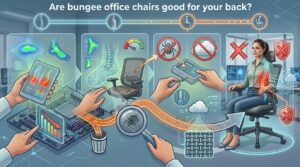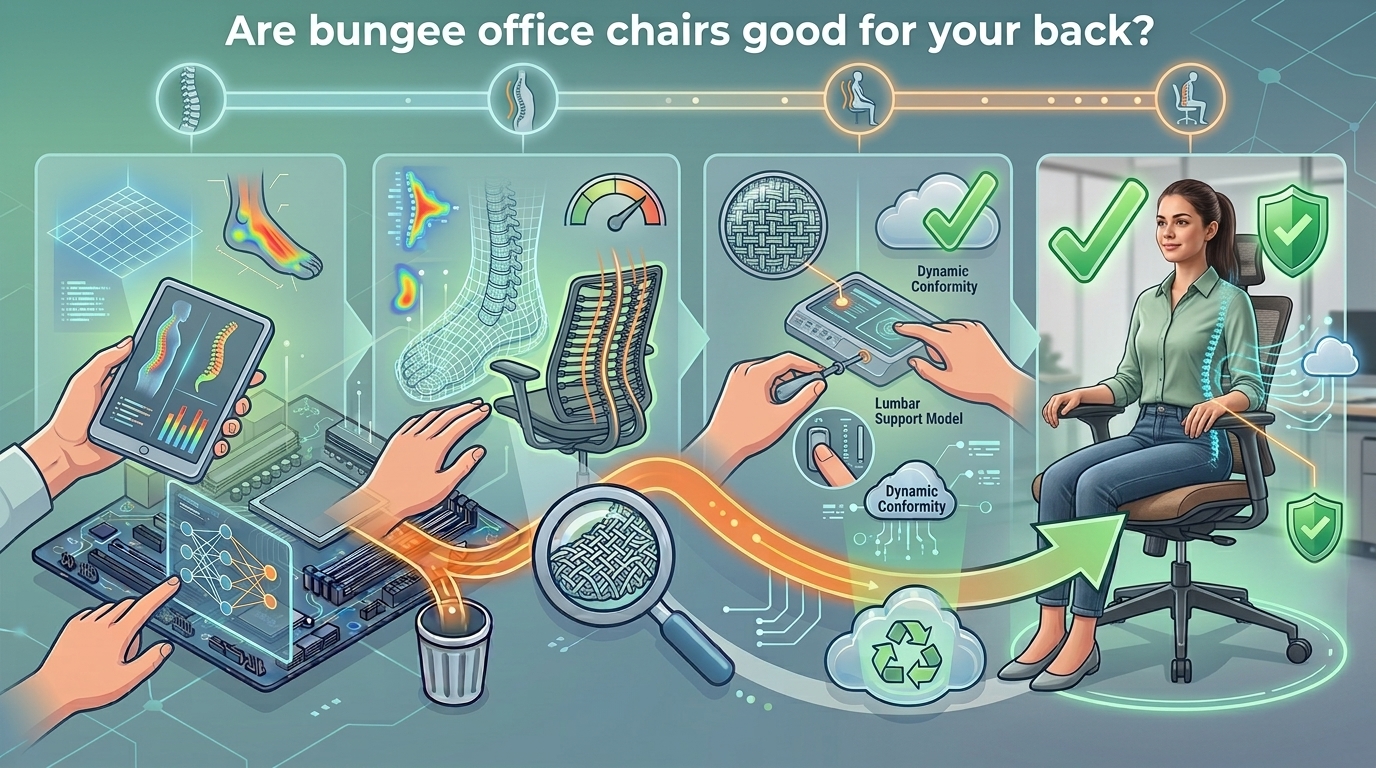
Are bungee office chairs good for your back? If you are setting up a modern workspace in tech hubs like San Francisco or working long hours in a high-rise apartment in New York, you have likely stumbled upon a quirky, modern seating trend: the bungee office chair.
With cross-woven elastic cords replacing traditional foam padding and mesh panels, these chairs look futuristic, minimalist, and exceptionally breathable. But as professionals across Texas, California, and Washington increasingly trade conventional task chairs for aesthetic alternatives, a critical question arises: Are bungee office chairs actually good for your back?
In this comprehensive, data-driven review tailored for itemguides.com, we will explore the biomechanics of bungee seating, analyze top-rated models on the market, weigh the pros and cons, and help you decide whether an elastic cord chair can support your spinal health or if it will leave you aching by afternoon.
1. What Exactly Is a Bungee Office Chair?
A bungee office chair uses a grid, web, or parallel rows of heavy-duty, latex-core bungee cords stretched firmly across a steel or heavy-duty plastic frame instead of a solid foam cushion.
Originally popularized by casual lounge furniture and dorm rooms, scaled-up versions have entered the commercial and home office market. They promise a dynamic “spring-cushion” effect that hugs your body contours, delivers unmatched airflow, and keeps you cool during grueling work sessions.
2. The Science of Seating: How Bungee Chairs Interact with Your Spine
To understand how a bungee chair impacts your back, we must look at how the human spine functions under load. When sitting for 6 to 8 hours a day—common for knowledge workers in Seattle, Austin, or San Francisco—your lower back (lumbar region) requires consistent, targeted support to maintain its natural inward “S” curve.
The Dynamic Tension Factor
Unlike rigid mesh or foam that pushes back with uniform resistance, bungee cords create a hammock effect. When you sit down:
- The Good: The cords stretch independently, conforming precisely to your unique weight distribution, relieving pressure points on your sit bones (ischial tuberosities), and encouraging micro-movements.
- The Bad: Because the cords stretch under pressure, they lack the firm, structural rigidity necessary to push your lumbar spine forward. Over extended periods, this can cause your pelvis to tilt backward (posterior pelvic tilt), flattening your lower spine and straining your spinal ligaments.
3. Top-Rated Bungee Office Chairs Reviewed – Are bungee office chairs good for your back
We evaluated leading bungee office chairs available on the market based on build quality, support, ergonomic adjustments, and user feedback.
1. The Container Store Office Bungee Chair
- Best For: Casual home offices and aesthetic minimalism.
- Support Style: Multi-row horizontal bungee cords.
- Ergonomic Score: 6.5 / 10
- Review: This is the gold standard of bungee desk chairs. It features a sturdy chrome or black steel frame and thick, resilient cords. It provides wonderful airflow—making it a hit during hot summers in Texas. However, it lacks dedicated lumbar adjustments, meaning users with pre-existing back issues will need an external lumbar pillow.
2. Zenithen Bungee Dish/Office Chair
- Best For: Compact spaces, creative studios, and budget shoppers.
- Support Style: Spiral or radial web pattern.
- Ergonomic Score: 5.5 / 10
- Review: Highly portable and visually striking, the Zenithen offers a bouncy, cradling feel. While comfortable for short bursts of creative writing or browsing, the lack of armrests and height adjustability on certain variants makes it unsuited for full-time professional coding or spreadsheet crunching.
3. Eurotech / Custom Ergonomic Bungee Hybrids
- Best For: Hybrid workers needing active seating.
- Support Style: Hybrid mesh-bungee lumbar bands.
- Ergonomic Score: 7.5 / 10
- Review: These hybrid models blend a traditional ergonomic frame with elastic suspension lumbar panels. They offer the best of both worlds: rigid spinal alignment combined with the shock-absorbing comfort of elastic tension.
4. Comparison Table: Bungee Chairs vs. Traditional Ergonomic & Mesh Chairs
| Feature | Bungee Office Chair | Traditional Mesh Ergonomic Chair | Executive Leather Chair |
| Lumbar Support | Low to Moderate (Passive/Flex) | High (Active, Adjustable) | Moderate (Thick, Unadjustable) |
| Breathability | Exceptional (Maximum airflow) | High | Low (Traps heat) |
| Adjustability | Minimal (Mostly height-only) | High (Armrests, tilt, depth, height) | Moderate |
| Best For Use | Casual use (2–3 hours/day) | Heavy use (8+ hours/day) | Executive boardrooms / lounging |
| Spinal Health Impact | Can cause slouching over time | Corrects posture & prevents pain | Encourages slouching if unpadded |
5. Pros and Cons of Bungee Office Chairs
The Pros:
- Unbeatable Ventilation: If your workspace lacks robust air conditioning during scorching summers in Dallas or Houston, the open cord matrix guarantees zero sweat build-up.
- Pressure Relief: The elastic flex distributes weight evenly across your glutes, avoiding the “dead-butt syndrome” common on hard seat pans.
- Lightweight and Portable: Easy to move, fold, or reconfigure in dynamic modern home offices.
The Cons:
- Lack of Spinal Rigidity: Over prolonged hours, the elasticity wears down, causing the center to sag and pulling your spine into a C-shape.
- Minimal Adjustability: Most bungee chairs lack adjustable armrests, seat depth controls, or dynamic tilt-locks.
- Cord Wear and Tear: Over months or years, bungee cords can lose their elasticity or snap under heavy localized loads.
6. Expert Tips: How to Make a Bungee Chair Back-Friendly
If you are committed to using a bungee office chair because of its aesthetic or sensory feel, you can protect your back by following these professional guidelines:
- Add a Contoured Lumbar Roll: Strap a memory foam lumbar cushion to the backrest to provide the rigid lower-back support the bungee cords lack.
- Follow the 20-20-20 Rule of Movement: Because elastic chairs encourage static slouching if you sit too long, stand up, stretch, or walk for 5 minutes every hour.
- Check Your Desk-to-Seat Ratio: Ensure your feet rest flat on the floor and your elbows form a 90-degree angle to prevent compensatory slouching.
- Monitor Weight Limits: Always verify the manufacturer’s weight capacity (usually between 200 to 250 lbs) to prevent premature stretching or snapping of the cords.
7. Frequently Asked Questions (FAQs)
1. Are bungee office chairs approved by chiropractors?
Most chiropractors do not recommend bungee office chairs for full-time professional work (8+ hours) because they lack active lumbar support and can promote posterior pelvic tilt. However, they are generally accepted for light, casual use.
2. Do bungee cords sag over time?
Yes. Lower-quality bungee cords lose their memory and elasticity after 12 to 18 months of heavy daily use, resulting in a sunken center that harms posture.
3. Can I use a bungee chair if I already have chronic back pain?
No. If you suffer from chronic lower back pain, sciatica, or herniated discs, you should opt for a certified ergonomic chair with adjustable lumbar systems rather than a flexible bungee system.
4. Are bungee chairs good for hot climates like Texas?
Yes! One of the standout advantages of bungee chairs is superior thermal comfort. The vast gaps between cords allow body heat to dissipate instantly, outperforming leather and thick fabric cushions in hot environments.
5. Do bungee office chairs come with armrests?
Most standard models are armless to maximize portability and compact storage. If you rely on armrests to relieve shoulder strain, look for specialized hybrid models.
6. How much weight can a typical office bungee chair hold?
Most standard models support between 200 and 250 pounds. Heavy-duty commercial variants may support up to 300 pounds, but you must check specifications carefully.
7. Can I replace the bungee cords myself if they break?
While some DIY enthusiasts attempt to re-string their chairs with marine-grade bungee cord, it is generally difficult to replicate factory tension safely, and it may void warranties.
8. Are bungee chairs good for gaming?
For casual mobile gaming, yes. For competitive or long-session PC gaming where precision posture is required, traditional ergonomic gaming chairs or mesh task chairs are far safer.
9. Do bungee chairs help with posture correction?
No. In fact, because they yield to pressure, they require your core muscles to work harder to stay upright, which often leads to slouching as fatigue sets in.
10. Where is the best place to buy a reliable bungee office chair?
Reputable home goods retailers like The Container Store, specialized office furnishers, and verified online storefronts offer the best selection with clear return policies.
8. Conclusion
So, are bungee office chairs good for your back? The short answer is: Only for casual, short-term use.
If you are a professional working long hours in New York, San Francisco, Los Angeles, Seattle, or Austin, your spine demands active, rigid lumbar support and comprehensive adjustability that elastic cords simply cannot provide over an 8-hour workday. However, if you need a stylish, ultra-breathable, secondary chair for light tasks, reading, or casual home-office setups, a bungee chair offers unique comfort—provided you supplement it with a proper lumbar pillow and take frequent stretching breaks.