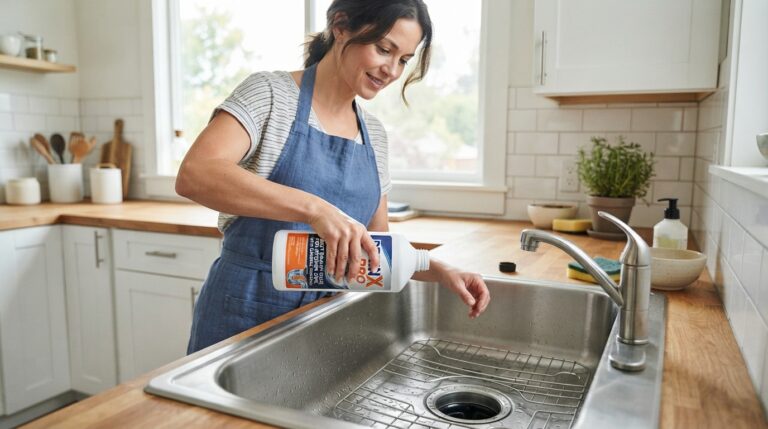
The short answer is: Yes, you can apply a penetrating sealer with a paint roller, but it is generally not the recommended primary application method.
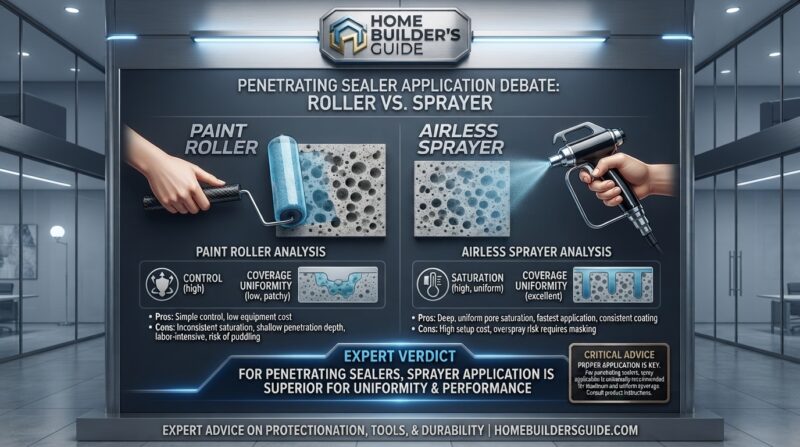
A low-pressure pump sprayer is almost always superior for applying penetrating sealers (such as silanes, siloxanes, siliconates, or silicates). Sprayers distribute liquid evenly and quickly, flooding concrete capillaries without leaving roller marks, foam, or uneven chemical coverage.
However, if you do not own a sprayer or are working in tight, windy, or sensitive areas—such as near delicate landscaping or parked cars—a roller can be used successfully if you follow specific high-volume flooding techniques and immediately avoid over-rolling.
Sprayer vs. Paint Roller: Quick Comparison
To help you decide which method fits your DIY or professional project, here is a breakdown of how the two tools compare when applying penetrating concrete sealers:
| Performance Metric | Low-Pressure Pump Sprayer | Paint Roller (Short/Medium Nap) |
| Application Speed | ⚡ Extremely Fast (1,000+ sq ft/hr) | 🐢 Moderate to Slow (300-500 sq ft/hr) |
| Penetration Depth | Maximum (Drenches pores uniformly) | Variable (Depends on pressure applied) |
| Risk of Surface Foaming | Very Low | Moderate to High (Rolling agitation traps air) |
| Over-Spray Risk | High (Requires masking on windy days) | Zero (Ideal near gardens and glass) |
| Equipment Cleanup | Easy (Flush pump/hose with water or solvent) | Medium (Roller covers usually disposed of) |
| Ideal Project Size | Large driveways, long walkways, patios | Edges, borders, small stoops, tight spaces |
| Overall Recommended Rating | ⭐⭐⭐⭐⭐ (Primary Method) | ⭐⭐⭐ (Secondary / Finishing Tool) |
The Science: Why Application Method Matters for Penetrating Sealers
Unlike topical acrylic or epoxy sealers that form a thick plastic film on top of the concrete, penetrating sealers function via chemical absorption.
                    [ CONCRETE CROSS-SECTION ]

   SPRAYER APPLICATION                    ROLLER APPLICATION
 (Deep Flood / High Absorption)        (Thinner Pass / Compression)
  ~~~~~~~~~~~~~~~~~~~~~~~~~             ~~~~~~~~~~~~~~~~~~~~~~~~~
  | Liquid floods surface |             | Roller presses liquid |
  | Absorbs 1/8" to 1/4"  |             | Absorbs 1/16" to 1/8" |
  | inside capillaries    |             | Risk of surface foam  |
  -------------------------             -------------------------
- Flood Requirements: Active silane and siloxane molecules need to be applied liberally in a wet film so they can sink deep into concrete capillaries (up to 1/4 inch deep) before the carrier liquid (water or solvent) evaporates.
- The Sprayer Advantage: Sprayers apply a continuous wet flood coat that saturates pores naturally without physical friction.
- The Roller Challenge: Paint rollers are designed to lay down thin, controlled coats of paint or film-forming sealers. When rolling a watery penetrating sealer, the roller sleeve can squeeze liquid out too thinly or whip air into water-based emulsions, causing temporary white foaming on the surface.
When Using a Roller Is Actually the Better Choice
While sprayers are the gold standard for open driveways, there are specific scenarios where using a roller—or combining a sprayer with a roller—is the smarter choice:
1. High-Wind Days
If you are sealing a driveway in coastal regions like San Francisco or open wind-swept areas in Texas, sprayers can create fine mists that drift onto neighbors’ cars, glass windows, or house siding. Silane/siloxane sealers can permanently etch glass if left to dry. A roller eliminates wind drift completely.
2. Edging & Border Protection
When working around delicate flower beds, brick facades, or painted trim, spraying requires extensive masking with plastic sheet rolls. Using a roller around the perimeter gives you pinpoint control over sealer placement.
3. Back-Rolling Puddles (The Hybrid Method)
The most professional technique combines both tools: spray the sealer liberally across the slab using a pump sprayer, then immediately follow behind with a dry 3/8-inch nap roller to push excess liquid into low spots and eliminate puddling.
Regional Environmental Factors: TX, NY, CA, WA & San Francisco
Climatic conditions in your region directly affect how fast penetrating sealers dry and how you should handle roller application:
1. California & San Francisco (VOC Regulations & Fog)
- Challenge: California (SCAQMD and Bay Area air districts) enforces strict low-VOC rules (<50 g/L). Most approved penetrating sealers are water-based micro-emulsions.
- Roller Tip: Water-based formulas foam easily when rolled aggressively. Use a heavy 3/8″ to 1/2″ nap roller and roll slowly in smooth, continuous lines to prevent air entrapment.
2. Texas (High Temperatures & Rapid Evaporation)
- Challenge: High heat causes the liquid carrier to flash off quickly before the active silane solids penetrate deep into the pores.
- Roller Tip: Avoid rolling under direct midday Texas sun. Roll early in the morning when ambient and surface concrete temperatures are between 50°F and 80°F. Load the roller heavily so the concrete stays wet for 3–5 minutes.
3. New York & Freeze-Thaw States
- Challenge: Heavy deicing salt usage and severe winter freeze-thaw cycles require maximum chemical penetration depth to prevent spalling.
- Roller Tip: Because rollers can coat thinly, apply two wet-on-wet passes with the roller within 15 minutes to guarantee adequate chemical loading into concrete pores.
4. Washington State (Pacific Northwest Humidity)
- Challenge: High dampness delays drying times and can trap moisture inside concrete pores.
- Roller Tip: Ensure the concrete is 100% dry (no rain for 24–48 hours) before rolling. Trapped moisture will prevent the rolled sealer from absorbing.
Step-by-Step Guide: How to Successfully Apply Penetrating Sealer with a Roller
If you choose to use a paint roller for your penetrating sealer project, follow this exact procedure to avoid surface foaming and uneven coverage:
1.Choose the Right Roller Cover:Equipment Selection.
Select a 3/8-inch or 1/2-inch nap lint-free microfiber or woven roller cover. Do not use cheap foam rollers, as they create excessive air bubbles and foam when rolling penetrating liquids.
2.Deep Clean & Dry Concrete:Preparation.
Pressure wash the surface (2500–3000 PSI) with a concrete degreaser. Allow the slab to dry completely for at least 24 to 48 hours.
3.Saturate the Roller Sleeve:Loading the Roller.
Pour penetrating sealer into a deep roller tray. Dip the roller and saturate it completely—do not wring it out completely dry on the tray grid. The goal is to transfer a heavy flood coat to the slab.
4.Roll in Parallel, Overlapping Sections:Application.
Roll smoothly in one direction across a 4×4 foot grid. Apply generous pressure to release liquid into the pores. Immediately cross-roll at a 90-degree angle while the surface is wet.
5.Apply Second Coat Within 15 Minutes:Wet-on-Wet Second Pass.
Apply your second coat while the first pass is still wet (“wet-on-wet”). Once the first coat fully dries, the concrete will repel any subsequent roller passes, causing liquid to puddle on top.
6.Back-Roll Low Areas:Puddle Elimination.
Inspect low spots in the driveway or patio. Roll out liquid puddles using a dry roller sleeve within 10 minutes to prevent dried white residue.
Pro Tips & Mistakes to Avoid When Rolling Penetrating Sealers
- Never Use a Foam Roller: Foam sleeves churn watery penetrating sealers into a frothy lather. This air entrapment leaves micro-gaps in the protective barrier once dried.
- Do Not Over-Roll: Pass over each section 2 to 3 times to distribute liquid, then move on. Continuous rolling over drying sealer creates friction, causing water-based emulsions to turn milky white on top of the slab.
- Beware of Dry Rolling: Keep the roller sleeve loaded with sealer at all times. A dry roller sleeve absorbs liquid back out of the concrete pores instead of depositing it.
10 Frequently Asked Questions (FAQs)
1. Will rolling a penetrating sealer leave visible roller marks or lines?
Unlike glossy acrylic paint or topical sealers, penetrating sealers absorb internally into concrete pores without leaving a thick surface film. As long as you roll evenly and do not leave heavy puddles, penetrating sealers dry to a invisible natural matte finish without visible roller lines.
2. What roller nap size is best for penetrating concrete sealer?
A 3/8-inch nap is ideal for smooth broom-finished driveways and walkways. A 1/2-inch to 3/4-inch nap works best for rough, textured, or stamped concrete surfaces to push liquid into deep depressions.
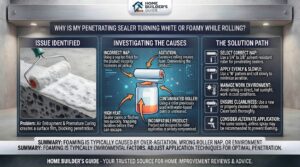
3. Why is my penetrating sealer turning white or foamy while rolling?
Foaming occurs when rolling agitates water-based silane/siloxane emulsions, trapping air in the liquid. If this happens, slow down your rolling stroke, use a high-quality woven roller cover, and back-roll gently to smooth out air bubbles before they dry.
4. Can I re-roll over a penetrating sealer after it has dried?
No. Once a penetrating sealer dries and cures (usually within 1 to 2 hours), it becomes water-repellent. If you attempt to roll another coat hours later, the new sealer will be repelled by the cured coat and pool on top as a white residue.
5. Is a sprayer faster than a roller for driveway sealing?
Yes, significantly. A pump sprayer can cover a standard 2-car driveway in about 20 to 30 minutes, whereas applying a penetrating flood coat with a roller will take 1 to 2 hours.
6. Do I need to wear a respirator when rolling penetrating sealers?
For water-based penetrating sealers used outdoors, a standard dust mask or light ventilation is sufficient. For solvent-based sealers (containing Xylene or Acetone), an organic vapor respirator mask is mandatory, even when rolling outdoors.
7. What type of sprayer should I buy if I decide not to use a roller?
Use a standard low-pressure pump sprayer (15 to 45 PSI) equipped with chemical-resistant Viton seals. High-pressure airless paint sprayers atomize penetrating sealers too finely, wasting material through drift.
8. Can I clean and reuse my roller cover after applying penetrating sealer?
For water-based sealers, you can clean roller sleeves immediately with warm soap and water. For solvent-based sealers, cleaning requires Xylene or mineral spirits; it is usually more practical to dispose of used roller covers.
9. How long after rolling can I drive on my driveway?
Most penetrating sealers allow foot traffic within 4 to 6 hours and heavy passenger vehicle traffic after 24 to 48 hours of curing time.
10. Can I use a paint brush instead of a roller for edges?
Yes. A 3-inch or 4-inch wide synthetic bristle brush works exceptionally well for cut-ins, step edges, and corners near walls where rollers cannot reach cleanly.
Conclusion
While a low-pressure pump sprayer remains the fastest and most efficient tool for applying penetrating concrete sealers, using a paint roller is a completely valid and practical alternative. By selecting a quality 3/8-inch or 1/2-inch nap woven sleeve, rolling gently to prevent surface foaming, and applying a heavy wet-on-wet flood coat, home and commercial property owners can achieve professional-grade water repellency and freeze-thaw protection on driveways, patios, and walkways.