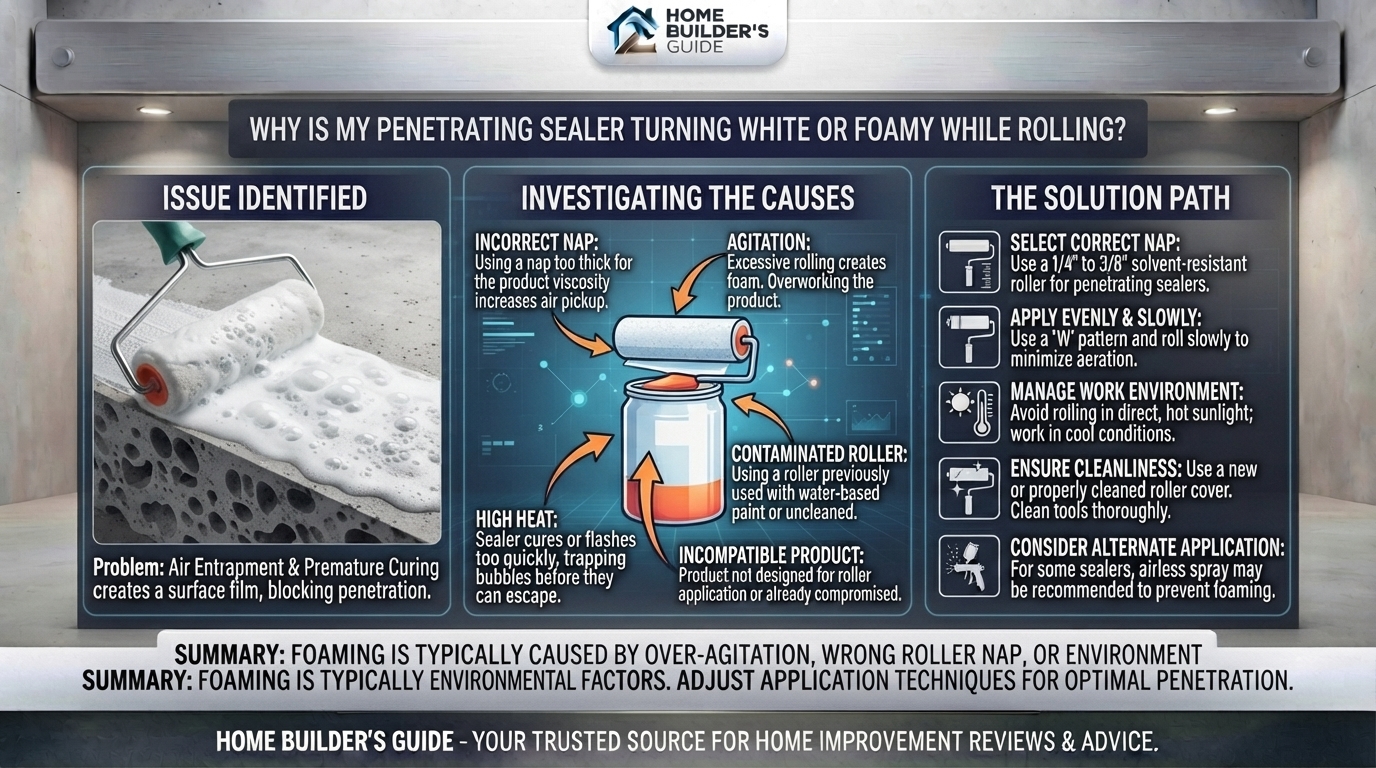
If you are currently in the middle of a concrete sealing project and notice your penetrating sealer whipping into a thick white foam or leaving cloudy streaks as you pass your paint roller over the slab, don’t panic. This is a very common issue during DIY and professional concrete sealing applications.
In most cases, turning white or foamy while rolling is a mechanical or chemical reaction caused by air entrapment, over-rolling, moisture conflict, or applying the product over a non-porous surface.
Understanding why this happens—and how to fix it immediately before it cures—will save your driveway, patio, or walkway from permanent cloudiness or failure.
Quick Diagnostic: Why Is Your Sealer Foaming or Turning White?
Before taking corrective action, use this quick comparison table to identify the exact cause of your sealer issue:
| Visual Symptom | Primary Cause | Severity | Corrective Action |
|—|—|—|
| White Frothy Lather / Air Bubbles | Rapid rolling agitation or wrong roller sleeve (foam sleeve) | Low (Fixable while wet) | Slow down rolling, switch to a 3/8″ woven microfiber sleeve, gently back-roll. |
| Milky White Film That Won’t Soak In | Concrete pores are blocked (Old acrylic sealer or un-etched dense slab) | High (Requires stripping) | Stop rolling immediately; wipe off unabsorbed liquid before it cures into a crust. |
| Cloudy White Haze Forming After 10–20 Min | Moisture conflict (Trapped substrate water or rain exposure) | Moderate to High | Allow full evaporation; apply solvent wash (Xylene) if solvent-based, or mild stripper if water-based. |
| Flaky White Powder After Drying | Over-application / Liquid left puddling in low spots | Moderate | Scrub surface with a stiff bristle brush and hot water degreaser or solvent. |
The Root Causes: Why Penetrating Sealers React to Rolling
Penetrating sealers (silanes, siloxanes, siliconates, and silicates) are fundamentally different from traditional paints or topical acrylic clear coats. They are designed to sink deep into concrete capillaries, not build a surface film.
When you introduce a paint roller to this chemistry, four main issues cause white foaming or cloudiness:
               [ AGITATION & MOISTURE CONFLICT ]

    FAST ROLLER STROKE                  TRAPPED SUBSTRATE MOISTURE
  (Whips Air into Emulsion)             (Water Pushes Out Sealer)
   ~~~~~~~~~~~~~~~~~~~~~~~               ~~~~~~~~~~~~~~~~~~~~~~~~~
   | Air Bubbles Trapped |               | Moisture rising up    |
   | Forms White Lather  |               | Prevents absorption   |
   | Dries as Cloudy     |               | Turns milky/blushed   |
   -----------------------               -------------------------
1. Mechanical Agitation & Air Entrapment
Water-based penetrating sealers are chemical micro-emulsions (active silane/siloxane solids suspended in water using surfactants). When you push a roller back and forth quickly across a rough concrete surface, the sleeve acts like a whisk, trapping air inside the emulsion. This creates a fine white foam on top of the concrete.
2. Over-Rolling During Initial Tack
As the carrier liquid begins to absorb into the concrete or evaporate into the air, the sealer enters its initial tacking phase. If you continue rolling back and forth over sealer that has already begun to absorb, the friction tears the forming chemical bond, turning the liquid milky white.
3. Blocked Concrete Capillaries (Unabsorbed Product)
A penetrating sealer must soak into bare concrete. If your concrete was previously sealed with an intact acrylic sealer, or if the slab is tight steel-troweled concrete whose pores were never opened, the sealer has nowhere to go. The liquid sits on top of the non-porous surface, dries out, and turns into an unsightly white powder or skin.
4. Hydrophobic Reaction with Substrate Moisture
Solvent-based penetrating sealers and moisture do not mix. If you roll a solvent sealer onto damp concrete, the solvent repels the trapped pore water. This conflict creates a cloudy white haze known as “blushing.”
Regional Environmental Pressures: TX, NY, CA, WA & San Francisco
Where you are sealing matters just as much as how you roll. Environmental factors play a major role in foaming and white blushing:
1. California & San Francisco Bay Area (Low-VOC Emulsions & Coastal Fog)
- The Factor: California (SCAQMD and Bay Area BAAQMD rules) mandates strict low-VOC water-based sealers (<50 g/L). These water-based micro-emulsions contain higher surfactant ratios, making them naturally more prone to foaming when agitated by a roller.
- Pro Tip: In foggy regions like San Francisco, high morning humidity slows evaporation, giving air bubbles more time to sit on the surface. Roll slowly using a 3/8-inch nap microfiber cover during mid-morning hours when ambient air is dry.
2. Texas (Extreme Heat & Rapid Surface Flash-Off)
- The Factor: High surface temperatures (above 85°F / 29°C) cause the water or solvent carrier to evaporate instantly before the active solids can penetrate the pores.
- Pro Tip: Rolling over hot Texas concrete causes the sealer to dry directly on the roller cover, creating white sticky strings and clumps. Always seal early in the morning when the concrete surface is cool to the touch.
3. New York & Freeze-Thaw States (High Pore Saturation)
- The Factor: Heavy rainfall during spring and autumn leaves significant moisture trapped deep within concrete slabs.
- Pro Tip: Concrete may feel dry on the surface, but internal dampness will force water vapor upward during application, turning solvent penetrating sealers white. Wait 48 hours after rain before applying sealers in NY.
4. Washington State (Pacific Northwest High Humidity)
- The Factor: Constant damp conditions delay curing times for water-based penetrating sealers.
- Pro Tip: Avoid rolling sealers late in the afternoon in WA, as nighttime dew can settle on uncured sealer and turn it white overnight.
Step-by-Step Fix: How to Stop and Repair White Foamy Sealer
If your sealer is foaming right now, follow these corrective steps immediately:
1.Stop Rolling Agitation:Immediate Action.
Cease back-and-forth rolling immediately. Pushing the roller over foaming sealer only introduces more air into the liquid emulsion.
2.Gently Back-Roll with a Loaded Sleeve:Air Bubble Removal.
Re-wet your roller sleeve with fresh liquid sealer. Slowly drag the loaded roller in one single direction across the foamy section with zero downward pressure. The liquid weight will collapse the foam bubbles.
3.Wipe Away Unabsorbed Liquid Puddles:Excess Removal.
If the white foam persists because the concrete is saturated and cannot absorb more liquid, mop up the excess using a clean, dry microfiber towel or a dry paint roller before it dries.
4.Re-Emulsify with Solvent or Stripper:Solvent Fix (If Dried White).
If a solvent-based sealer dried white, pour a small amount of Xylene over the affected area and scrub gently with a stiff brush to re-dissolve the film. For dried water-based sealer, scrub with a commercial concrete stripper or heavy degreaser.
Pro Tips for Preventing Sealer Foaming in the Future
- Ditch Foam Rollers Completely: Never use cheap high-density foam roller covers for penetrating sealers. Foam sleeves squeeze and release liquid rapidly, creating thousands of microscopic air bubbles with every turn.
- Use Low-Pressure Sprayers First: The absolute best way to avoid foaming is to spray the sealer onto the driveway using a pump sprayer (15–30 PSI), then use a dry roller only to push puddles around gently (back-rolling).
- Verify Pore Openness (Water Test): Before starting any sealing job, pour water on the slab. If the water beads up, your pores are closed—applying a penetrating sealer will result in white residue.
10 Frequently Asked Questions (FAQs)
1. Will the white foam disappear on its own as the sealer dries?
If the white foam is simply light air entrapment in a water-based sealer, it often collapses and clears up as the liquid soaks in and evaporates. However, if the white foam is caused by unabsorbed product drying on top of blocked pores, it will dry into a permanent white crust that must be scrubbed off.
2. Can I apply a second coat if the first coat turned white?
No. You must resolve and remove the white haze or unabsorbed residue before applying any additional sealer. Applying a second coat over white residue will trap the flaw underneath and worsen the problem.
3. What type of roller cover prevents penetrating sealer from foaming?
Use a 3/8-inch nap lint-free microfiber or woven roller sleeve. Microfiber lays down liquid smoothly without whipping air into water-based emulsions.
4. Why did my solvent-based penetrating sealer turn white hours after applying?
This is almost always caused by trapped substrate moisture (“blushing”). Water rising from beneath the slab clashed with the curing solvent sealer. You can usually fix this by scrubbing the surface with pure Xylene to re-open the formula and allow moisture to escape.
5. Does white foam mean the sealer is ruined or defective?
Rarely. White foam is almost always an application error (over-rolling, wrong sleeve, or blocked pores) rather than a defective product manufacture.
6. Can I use a pressure washer to blast away dried white sealer residue?
Pressure washing (2500–3000 PSI) with a turbo nozzle can remove loose, flaking white residue, but high pressure alone may etch or damage soft concrete. Combining pressure washing with a chemical stripper or Xylene yields much safer results.
7. How long should I wait after rain before rolling a penetrating sealer?
Wait at least 24 to 48 hours of sunny, dry weather after heavy rain before applying a penetrating sealer, ensuring internal concrete capillaries are completely dry.
8. Why is my water-based silane sealer turning milky in the roller tray?
Water-based silane/siloxane sealers are naturally milky-white liquids inside the container. This milkiness is normal; the liquid dries completely clear once absorbed into open concrete.
9. Will a penetrating sealer turn white if applied in direct sunlight?
Yes. Direct sunlight and hot concrete cause rapid liquid flash-off. The carrier evaporates before the active silane molecules can soak inside, leaving white solids sitting dry on top of the driveway.
10. Can I mix Xylene into a water-based sealer to fix white spots?
No! Never mix organic solvents like Xylene or Acetone into a water-based sealer. It will cause the water-based emulsion to curdle instantly into a ruined, rubbery mess.
Conclusion
A penetrating sealer turning white or foamy while rolling is almost always a sign of excessive rolling friction, incorrect roller sleeve selection, blocked concrete pores, or trapped substrate moisture.
By switching to a 3/8-inch microfiber roller cover, rolling slowly in smooth passes, ensuring the concrete pores are open and dry, or using a low-pressure sprayer as your primary tool, you can prevent white foaming entirely and secure invisible, long-lasting surface protection for years to come.