When a deep cavity causes intense, throbbing tooth pain, finding immediate relief is often all you can think about. A common folk remedy suggests placing an aspirin tablet directly inside the cavity hole or resting it against adjacent gums to target the pain right at its source.
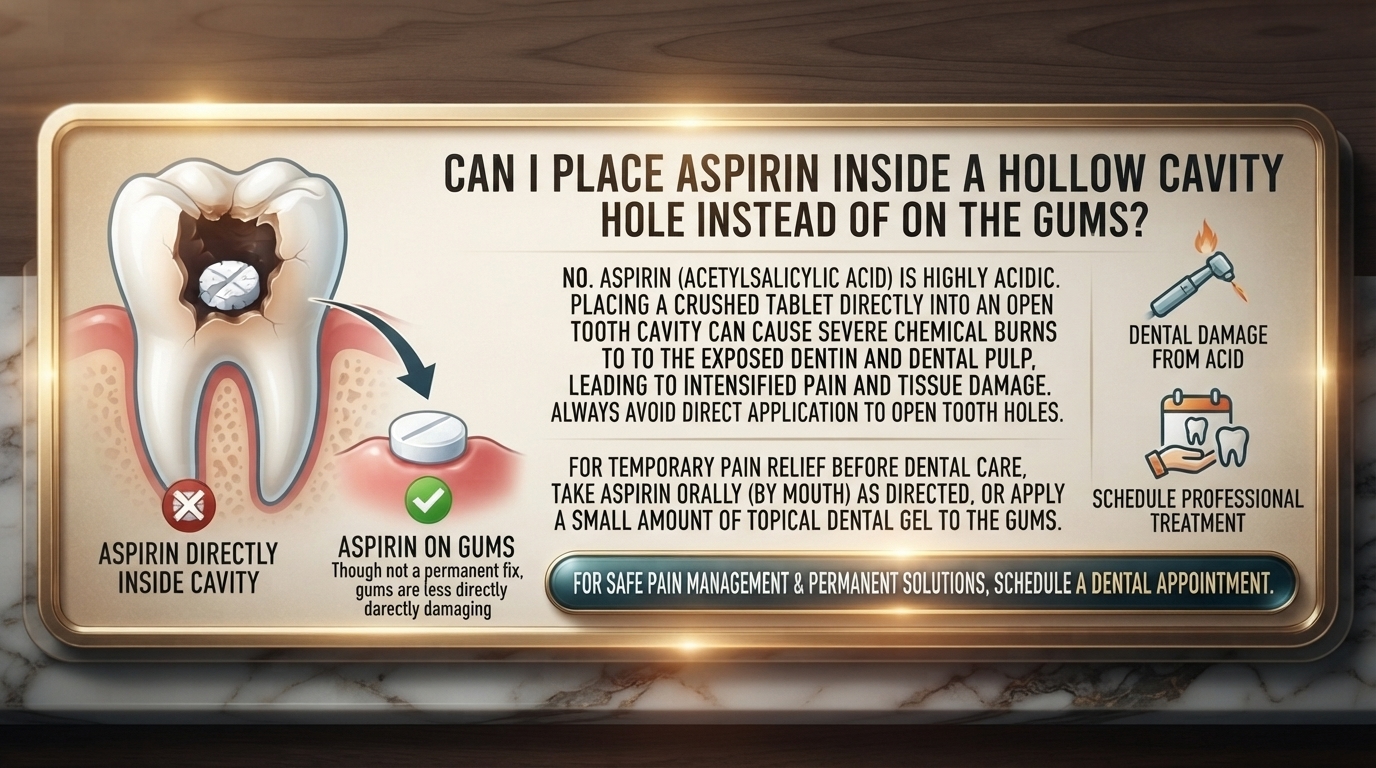
No, you should never place aspirin inside a hollow cavity hole or on your gums. Aspirin must always be swallowed whole with water.
Aspirin is acetylsalicylic acid. Placing a concentrated acid tablet directly against an open tooth cavity or oral tissue will not numb the nerve. Instead, it causes severe chemical mucosal burns (“aspirin burn”), dissolves surrounding enamel and dentin, and chemically destroys delicate tooth pulp.
This guide breaks down the chemical dangers of topical aspirin, safe home relief protocols, regional environmental impacts across key US states, reviews of over-the-counter emergency dental kits, and a detailed 10-question emergency FAQ.
Medical Disclaimer: The information provided here is for educational purposes only. Always consult a licensed dentist or healthcare provider for diagnostic evaluation and safe emergency pain management.
1. The Chemistry of “Aspirin Burn”: Why Direct Contact Destroys Oral Tissue
To understand why placing aspirin inside a tooth cavity is dangerous, it helps to examine its chemical composition and how it interacts with human tissue.
1. Acidic Dissolution (Acetylsalicylic Acid)
Aspirin is chemically known as acetylsalicylic acid (C9H8O4). When an aspirin tablet dissolves inside a moist cavity hole, it breaks down into concentrated salicylic acid and acetic acid with a highly acidic pH level between 2.0 and 3.0.
[Aspirin Tablet + Saliva/Moisture] ──► [Concentrated Salicylic Acid (pH 2.0-3.0)]
                                                  │
       ┌──────────────────────────────────────────┴──────────────────────────────────────────┐
       ▼                                                                                     ▼
[Hard Tissue Impact]                                                                 [Soft Tissue Impact]
• Demineralizes Tooth Enamel                                                         • Coagulation Necrosis of Mucosa
• Erodes Exposed Dentin Tubules                                                      • White Sloughing & Chemical Lesions
• Acid Distresses Exposed Pulp Nerve                                                 • Secondary Painful Ulcerations
2. Destruction of Soft Tissue Mucosa (Coagulation Necrosis)
When acetylsalicylic acid contacts the soft oral mucosa or gingival tissue, it causes coagulation necrosis—a process where low pH denatures cellular proteins, killing the top tissue layers. Within minutes, a thick, painful, white sloughing lesion forms over the area. This “aspirin burn” creates an additional chemical wound that takes up to 14 days to heal.
White mucosal sloughing caused by chemical burn from direct aspirin contact. Source: Semantic Scholar
3. Destruction of Hard Tooth Structure & Nerve Irritation
Human enamel begins demineralizing at a pH of 5.5. Placing a pH 2.0 acid tablet directly inside a cavity void rapidly dissolves surrounding dentin walls. Rather than soothing the tooth nerve, the harsh acid penetrates deeper toward the pulp, triggering severe chemical pulpitis.
4. Why Aspirin Only Works Systemically
Aspirin has no topical anesthetic properties. It relieves pain only after being swallowed, absorbed through the gastrointestinal tract, and carried through the bloodstream to inhibit cyclooxygenase (COX-1 and COX-2) enzymes systemically.
2. Topical Placement vs. Systemic Ingestion Matrix
Understanding how direct contact compares to swallowing aspirin highlights why topical application causes harm without delivering relief:
| Attribute / Impact Area | Direct Placement Inside Cavity / Gums | Proper Systemic Ingestion (Swallowed) |
|---|---|---|
| Mechanism of Action | Localized chemical acid erosion | Systemic COX enzyme inhibition via bloodstream |
| Pain Relief Outcome | Zero direct pain relief (increases pain) | Effective relief of mild-to-moderate inflammation |
| Impact on Soft Tissue | Severe chemical burns, white sloughing, tissue death | No direct tissue contact or mucosal damage |
| Impact on Enamel & Dentin | Acid demineralization and cavity expansion | No effect on tooth enamel or dentin structure |
| Impact on Pulp Nerve | Chemical irritation and accelerated inflammation | Reduces systemic inflammatory markers |
| Recovery / Healing Time | 7–14 days required to heal secondary chemical burn | N/A (normal systemic processing) |
3. Safe Emergency First-Aid Protocol for an Open Cavity
If you have an aching tooth with an open cavity hole, follow this safe emergency response protocol to manage discomfort until your dental visit:
Clear Trapped Food Debris
Step 1
1.Clear Trapped Food Debris:Step 1.
Gently floss around the affected tooth to remove trapped food particles that increase nerve pressure. Flush the area with a warm saltwater rinse (1/2 tsp salt in 8 oz warm water) to clean the cavity void.
Swallow Systemic OTC Pain Relievers
Step 2
2.Swallow Systemic OTC Pain Relievers:Step 2.
Swallow an over-the-counter pain reliever such as ibuprofen or acetaminophen with water according to package instructions. Never crush pills or place them inside the tooth.
Apply Topical Eugenol (Clove Oil) Correctly
Step 3
3.Apply Topical Eugenol (Clove Oil) Correctly:Step 3.
Saturate a tiny cotton pellet with 1–2 drops of eugenol (clove oil extract), squeeze out any excess liquid, and gently place the pellet inside the cavity void. Eugenol safely numbs exposed nerve endings.
Seal the Cavity Void with Temporary Material
Step 4
4.Seal the Cavity Void with Temporary Material:Step 4.
Place a small dab of over-the-counter temporary zinc oxide filling paste directly over the cavity to block air, cold liquids, and food debris from reaching exposed dentin tubules.
4. Regional Climate & Environmental Considerations: TX, CA, WA & NY
Environmental triggers, regional beverage habits, and local climate patterns across major US regions influence cavity development and thermal tooth sensitivity:
Texas & Desert Southwest
- Environmental Driver: Extreme summer temperatures (100∘F+) lead to high consumption of iced teas, sweet sodas, and sports drinks.
- Impact on Dental Health: Dehydration lowers salivary protection, accelerating enamel acid erosion. Chewing ice or drinking freezing liquids in hot weather creates micro-cracks in enamel, exposing underlying dentin and triggering sharp nerve pain.
California & San Francisco Bay Area
- Environmental Driver: High intake of acidic beverages (artisanal espresso, kombucha, cold-pressed juices) combined with cool coastal fog in San Francisco.
- Impact on Dental Health: Frequent exposure to acidic drinks strips outer enamel, exposing dentin tubules. When cold SF bay winds hit exposed dentin, it triggers sudden, sharp nerve shocks along the trigeminal nerve pathway.
Washington State & Pacific Northwest
- Environmental Driver: High dark-roast coffee consumption paired with cool, damp year-round weather.
- Impact on Dental Health: Alternating between hot coffee and cold outdoor air causes thermal stress in older dental fillings. Micro-gaps open around filling edges over time, allowing bacteria to enter underneath and cause quiet, deep decay.
New York & Northeast Urban Centers
- Environmental Driver: Fast-paced urban stress, late-night dining, and freezing winter weather.
- Impact on Dental Health: Stress frequently leads to nighttime teeth grinding (bruxism), which wears down biting surfaces and exposes inner dentin. When freezing NYC winter air hits bruxism-damaged teeth, severe throbbing pressure follows.
5. Over-the-Counter Dental Relief Products Review
Using properly formulated over-the-counter temporary dental products provides safer, cleaner, and far more effective pain management than DIY aspirin placement:
Temporary dental filling kits safely seal cavity voids to protect exposed nerves without chemical irritation. Source: Dentek
1. Dentemp Premium Temporary Tooth Filling Kit
- Active Ingredients: Zinc Oxide & Eugenol Paste
- Form: Pre-mixed temporary filling compound
- Overview: Designed specifically to temporarily repair lost fillings or seal open cavity voids. The zinc oxide paste forms a protective seal that isolates exposed dentin from air, hot/cold liquids, and food debris, while built-in eugenol soothes irritated nerve fibers.
- Pros: Seals out external triggers effectively; contains soothing eugenol; holds up until your dental appointment.
- Cons: Requires a clean, dry cavity void to adhere properly; temporary fix only.
2. Red Cross Toothache Complete Medication Kit
- Active Ingredient: Eugenol 85% (Clove Oil Extract)
- Form: Liquid drops with precision cotton pellets and tweezers
- Overview: A classic emergency kit for localized cavity pain. It utilizes pure eugenol liquid paired with tiny cotton pellets, allowing you to place targeted numbing relief directly inside a cavity void without spreading liquid across delicate gums.
- Pros: Fast local anesthetic effect within 3 minutes; includes precise application tools; targets open cavity voids safely.
- Cons: Strong herbal taste; will not treat deep bone infections or fever.
3. Orajel 4X Medicated For Toothache & Gum Cream
- Active Ingredient: Benzocaine 20% + Menthol 0.2%
- Form: Topical gel / cream
- Overview: A widely accessible topical anesthetic formulation. Maximum-strength benzocaine numbs soft gum tissue on contact, while menthol provides a soothing cooling effect that calms localized tissue irritation.
- Pros: Instant contact numbing on soft tissue; easy application; pleasant mint flavor.
- Cons: Short duration (30–45 minutes); less effective at penetrating closed enamel than liquid eugenol.
6. Frequently Asked Questions (FAQ)
Q1: What should I do if I already placed aspirin in my cavity or on my gums?
Rinse your mouth immediately with warm water or a mild baking soda solution (1/2 tsp baking soda in 8 oz water) to neutralize remaining acid. Remove any remaining tablet fragments gently. Do not scrub the burned tissue, and seek dental care to evaluate both the cavity and the chemical burn.
Q2: How long does an aspirin burn take to heal?
An oral aspirin burn typically takes 7 to 14 days to heal completely. The white sloughing tissue will slough off, leaving a sensitive raw area underneath. Avoid spicy, acidic, or crunchy foods while the mucosa recovers.
Q3: Why do some folk remedies recommend putting aspirin on a toothache?
This myth originated before the systemic pharmacokinetics of aspirin were fully understood. People assumed that placing a pain-relieving pill directly on the source of pain would work like a topical salve, unaware of acetylsalicylic acid’s corrosive effect on soft mucosa and hard enamel.
Q4: Can I crush aspirin and mix it with water to rinse my mouth?
No. Rinsing with crushed aspirin dissolved in water coats your entire mouth in an acidic solution, increasing the risk of widespread mucosal chemical burns, enamel erosion, and generalized oral irritation.
Q5: Is clove oil (eugenol) safe to put inside a cavity void?
Yes, when used correctly. Eugenol is a natural anesthetic used in professional dental materials. Place 1–2 drops on a tiny cotton pellet, squeeze out any excess liquid, and insert it gently into the cavity void. Avoid getting excess eugenol on surrounding soft gums.
Q6: Can placing aspirin in a cavity cause permanent tooth damage?
Yes. Concentrated acetylsalicylic acid dissolves outer enamel and dentin walls, rapidly enlarging the cavity void. If the acid reaches exposed pulp tissue, it can trigger acute chemical pulpitis, requiring root canal therapy or extraction.
Q7: What is the best swallowed pain reliever for a severe toothache?
Combining or alternating ibuprofen (an anti-inflammatory) and acetaminophen (a central analgesic) as directed on packaging is considered one of the most effective non-prescription strategies for severe dental pain.
Q8: Can a temporary filling kit cure my toothache permanently?
No. Temporary filling materials seal out external triggers to protect exposed nerves temporarily, but they do not eliminate decay-causing bacteria. You must see a dentist to remove decayed tissue and place a permanent restoration.
Q9: When is a toothache considered a medical emergency?
Seek emergency medical or dental care immediately if your toothache is accompanied by facial swelling, fever, difficulty swallowing or breathing, or swelling that reaches the eye socket or neck spaces.
Q10: What is the safest way to take aspirin for dental pain?
Swallow aspirin tablets whole with a full glass of water or milk after food. This allows the medication to be absorbed safely into your bloodstream without exposing delicate oral tissues to direct acid contact.
Conclusion
Placing an aspirin tablet directly inside a cavity hole or against your gums is a dangerous practice that causes severe chemical burns, dissolves tooth enamel, and worsens nerve irritation without relieving pain.
Remember these essential safety guidelines:
- Always swallow aspirin whole with water so it works systemically through your bloodstream.
- Use proper topical alternatives like eugenol (clove oil) pellets or over-the-counter temporary filling kits to protect exposed cavity voids safely.
- Schedule a professional dental visit promptly to clean out the decay, protect your tooth pulp, and receive a permanent restoration.