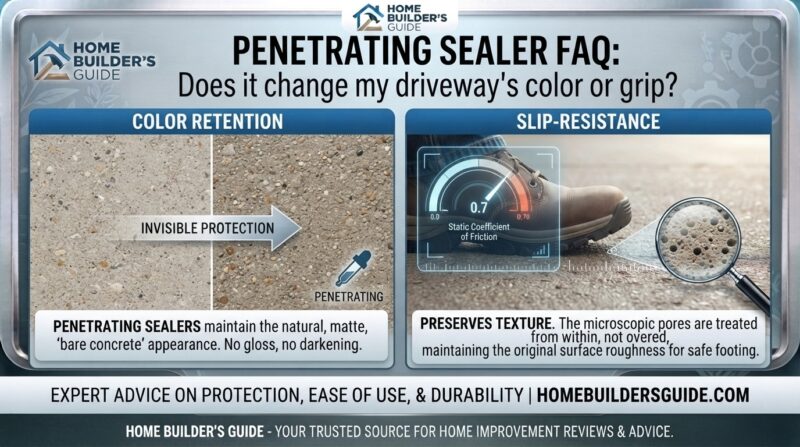
When investing in concrete driveway sealing, two concerns top the list for most homeowners: Will this change how my driveway looks? and Will it turn into an ice-skating rink when it rains?
The short answer is no. High-quality penetrating concrete sealers (such as silanes, siloxanes, and siliconates) do not alter the natural color, finish, or slip-resistance of your driveway.
Unlike topical coatings like acrylics, epoxies, or urethane enamels, penetrating sealers work beneath the concrete matrix rather than forming a film on top.
Direct Comparison: Penetrating Sealers vs. Topical Sealers
Understanding the fundamental difference between penetrating sealers and topical film-forming coatings explains why color and slip resistance remain unaffected.
PENETRATING SEALER (Silane/Siloxane)         TOPICAL FILM SEALER (Acrylic/Epoxy)
┌─────────────────────────────────┐        ┌─────────────────────────────────┐
│     Unaltered Natural Texture   │        │   Glossy Plastic Film Layer     │
├─────────────────────────────────┤        ├─────────────────────────────────┤
│  ████ Hydrophobic Chemical ████ │        │  Concrete Base (Pores Covered)  │
│  ████ Reaction Inside Pores ███ │        │                                 │
└─────────────────────────────────┘        └─────────────────────────────────┘
• 0% change in slip resistance             • Can become slick when wet
• 0% gloss or sheen change                 • Enhances color / creates gloss
• Zero peeling or flaking                  • Subject to wear, peeling, yellowing
| Performance Feature | Penetrating Sealer (Silane/Siloxane) | Topical Acrylic Sealer (Wet-Look/Gloss) |
| Surface Appearance | Natural, completely invisible matte | High gloss, satin, or enhanced “wet-look” |
| Color Impact | 0% Change (Preserves natural concrete color) | Slight to Significant Darkening (Enhances pigments) |
| Wet Slip Resistance | 100% Unchanged (Preserves existing COF*) | Decreased (Requires anti-slip additives) |
| Surface Film Layer | None (Absorbs into pores) | Yes (Creates a 1–3 mil topical plastic barrier) |
| Peeling / Yellowing Risk | 0% Risk (Cannot peel or yellow under UV) | Moderate to High (Requires re-stripping over time) |
| Breathability | 100% Vapor Permeable | Partial to Low Vapor Permeability |
| Expected Lifespan | 5 to 10 Years | 1 to 3 Years |
*COF = Coefficient of Friction
The Chemistry Behind Penetrating Sealers: How They Preserve Appearance
To understand why your driveway won’t change color or become slick, you have to look at what happens at the molecular level.
1. Absorption vs. Surface Coating
Penetrating sealers are composed of extremely small molecules—typically measured in nanometers. When sprayed onto clean concrete, these molecules sink 1/8 to 3/8 of an inch deep into the open capillaries and pores of the concrete slab.
2. The Hydrophobic Chemical Reaction
Once inside, the silane or siloxane reacts with the silica and free lime naturally present in the concrete matrix. This forms a permanent, cross-linked silicone resin lining inside the pore walls.
Because the sealer resides inside the pores rather than resting on top:
- The surface micro-texture of the concrete remains untouched.
- Light reflects off the surface in the exact same manner as unsealed concrete (preserving the exact color tone).
- Tire and foot traction are maintained at the concrete’s original physical safety level.
What About “Wet-Look” Penetrating Sealers?
While standard silanes and siloxanes leave zero visual trace, you may encounter products advertised as “Enhancing Penetrating Sealers” or “Wet-Look Penetrating Sealers.”
It is vital to distinguish between these product categories:
Standard Penetrating Sealers (Invisible / Natural)
- Active Ingredients: 100% Silane, Siloxane, or Silane-Siloxane Blends.
- Visual Effect: Invisible. Water beads up, but dry concrete looks identical to untreated concrete.
- Slip Impact: None.
Color-Enhancing Penetrating Sealers (Slight Darkening)
- Active Ingredients: Silane/Siloxane blended with specialized penetrating darkeners or micro-polymers.
- Visual Effect: Darkens the natural tone of the stone or concrete (similar to how concrete looks when sprayed with water), but leaves no surface gloss or shine.
- Slip Impact: None to extremely minor (does not create a smooth topical coating).
Buyer Tip: If you want zero color change, select a pure Silane/Siloxane micro-emulsion labeled “Natural Look” or “Invisible Protection.” Avoid any sealer labeled “Enriching,” “Enhancing,” or “Wet Look.”
Coefficient of Friction: Testing Slip-Resistance
Safety on driveways—especially on inclines or in rainy and icy climates—is governed by the Coefficient of Friction (COF).
COF Scale for Walkway Safety:
0.0 ─────────────── 0.5 ────────────────── 0.6+ ─────────────── 1.0
[ Dangerously Slick ] [ OSHA Minimum Standard ] [ Highly Slip-Resistant ]
                            ▲
                   Penetrating Sealers Maintain
                   Pre-Application COF (~0.65+)
- OSHA & ADA Safety Threshold: A Static COF of 0.50 or higher is required for flat walking surfaces; 0.60 or higher is recommended for ramps and driveways.
- Untreated Broom-Finished Concrete: Typically measures between 0.65 and 0.80 COF.
- Concrete with Penetrating Sealer: Measures identically to untreated concrete (0.65–0.80 COF) because the surface profile is unchanged.
- Concrete with High-Gloss Acrylic: Drops to 0.35–0.45 COF when wet, creating a slippery surface unless broadcast anti-slip grit (like aluminum oxide or polypropylene beads) is mixed into the wet sealer.
Rare Exceptions: When Color Change CAN Occur
While penetrating sealers do not inherently change concrete color, specific application errors can cause unintended visual issues:
1. Sealing Over Contaminants or Unwashed Concrete
If oil, dirt, efflorescence (white salt deposits), or mold are present on the driveway when the sealer is applied, the chemical reaction can lock those stains into the pore structure or cause localized discoloration.
2. Puddling and Over-Application
Penetrating sealers must fully absorb into the concrete. If excess sealer pools in low spots and is allowed to dry on the surface, it can leave behind a white, chalky residue or a faint haze.
- Solution: Always back-roll or wipe up excess sealer that has not absorbed after 10–15 minutes.
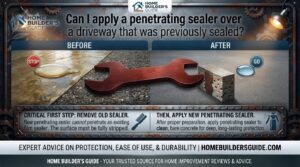
3. Applying Over Previously Sealed Surfaces
If your driveway was previously sealed with a film-forming acrylic sealer, a new penetrating sealer cannot soak into the pores. It will sit on top of the old acrylic coat, turning cloudy or patchy as it fails to absorb.
Regional Climate Factors Across Key US Markets
Different regions present unique challenges regarding driveway traction, moisture exposure, and visual maintenance:
🤠 Texas (Houston, Dallas-Fort Worth, Austin)
- Climate Impact: High summer temperatures and sudden torrential downpours.
- Color & Traction Considerations: Glossy topical coatings can soften or become slick under extreme Texas summer sun. A natural penetrating sealer (like a water-based silane-siloxane) keeps driveways completely non-slip during heavy rain while protecting against UV degradation.
🌉 California & San Francisco Bay Area
- Climate Impact: Coastal fog, salt air, and strict regional environmental regulations (CARB / BAAQMD VOC limits).
- Color & Traction Considerations: Homeowners in steep Bay Area neighborhoods require maximum driveway traction. Pure penetrating sealers preserve broom-finish traction without adding slickness, all while meeting California’s low-VOC air quality rules.
🗽 New York & Mid-Atlantic
- Climate Impact: Severe winter freeze-thaw cycles, snow accumulation, and heavy deicing salt exposure.
- Color & Traction Considerations: Deicing salts eat away at concrete surfaces, causing scaling and pop-outs. Penetrating sealers protect against salt damage beneath the surface without creating a slippery top coat under snow and black ice.
🌲 Washington State & Pacific Northwest (Seattle, Tacoma)
- Climate Impact: Persistent dampness, shade, moss, and algae growth.
- Color & Traction Considerations: Wet topical sealers combined with green algae create extreme fall hazards. Penetrating sealers prevent moisture absorption deep within the concrete—starving moss and algae of the water they need to grow—without making wet driveways slick.
DIY Tips for a Safe, Flawless Application
To guarantee your sealer preserves the natural color and slip resistance of your driveway, follow these four essential steps:
- Perform a Water Absorption Test: Pour a cup of water on your clean driveway. If it soaks in within 2–3 minutes and darkens the concrete, the pores are open and ready for a penetrating sealer. If it beads up, a previous sealer is still active.
- Pressure Wash Thoroughly: Remove all dirt, organic growth, and oil stains using a concrete degreaser and a 3,000 PSI pressure washer. Allow the slab to dry for a full 24 to 48 hours.
- Use a Low-Pressure Sprayer: Apply the penetrating sealer evenly using a garden sprayer with a fan tip. Apply two “wet-on-wet” coats (the second coat applied within 15 minutes of the first).
- Back-Roll Excess Product: Use a dry roller to redistribute any puddles or pooled liquid before it dries on the surface to avoid white residue spots.
10 Frequently Asked Questions (FAQs)
1. Will a penetrating sealer make my driveway look shiny or glossy?
No. Penetrating sealers do not form a film on top of the surface, so they add zero shine or gloss. The concrete will retain its natural, flat matte appearance.
2. Does a penetrating sealer darken concrete when it rains?
While water will bead on top of a sealed driveway rather than soaking in immediately, the underlying concrete may still appear slightly darker during prolonged rainfall as surface moisture sits on top. However, once the water evaporates, it returns to its exact original dry color.
3. Can I use a penetrating sealer on stamped or colored concrete?
Yes. Penetrating sealers work well on stamped or integrally colored concrete if you want to protect the slab from water damage without adding a shiny or slippery acrylic sheen. However, if you want to enhance or intensify the color pigments, an acrylic sealer or color-enhancing sealer is required.
4. How long does a penetrating sealer last on a concrete driveway?
A high-solids silane/siloxane penetrating sealer typically lasts 5 to 10 years before requiring re-application, significantly outlasting topical acrylic sealers (which last 1 to 3 years).
5. Why did my driveway turn white after applying a penetrating sealer?
A white or cloudy residue occurs when the sealer was over-applied or applied to wet concrete, causing excess product to dry on the surface rather than absorbing into the pores. This can usually be cleaned using a stiff brush and a mild acid or chemical solvent cleaner.
6. Will oil stains still show up on concrete treated with a penetrating sealer?
Standard silane/siloxane sealers primarily repel water and deicing salts. While they slow down oil penetration, oil can still leave a surface mark if left sitting. For maximum oil resistance, choose a penetrating sealer specifically infused with fluoropolymers.
7. Does a penetrating sealer protect against winter road salt?
Yes. Penetrating silane/siloxane sealers are considered the industry standard for road salt protection. They block chloride ions from penetrating the concrete matrix, preventing internal chemical breakdown and freeze-thaw spalling.
8. Is a penetrating sealer slippery for pets and children?
No. Because penetrating sealers do not alter the surface texture or micro-grooves of the concrete, traction remains 100% unchanged for foot traffic, pets, and vehicle tires.
9. Can I apply a wet-look acrylic sealer over a penetrating sealer later if I change my mind?
Generally, no. Because the penetrating sealer makes the concrete hydrophobic (water- and liquid-repellent), a subsequent topical acrylic coating will struggle to adhere properly and may peel or flake off.
10. How can I test if my penetrating sealer is still working years later?
Perform a simple water drop test. Splash a small amount of water onto various sections of your driveway. If the water forms tight droplets and sits on the surface, the sealer is active. If the concrete immediately darkens and absorbs the water, it is time to re-seal.
Conclusion: Total Protection Without Aesthetic Compromise
If you want to protect your concrete driveway from freeze-thaw damage, pitting, road salts, and water intrusion without changing its color or making it slippery, a penetrating silane/siloxane sealer is the ideal choice.
By soaking deep into the concrete’s pores rather than forming a surface film:
- Color and texture remain 100% natural.
- Traction and slip safety remain completely unaffected.
- Protection lasts up to 5–10 years without peeling or flaking.
For homeowners looking for invisible, long-lasting driveway defense, penetrating sealers offer the perfect balance of safety, durability, and natural aesthetic appeal.