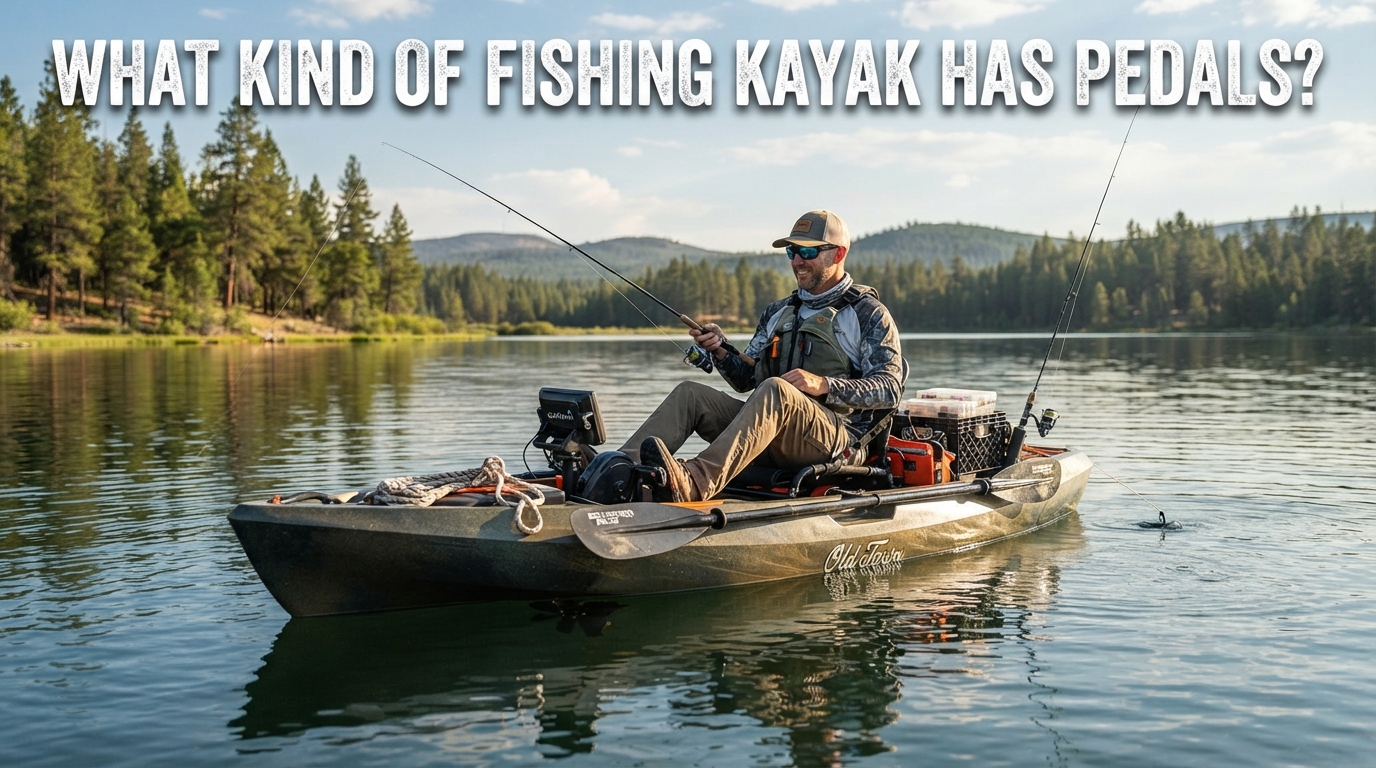
What kind of fishing kayak has pedals? For anglers upgrading from traditional paddling to a hands-free setup, one question rules the market: What kind of fishing kayak has pedals?
A pedal-drive fishing kayak is a specialized sit-on-top watercraft propelled by a mechanical lower-unit integrated directly into the hull. Instead of holding a paddle while trying to control a drift, fight a fish, or cast near structure, you use your legs—the strongest muscle group in your body—to power forward and reverse.
Whether you are targeting largemouth bass on the sprawling reservoir lakes of Texas, chasing striped bass in the choppy bays of New York, navigating the kelp beds and surf entries of California, tracking salmon in the chilly rivers of Washington, or sneaking up on bay fish around San Francisco, pedal kayaks have completely revolutionized modern angling.
Understanding Pedal Kayak Drive Systems
Not all pedal systems are built the same. Manufacturers generally divide pedal-drive fishing kayaks into two distinct mechanical categories: Propeller Drives and Fin Drives.
+------------------------+----------------------------------+----------------------------------+
| Feature / Metric       | Propeller-Drive Systems          | Fin-Drive (Flapping) Systems     |
+------------------------+----------------------------------+----------------------------------+
| Primary Mechanics      | Rotating prop (like a boat motor)| Scissor-like fluttering fins     |
| Reverse Operation      | Instant (just backpedal)         | Requires pull-cable shift or 360 |
| Shallow Water Handling | Vulnerable to striking bottom    | Fins automatically flatten/kick  |
| Efficiency             | Incredible torque and acceleration| Highly efficient glide speed     |
+------------------------+----------------------------------+----------------------------------+
1. Propeller-Drive Systems (e.g., Old Town PDL, Native Propel)
Propeller systems function much like an outboard motor scaled down for human power. When you pedal forward, a underwater prop spins to push water backward.
- The Pros: Instant reverse by simply pedaling backward; exceptional torque against strong winds and tides; highly intuitive for anyone who has ever ridden a bicycle.
- The Cons: They have a deeper draft. If you cross shallow flats or oyster beds, you run the risk of striking the prop if you don’t lift the drive.
2. Fin-Drive Systems (e.g., Hobie MirageDrive)
Fin systems use alternating pedals that push two underwater fins back and forth, mimicking the motion of a penguin’s flippers or a fish’s tail.
- The Pros: Incredible gliding efficiency; “kick-up” fins automatically fold flat against the hull when they hit an underwater obstacle, making them supreme for shallow water navigation.
- The Cons: Traditional fin drives require a hand-shift lever to transition into reverse (though modern high-end versions feature 360-degree vector control).
Detailed Product Reviews: The Best Pedal Fishing Kayaks on the Market
Evaluating the top-performing pedal kayaks requires looking closely at stability, drive reliability, deck space, and overall value.
1. Old Town Sportsman 120 PDL Pro
- Drive Type: Propeller (PDL Drive)
- Length: 12 feet
- Weight: ~85 lbs (hull)
- Best For: All-around versatility, durability, and low-maintenance ownership.
Product Review:
The Old Town Sportsman 120 PDL Pro stands as a benchmark for dependable performance. Built around a seasoned, highly robust tri-hull design, it offers exceptional primary and secondary stability, allowing most anglers to stand and sight-cast with absolute confidence. The patent-pending PDL drive drops in and locks securely in seconds, and can be flipped up instantly into a shallow-water shallow-docking position. Backpedaling engages an immediate reverse, making it simple to hold your ground against wind or current. Backed by a legendary 5-year warranty on the drive, it’s an effortless pick for anglers from Texas lakes to New York reservoirs who demand reliability.
2. Hobie Mirage Pro Angler 12 (with 360 XR Drive)
- Drive Type: Fin-Drive (MirageDrive 360 with Kick-Up Fins)
- Length: 12 feet
- Weight: ~129 lbs (fully rigged)
- Best For: Ultimate maneuverability and tournament-level fishing
Product Review:
The Hobie Pro Angler 12 with the MirageDrive 360 XR is widely considered the peak of kayak engineering. The 360-degree drive allows you to rotate and move the kayak in any direction—forward, backward, sideways, and diagonally—giving you unmatched boat control in tight spaces or heavy currents. The Vantage ST seat elevates you high above any bilge water, offering mesh-backed comfort for 10-hour days. It is packed with H-Rail accessory tracks, massive horizontal rod storage, and a cavernous front hatch. The trade-off is weight and price: it is heavy and expensive, requiring a trailer or truck bed setup.
3. Jackson Knarr FD
- Drive Type: Propeller (Flex Drive Mark IV)
- Length: 13 feet 9 inches
- Weight: ~105 lbs
- Best For: Big water, coastal environments, and rough chop
Product Review:
Designed for aggressive open-water conditions, the Jackson Knarr FD cuts through wind-driven chop effortlessly. Its Flex Drive Mark IV system features a long-shaft propeller on a break-away mount that glides cleanly over submerged obstructions. The hull is optimized for tracking speed without sacrificing stand-up stability. The EZ-Rider multi-position seat and TriTrak track systems make customization intuitive. If you plan on tackling choppy coastal bays or deep northern lakes, the Knarr handles open water like a miniature skiff.
4. Vibe Shearwater 125
- Drive Type: Modular (Compatible with X-Drive Pedal System or Electric Motor)
- Length: 12 feet 6 inches
- Weight: ~75 lbs (hull only)
- Best For: Anglers who want modular upgrade paths
Product Review:
Vibe engineered the Shearwater 125 to grow with your budget and style. You can purchase it as a traditional paddle layout, drop in the pod-based X-Drive pedal system, or convert it to a fully motorized setup. It features a sharp entry hull, a wide open deck plan, and a massive array of integrated gear tracks. It strikes an attractive middle-ground for weight and price, offering high-end modular customization without locking you into a single propulsion method on day one.
Regional Considerations: Tailoring Your Pedal Kayak to Local Waters
Different geographic regions present vastly unique water conditions. Selecting the right kayak depends heavily on where you drop anchor.
+--------------------+--------------------------------+---------------------------------+
| Region             | Typical Water Conditions       | Recommended Drive / Style       |
+--------------------+--------------------------------+---------------------------------+
| Texas              | Shallow flats, wind-swept bays | Propeller with shallow lift     |
| New York           | Deep glacial lakes, rivers     | Robust tracking prop/fin hybrid |
| California         | Open ocean swells, kelp beds   | Fin-drive with kick-up capacity |
| Washington         | Cold alpine lakes, heavy flows | High-torque prop drive          |
| San Francisco      | Strong tides, bay chop, wind   | Heavy-duty 360-degree drive     |
+--------------------+--------------------------------+---------------------------------+
- Texas: Anglers frequently target redfish and speckled trout in shallow marsh flats and wind-swept bays. A propeller kayak with an easy lift-out mechanism prevents prop damage when crossing skinny water.
- New York: From the deep waters of the Finger Lakes to the Hudson River, New York anglers deal with shifting weather and structured bass territory. A stable 12-foot propeller platform handles mixed currents and choppy surfaces seamlessly.
- California & San Francisco: Open ocean swells, heavy surf launches, and giant kelp forests demand a seaworthy hull. Fin-drive systems with kick-up capabilities excel here, allowing fins to automatically retract when brushing against thick kelp strands instead of getting hopelessly tangled.
- Washington: Cold alpine lakes and swift-flowing river mouths require reliable reverse capabilities and high-torque performance to maintain position against cold mountain currents.
Essential Safety and Maintenance Tips for Pedal Kayaks
- Flush After Saltwater Use: If you fish the coastal waters of California, New York, or San Francisco, rinse your entire pedal drive and hull with fresh water immediately after every trip to prevent mineral or salt buildup inside the cables, gears, and bearings.
- Carry a Backup Paddle: Mechanical systems can occasionally fail or foul in heavy aquatic vegetation. Never venture onto open water without a securely mounted hand paddle.
- Know Your Draft Depth: Always verify the clearance depth of your specific pedal system before launching into shallow rocky areas to prevent structural damage to the lower unit.
- Use a Leash: Secure your expensive pedal drive to the kayak hull with a tether or leash. If your kayak flips in heavy surf or high wind, a loose pedal drive will sink instantly.
- Transport Smart: Never leave heavy pedal drives locked inside the kayak scupper wells during highway transport; road vibrations can stress the mounting brackets. Store them securely in your vehicle bed or trunk.
10 Comprehensive FAQs
1. What kind of fishing kayak has pedals?
Sit-on-top fishing kayaks equipped with either a propeller-driven lower unit (rotated by a hand crank or bicycle-style pedals) or a fin-drive system (powered by alternating push pedals) feature pedals. Brands like Old Town, Hobie, Jackson, and Vibe specialize in these configurations.
2. Can you go in reverse with a pedal kayak?
Yes. Propeller-driven kayaks (like the Old Town PDL) can go into reverse instantly simply by pedaling backward. Traditional fin-drive systems require either a hand-control shift lever to reverse the fin angle or a specialized 360-degree vector system.
3. What happens if I hit a shallow rock with a pedal kayak?
It depends on the system. Fin drives with kick-up technology automatically fold flat against the hull on impact. Propeller drives generally require you to manually flip or pull a release latch to raise the prop out of harm’s way before hitting shallow hazards.
4. Are pedal kayaks heavy to transport?
Yes. Because they house mechanical gear systems, reinforced hulls, and heavy-duty frame seats, pedal kayaks typically weigh between 80 to 130 pounds fully rigged. Using a kayak cart and a truck bed extender or trailer makes transport significantly easier.
5. Can I stand up and fish in a pedal kayak?
Most modern fishing pedal kayaks feature wide, flat-bottomed hybrid stability hulls (often 34 to 38 inches wide) specifically designed to provide enough primary stability for an adult to stand, stretch, and cast comfortably.
6. Are pedal kayaks better than traditional paddle kayaks?
For fishing, yes. Pedal kayaks free up your hands entirely for holding rods, casting, managing electronics, and fighting fish. They also allow you to cruise much faster and longer with less physical exhaustion by utilizing your legs instead of your upper body.
7. Do pedal drives require a lot of maintenance?
Basic maintenance is straightforward. Most manufacturers recommend washing the unit with fresh water after every trip, inspecting drive pins annually, and applying marine-grade grease or oil to internal moving parts as specified in the owner’s manual.
8. Can I add an electric motor to a pedal kayak later?
Many modern pedal kayaks—such as the Vibe Shearwater or Old Town ePDL+ series—are designed to be modular. You can swap out the pedal console for a dedicated electric motor pod or attach a transom-mounted trolling motor as your budget allows.
9. How do you steer a pedal kayak if your hands are free?
Steering is controlled via a hand-operated rudder system. A small lever or knob is typically mounted directly beside the seat within easy fingertip reach, operating steering cables connected to a rudder at the stern of the boat.
10. What is the average price range for a quality pedal fishing kayak?
Entry-level pedal-drive kayaks generally start around $1,200 to $1,800. High-end tournament-ready platforms outfitted with advanced 360-degree drives or integrated electronic steering systems can range anywhere from $2,500 to over $4,500.
Conclusion
Investing in a pedal-drive fishing kayak completely transforms how you approach the water. By shifting the workload to your legs, you gain unprecedented hands-free boat control, endurance, and precision targeting. Whether you are navigating the windy reservoirs of Texas, battling tidal shifts in New York, or exploring the Pacific currents along the California and San Francisco coasts, selecting the right prop or fin system ensures your next on-the-water adventure is both efficient and successful.