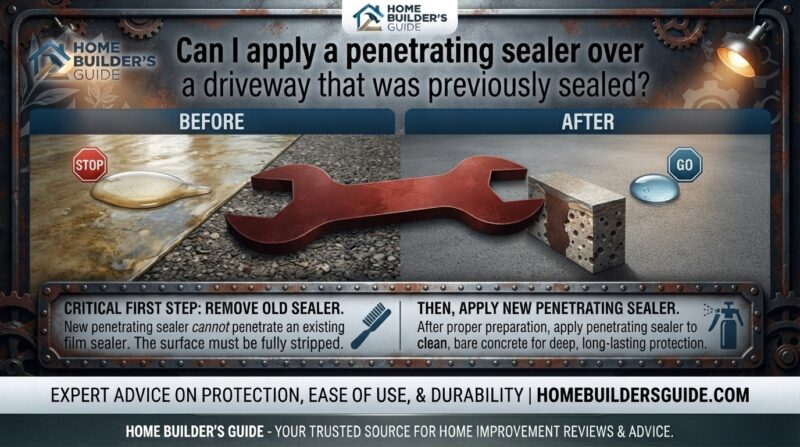
The short answer is: It depends entirely on what type of sealer was previously applied and its current condition.
If your driveway was previously sealed with a film-forming sealer (such as acrylic, polyurethane, or epoxy) that is still intact, you cannot apply a penetrating sealer directly over it. Penetrating sealers must soak into the open pores of the concrete to form a chemical bond. An intact film-forming sealer blocks these pores, causing the new penetrating sealer to puddle, turn white, sticky, or fail completely.
However, if the previous sealer was also a penetrating sealer (like silane, siloxane, or siliconate) or if an old topical coating has completely worn off, yes, you can re-apply a penetrating sealer—provided the concrete passes a simple water absorption test.
Understanding Driveway Sealers: Penetrating vs. Film-Forming
To make the right decision for your driveway, you need to understand the fundamental chemical difference between the two primary categories of concrete and masonry sealers.
       [ CONCRETE SURFACE CROSS-SECTION ]

   FILM-FORMING SEALER             PENETRATING SEALER
  (Acrylic / Polyurethane)         (Silane / Siloxane)
  ======================           ....................  <-- Surface remains bare
  |   Plastic Surface  |           | Chemical reaction|
  |     Membrane       |           | INSIDE concrete  |  <-- Hydrophobic barrier
  ----------------------           |    pores         |      inside matrix
  [   Concrete Pores   ]           [  Subsurface pores]
1. Penetrating Sealers (Silanes, Siloxanes, Siliconates, Silicates)
- How They Work: Rather than staying on top, penetrating sealers soak deep into the concrete’s capillaries (up to 1/4 inch deep). They react chemically with the free lime and silica inside the concrete matrix to form a hydrophobic barrier.
- Visual Appearance: Unaltered. They leave a natural matte finish with zero gloss, shine, or color change.
- Breathability: 100% breathable. Moisture vapor trapped beneath the concrete can escape freely without causing blistering or peeling.
- Longevity: Long-lasting (5 to 10+ years), as they cannot peel, chip, or flake from surface traffic or UV exposure.
2. Film-Forming Sealers (Acrylics, Polyurethanes, Epoxies)
- How They Work: These sealers rest entirely on top of the surface, creating a continuous protective plastic membrane over the concrete.
- Visual Appearance: High-gloss, semi-gloss, or “wet look.” They often darken the concrete and enhance its color.
- Breathability: Low to non-breathable. Water vapor pushing up from beneath the driveway can cause the film to bubble, cloud, or peel.
- Longevity: Shorter lifespan (1 to 3 years) before re-coating or maintenance is required.
Sealer Compatibility Matrix
Before applying any product, consult this matrix to determine if your planned application is chemically compatible:
| Existing Surface State | Target New Sealer: Penetrating (Silane/Siloxane) | Target New Sealer: Film-Forming (Acrylic) |
| Bare / Unsealed Concrete | ✅ Direct Application Approved | ✅ Direct Application Approved |
| Old Penetrating Sealer (Worn Down) | ✅ Direct Application Approved | ✅ Direct Application Approved |
| Intact Film-Forming Acrylic (Glossy) | ❌ FAIL (Will not penetrate) | ✅ Re-coat with compatible Acrylic |
| Flaking / Peeling Acrylic Sealer | ❌ FAIL (Requires complete stripping) | ❌ FAIL (Requires stripping existing coat) |
| Cure & Seal Compound | ❌ FAIL (Blocks pore structure) | ⚠️ Conditional (Light sanding/solvent wash) |
Critical Takeaway: A penetrating sealer requires open concrete capillaries. If anything sits between the penetrating liquid and the bare concrete substrate, the product will dry as an unsightly white residue on top of the driveway.
How to Test Your Driveway: 2 Simple Diagnostic Steps
If you bought a house recently or cannot remember what sealer was used previously, perform these two fast tests on different areas of your driveway.
Test 1: The Water Absorption Test
This test determines whether the surface pores are open enough to receive a penetrating product.
- Pour 1/4 cup of clean water onto the concrete.
- Watch the water closely for 5 to 10 minutes:
- Result A (Beads Up): If the water beads into tight droplets and stays on top, the driveway is sealed with an active product (either film-forming or penetrating). Do not apply a penetrating sealer.
- Result B (Soaks In / Darkens Concrete): If the concrete darkens within 3–5 minutes and absorbs the water, the pores are open. You can safely apply a penetrating sealer.
Test 2: The Solvent Test (Xylene or Acetone)
If water beads up and you suspect an old acrylic coating is present, use a solvent test to verify if a film-forming sealer exists.
- Pour 1 tablespoon of pure Xylene or Acetone onto a small, inconspicuous area of the driveway.
- Let it sit for 20 to 30 seconds, then rub it gently with a clean rag.
- Observe the surface:
- Tackiness / Slime: If the surface becomes sticky, gummy, or soft, you have an acrylic or solvent-based film-forming sealer.
- No Reaction: If the surface remains hard and unchanged, you either have a penetrating sealer or an unsanded polyurethane/epoxy.
Regional Sealing Considerations: Texas, California, New York, Washington & San Francisco
Environmental conditions drastically impact how sealers perform, wear down, and apply. Here is specific guidance based on regional climate challenges:
1. Texas (Extreme Heat & High UV Exposure)
- The Challenge: High sun exposure bakes acrylic coatings, causing them to turn yellow, micro-crack, and break down quickly.
- Recommendation: Penetrating silane/siloxane sealers are superior in Texas because UV radiation does not degrade subsurface chemical bonds.
- Application Tip: Apply early in the morning when surface temperatures are below 85°F (29°C). Applying penetrating sealer to hot concrete causes rapid solvent/water flash-off before it can penetrate.
2. New York & Northern States (Freeze-Thaw & Deicing Salts)
- The Challenge: Freeze-thaw cycles cause trapped water to expand inside concrete, leading to spalling, pop-outs, and scaling. Road salts accelerate chemical breakdown.
- Recommendation: Water-repellent silane or siliconate penetrating sealers are essential for NY driveways. They prevent salt-laden water from entering capillaries.
- Application Tip: Ensure the surface is thoroughly dry (no rain for 48 hours before or after application) and apply before winter temperatures drop consistently below 50°F (10°C).
3. California & San Francisco (VOC Regulations & Coastal Humidity)
- The Challenge: California (especially the Bay Area / SCAQMD zones) enforces strict VOC (Volatile Organic Compound) emission limits. Solvent-based sealers may be restricted or prohibited. Furthermore, fog and coastal humidity delay drying times.
- Recommendation: Select water-based silane/siloxane micro-emulsions with <50 g/L VOC content.
- Application Tip: Avoid late-afternoon applications in coastal microclimates like San Francisco, where cold fog can settle on wet sealer and compromise the cross-linking process.
Step-by-Step Guide: Preparing & Re-Sealing Your Driveway
If your diagnostic tests revealed that a penetrating sealer can be applied—or if you need to strip old acrylic coatings first—follow this step-by-step workflow:
1.Diagnose & Inspect:15-30 Minutes.
Perform the Water Absorption Test and Solvent Test across multiple sections of your driveway (near the garage, mid-driveway, and near the street) to confirm pore openness.
2.Strip Existing Coating (If Applicable):2-6 Hours.
If an old acrylic coating is flaking or blocking water absorption, apply a chemical coating stripper (soy-based or solvent-based). Let it dwell according to manufacturer instructions, then pressure wash the residue away thoroughly.
3.Deep Surface Cleaning:1-2 Hours.
Pressure wash the concrete (2500–3000 PSI) using a concrete cleaner/degreaser. Remove oil stains, tire marks, mildew, and dirt. Penetrating sealers cannot bond through oil or grime.
4.Allow Complete Drying:24-48 Hours.
Concrete must be bone-dry. Trapped moisture inside the pores prevents the penetrating sealer from soaking in deeply.
5.Apply the Penetrating Sealer:1-2 Hours.
Use a low-pressure pump sprayer equipped with an oil-resistant or water-resistant nozzle. Spray a wet-on-wet coat evenly, saturating the surface until it stays wet for 3–5 minutes before soaking in.
6.Back-roll Excess & Cure:24 Hours.
If liquid puddles form in low spots, immediately roll them out with a dry paint roller. Allow 6 hours for foot traffic and 24 hours for vehicle traffic.
Pro-Tips & Common Mistakes to Avoid
- Never double-coat after curing: Penetrating sealers work by repelling liquid. If you apply a second coat after the first coat has fully dried (usually after 1–2 hours), the second coat will be repelled by the first and dry white on top. Apply the second coat “wet-on-wet” within 15–20 minutes of the first.
- Check the Weather Forecast: Ensure no rain is forecasted for 24 hours after application. Rain on curing penetrating sealer can wash unreacted silane compounds out of the pores.
- Mind the Temperature: Apply when ambient and surface temperatures are between 50°F and 85°F (10°C to 29°C).
- Protect Adjacent Surfaces: Cover landscaping, glass, aluminum trim, and painted surfaces. Silane/siloxane sealers can etch glass and stain painted finishes if left to dry.
10 Frequently Asked Questions (FAQs)
1. How do I know if my driveway has a film-forming or penetrating sealer?
Perform the Water Absorption Test and Solvent Test. Pour water onto the concrete; if it darkens and soaks in within a few minutes, there is no active film-forming barrier. Pour a few drops of acetone or Xylene; if the surface turns sticky or soft, a film-forming acrylic sealer is present.
2. What happens if I apply a penetrating sealer over an old acrylic sealer?
The penetrating sealer will not be able to soak into the concrete pores. It will pool on top of the acrylic membrane, turn into a sticky, hazy, or milky-white residue, and eventually flake off, leaving a blotchy finish.
3. Can I pressure wash off an old film-forming sealer to apply a penetrating sealer?
Pressure washing alone rarely removes 100% of an acrylic sealer unless it is severely degraded. You generally need a commercial chemical sealer stripper combined with hot-water pressure washing or sandblasting to clear all pores fully.
4. How long after stripping an old sealer can I apply a penetrating sealer?
After stripping and pressure washing, allow the driveway to dry completely for at least 24 to 48 hours under sunny, dry conditions before applying a penetrating sealer.
5. Can I re-apply a penetrating sealer over a driveway previously sealed with a penetrating sealer?
Yes. If the old penetrating sealer has worn down over time (typically 5 to 10 years) and the driveway passes the water absorption test, you can apply a fresh coat of penetrating sealer.
6. How often should a penetrating concrete sealer be re-applied?
High-quality silane/siloxane penetrating sealers typically last 5 to 10 years on residential driveways. You only need to re-apply when water no longer beads on the surface and the concrete visibly absorbs moisture during rain.
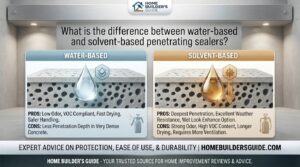
7. Is a solvent-based or water-based penetrating sealer better?
Solvent-based penetrating sealers often penetrate slightly deeper on dense concrete and tolerate lower temperatures during application. Water-based penetrating sealers have lower odor, compliant VOC levels (ideal for CA/WA regulations), and can be applied to damp concrete.
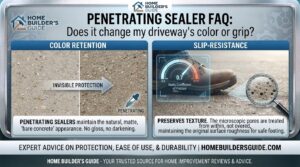
8. Will a penetrating sealer change the color or gloss of my driveway?
No. Penetrating sealers operate beneath the surface inside the pores. They do not alter the texture, color, or gloss level of the concrete once cured, preserving its natural, matte look.
9. Why is my penetrating sealer turning white after application?
A penetrating sealer turns white if too much product was applied, if puddles were left to dry without back-rolling, or if applied over an existing non-porous sealer. You can clean dried surface residue using a stiff bristle brush and solvent or mild acid etch depending on product chemistry.
10. How long does a penetrating sealer take to cure before driving on it?
Most penetrating sealers dry to the touch in 2 to 4 hours. Allow 6 hours for light foot traffic and at least 24 to 48 hours before driving heavy passenger vehicles onto the driveway.
Conclusion
Applying a penetrating sealer over a previously sealed driveway is completely safe and effective—as long as the concrete pores are open. If your driveway currently absorbs water, or if previous coats of sealer were also penetrating formulas, you can proceed directly after a thorough cleaning. If an acrylic or film-forming membrane remains on the surface, you must strip it completely to allow the penetrating silane or siloxane formula to reach the concrete matrix and deliver long-lasting protection against salt, water damage, and freeze-thaw cracking.