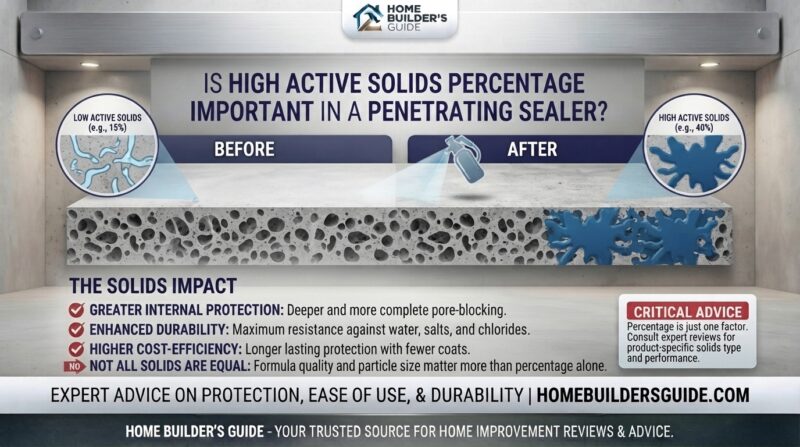
Yes, the percentage of active solids is one of the most critical factors determining the performance, depth of penetration, and lifespan of a penetrating concrete sealer.
The “active solids content” refers to the percentage of pure silane, siloxane, siliconate, or silicate compounds suspended within the product’s liquid carrier (water or solvent). When you spray a sealer onto concrete, the liquid carrier evaporates, leaving only the active solids behind to react chemically inside the capillaries.
A penetrating sealer with a higher active solids content (e.g., 40% vs. 10%) deposits significantly more protective hydrophobic chemical structure into the concrete matrix per application. This directly results in deeper protection against water absorption, salt spalling, freeze-thaw damage, and an extended lifespan of up to 10+ years instead of 1 to 3 years.
Active Solids Breakdown: Low vs. High Percentage Comparison
Understanding how active solids concentration impacts application frequency, coverage, and protection levels is essential before purchasing commercial or residential sealers.
| Performance Metric | Low Active Solids (5% – 15%) | Moderate Active Solids (20% – 30%) | High Active Solids (40% – 100%) |
|—|—|—|
| Typical Target Substrates | Low-cost residential driveways, DIY touch-ups | Standard residential driveways, patios, walkways | Heavy commercial, DOT bridge decks, extreme freeze-thaw slabs |
| Protective Lifespan | 1 to 3 Years | 5 to 7 Years | 10 to 20+ Years |
| Penetration Depth | Shallow (1/16″ to 1/8″) | Moderate (1/8″ to 1/4″) | Deepest (up to 3/8″ or more) |
| Freeze-Thaw Resistance | Basic / Moderate | High | Superior / Industrial Grade |
| Salt & Deicing Resistance | Minimal | Strong | Maximum (DOT Standards) |
| Number of Coats Needed | 2 to 3 Coats | 1 to 2 Coats | 1 Heavy “Wet-on-Wet” Coat |
| Upfront Cost per Gallon | $ (Low) | $$(Moderate) \vert{}$$$ (High) |
| Long-Term Cost Efficiency | Low (Requires frequent re-application) | High | Highest (Lowest cost per year of protection) |
The Science: How Active Solids React Inside Concrete
To understand why solids content matters, you must look at how penetrating sealers interact with concrete at a chemical level.
Unlike topical acrylics or polyurethanes that sit on top of concrete to form a plastic coating, penetrating sealers enter open capillaries. Once inside, the active ingredients undergo a chemical reaction driven by hydrolysis and cross-linking:
                       [ SUBSTRATE CAPILLARY PORE ]

      LOW SOLIDS FORMULA (10%)                 HIGH SOLIDS FORMULA (40%)
   ===============================          ===============================
   |  90% Liquid Carrier (Evaps) |          |  60% Liquid Carrier (Evaps) |
   |  10% Active Silane Solids   |          |  40% Active Silane Solids   |
   -------------------------------          -------------------------------
   |  Sparse hydrophobic barrier |          |  Dense, interconnected      |
   |  Pores remain partially     |          |  hydrophobic network inside |
   |  vulnerable over time       |          |  capillary matrix           |
   -------------------------------          -------------------------------
- Carrier Evaporation: The liquid carrier (water or solvent) carries active molecules into the porous concrete before evaporating into the air.
- Substrate Binding: Active silane/siloxane molecules react with moisture and calcium hydroxide (free lime) in the concrete.
- Cross-Linking Matrix: The molecules bond to the pore walls and form a microscopic, three-dimensional hydrophobic network.
If a sealer contains 90% carrier liquid and only 10% active solids, 90% of what you spray onto the driveway evaporates into the atmosphere. Conversely, a 40% active solids sealer leaves four times more active material inside the concrete pores to form a dense, durable water-repellent barrier.
Active Ingredients Compared: Silane, Siloxane, Siliconate & Silicates
The ideal solids percentage depends heavily on the specific active ingredient chemical used in the sealer formula:
1. Silanes (Small Molecule — Requires High Solids)
- Molecule Size: Microscopic (under 1 nanometer).
- Behavior: Penetrates dense, smooth concrete deeply (bridge decks, parking structures).
- Solids Recommendation: Silanes evaporate rapidly due to high volatility. Therefore, high-performance silanes are typically formulated at 40% to 100% active solids. Low-solids silanes (below 20%) are ineffective.
2. Siloxanes (Larger Molecule — Effective at Moderate Solids)
- Molecule Size: Medium (1 to 10+ nanometers).
- Behavior: Excellent for porous surfaces like concrete block, brick, and broom-finished driveways.
- Solids Recommendation: Siloxanes are less volatile than silanes. Formulas with 10% to 20% active solids perform exceptionally well on porous masonry.
3. Silane/Siloxane Blends (The Hybrid Standard)
- Behavior: Combines deep-penetrating small silane molecules with surface-sealing siloxane molecules.
- Solids Recommendation: 20% to 40% active solids represents the ideal commercial and high-end residential performance tier.
Regional Environmental Factors: TX, NY, CA, WA & San Francisco
Where your property is located dictates how much protection your concrete needs against moisture, freezing, or UV degradation:
1. California & San Francisco Bay Area (VOC Rules & Coastal Salt Air)
- The Challenge: California (especially SCAQMD and BAAQMD districts) strictly regulates Volatile Organic Compounds (VOCs). High-solids solvent sealers may exceed regional emission limits.
- Solution: Choose high-solids water-based silane/siloxane sealers (20% to 40% active solids) with VOC levels under 50 g/L. They comply with strict San Francisco air rules while protecting coastal driveways against salt fog.
2. New York & Northern Freeze-Thaw Zones
- The Challenge: Heavy snowfall, freeze-thaw cycles, and chemical deicing salts (calcium chloride).
- Solution: Northern driveways require 40% active solids silane or silane/siloxane sealers. Low-solids sealers break down under heavy salt applications within a single winter.
3. Washington State (Pacific Northwest Moisture)
- The Challenge: Persistent rain and dampness leading to moss, lichen, and efflorescence.
- Solution: High-solids breathable penetrating sealers (20% to 40%) keep liquid water out while allowing trapped substrate vapor to escape, preventing moss anchorage inside concrete pores.
4. Texas (Extreme Heat & UV Exposure)
- The Challenge: High temperatures accelerate thermal expansion and dry out concrete rapidly during sealer application.
- Solution: Apply high-solids water-based penetrating sealers during cool early morning hours to ensure active silanes soak deep into capillaries before surface evaporation occurs.
Step-by-Step Guide: Selecting & Applying High-Solids Sealers
To get the full value out of a high active solids penetrating sealer, follow this professional application process:
1.Verify Technical Data Sheet (TDS):Label Inspection.
Check the product’s Technical Data Sheet for the “Active Content” or “Percent Solids” specification. Ensure it specifies pure active silane/siloxane solids rather than total non-volatile matter.
2.Perform Porosity & Water Test:Water Test.
Pour water on the concrete. If water absorbs within 3–5 minutes, the pores are open. If water beads up, an old coating exists and must be stripped before applying a high-solids product.
3.Deep Clean Substrate:Pressure Wash.
Pressure wash (2500–3000 PSI) using concrete cleaner/degreaser to clear oil, dirt, and organic growth. Clean pores allow deep chemical migration.
4.Allow 24–48 Hours Drying Time:Drying Window.
Substrate pores must be free of liquid water so high-solids active chemicals can occupy capillary space.
5.Apply Heavy Wet-on-Wet Coat:Sprayer Technique.
Using a low-pressure sprayer, saturate the surface evenly. Apply a second coat within 15–20 minutes while the surface remains wet to maximize solid deposition.
6.Back-Roll Excess Product:Puddle Removal.
Roll out liquid puddles in low spots using a dry roller within 10 minutes to prevent dried white residue from high active solids content.
Pro Tips & Common Mistakes to Avoid
- Don’t Assume Higher Solids Is Always Better for Dense Concrete: Applying a 100% active solids sealer to an extremely smooth, polished interior floor can lead to surface pooling because the pores are too tight to absorb massive chemical volumes. For dense troweled surfaces, a 40% silane formula offers maximum penetration without surface buildup.
- Watch Out for “Total Solids” Marketing Tricks: Some manufacturers list “Total Solids” on their labels, combining active silane with cheap fillers or resins. Ensure the technical sheet specifies Active Silane/Siloxane Solids.
- Always Back-Roll High Solids Formulas: Because 40% active solids sealers leave significant material behind, unabsorbed excess liquid left in low spots can dry into an unsightly white powder. Always back-roll puddles immediately.
10 Frequently Asked Questions (FAQs)
1. Is a 40% active solids penetrating sealer better than a 20% active solids sealer?
Yes, for demanding environments. A 40% active solids sealer deposits twice as much active chemical protection into concrete capillaries per application, delivering superior freeze-thaw and salt protection with a longer service life (10+ years vs 5–7 years).
2. Can active solids percentage be too high for certain concrete surfaces?
Yes. On extremely smooth or low-porosity concrete (such as polished or tight steel-troweled floors), very high solids formulas (e.g., 100% solids silane) may struggle to fully absorb, leaving excess liquid on the surface that must be wiped off.
3. How do I find out the active solids percentage of a sealer?
Look at the manufacturer’s Technical Data Sheet (TDS) or Safety Data Sheet (SDS). High-quality brands clearly list active silane/siloxane content under the composition or technical specification section.
4. Does a higher active solids content make the sealer shiny?
No. Penetrating sealers work internally inside the pores and do not form a surface film. Whether the sealer is 10% or 40% active solids, it cures to a completely natural matte finish with no gloss.
5. Why are high active solids sealers more expensive upfront?
Silane and siloxane active raw materials are expensive chemical compounds. High-solids sealers contain far less carrier water or solvent and far more pure active chemical, increasing manufacturing costs while offering lower cost-per-year protection.
6. Do high active solids sealers require special sprayers?
Water-based high-solids formulas can generally be applied using standard chemical-resistant pump sprayers. High-solids solvent formulas require sprayers equipped with solvent-resistant Viton seals.
7. How many coats of a 40% active solids sealer do I need?
Typically, one heavy “wet-on-wet” application (two passes applied within 15 to 20 minutes) is sufficient for 40% active solids formulas.
8. Are high active solids sealers compliant with California VOC laws?
Water-based 20% to 40% active solids penetrating sealers easily comply with strict California SCAQMD and Bay Area VOC regulations (< 50 g/L). Solvent-based high-solids formulas may require specialized VOC-exempt solvents (like Acetone) to remain compliant.
9. How long does a 40% active silane/siloxane sealer last on a residential driveway?
Under typical residential foot and vehicle traffic, a professional-grade 40% active silane/siloxane sealer lasts 10 to 15 years before requiring re-treatment.
10. Will a high-solids penetrating sealer protect against oil stains?
Standard silane and siloxane penetrating sealers repel water, salt, and freeze-thaw damage, but do not repel oil. To repel oil stains, select a high-solids penetrating sealer formulated with fluorochemical additives.
Conclusion
When evaluating penetrating concrete sealers, active solids percentage directly dictates real-world performance, lifespan, and value. While low-solids sealers (5% to 15%) carry lower upfront price tags, they require frequent re-application every 1 to 3 years. Investing in a professional-grade penetrating sealer with 20% to 40%+ active silane/siloxane solids delivers maximum capillary protection, superior salt and freeze-thaw defense, and a service life of 10+ years—saving property owners substantial time and maintenance costs over the life of the concrete.