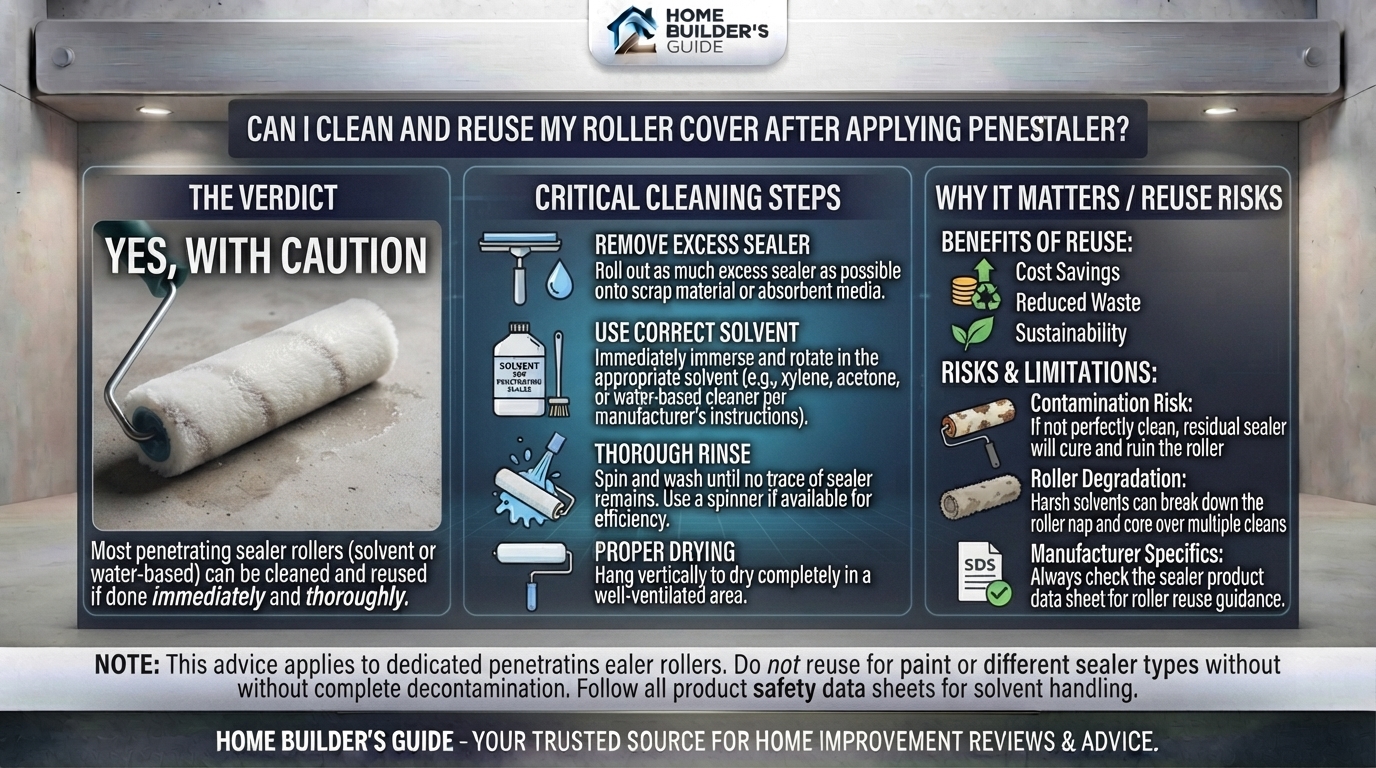
The short answer is: Yes, you can clean and reuse a roller cover after applying a penetrating sealer, but whether it is practical or cost-effective depends entirely on the type of sealer carrier used (water-based vs. solvent-based) and the quality of the roller cover.
If you used a water-based penetrating sealer (such as a water-based silane, siloxane, or siliconate), cleaning the roller sleeve is fast, inexpensive, and easy using warm water and liquid soap—provided you wash it immediately before the sealer cures.
However, if you used a solvent-based penetrating sealer (containing solvents like Xylene, Acetone, or mineral spirits), cleaning requires washing the sleeve with expensive organic solvents. Because the solvent cost often exceeds the price of a replacement roller sleeve, disposing of used covers is usually the smarter, safer, and cleaner choice for solvent applications.
Decision Matrix: Clean & Reuse vs. Dispose
Use this breakdown to determine whether you should clean your roller sleeve or toss it after your sealing project:
| Sealer Type & Carrier | Cleaning Effort | Cleaning Solvent Needed | Average Cost to Clean | Recommended Action |
| Water-Based Penetrating Sealer | 🟢 Easy (5–10 mins) | Warm Water + Dish Soap | < $0.50 | Clean and Reuse |
| Solvent-Based Penetrating Sealer | 🔴 Hard (15–20 mins) | Xylene, Acetone, or Mineral Spirits | $5.00 – $10.00 | Dispose of Sleeve |
| Siliconate / Silicate Hardener | 🟡 Moderate (5–10 mins) | Clean Water + Vinegar Rinse | < $1.00 | Clean Immediately |
| Cheap Polyester/Foam Sleeve | 🔴 Not Worth It | Water or Solvent | Time > Value | Dispose of Sleeve |
| Premium Microfiber Sleeve | 🟢 High Reuse Value | Water + Soap | High ROI | Clean and Reuse (Water-Based) |
The Chemistry: Why Penetrating Sealers Behave Differently on Roller Covers
Understanding what happens inside the fibers of your roller cover helps explain why cleaning timing and solvents matter so much.
Penetrating sealers do not form a thick surface coat like acrylic latex paints. Instead, they contain active chemical solids (silanes, siloxanes, or siliconates) suspended inside a liquid transport carrier:
            [ ROLLER FIBER CROSS-SECTION ]

   WATER-BASED CURED STATE               SOLVENT-BASED CURED STATE
   =======================               =========================
   Active silane solids cross-link       Solvent evaporates fast;
   and bind to synthetic fibers          resin/solids harden into
   if allowed to dry completely.         stiff, water-repellent mat.
   -----------------------               -------------------------
   [ Must wash before cross-linking ]    [ Requires solvent dissolution ]
- Water-Based Emulsions: As long as the water carrier remains wet inside the woven microfiber fibers, the active silane/siloxane molecules can be rinsed away easily with plain water and soap. However, if the roller cover dries out, the active molecules cross-link and permanently bind to the synthetic fibers, rendering the sleeve hydrophobic (water-repellent) and stiff.
- Solvent-Based Solutions: Solvent carriers evaporate much faster than water. As the solvent flashes off during rolling, the concentration of active silane solids inside the roller sleeve spikes rapidly, causing the fibers to stiffen quickly. Re-dissolving these solids requires harsh chemical solvents that break down the glue holding the roller sleeve to its inner plastic core.
Regional Environmental Regulations: CA, NY, WA, TX & San Francisco
How you clean tools and dispose of wash water or solvent residues depends heavily on your local environmental laws and climate:
1. California & San Francisco Bay Area (VOC Rules & Disposal Standards)
- The Rule: California (governed by SCAQMD, BAAQMD, and CalEPA) strictly regulates volatile organic compound (VOC) emissions and toxic waste disposal. Rinsing solvent-based sealers with Xylene into storm drains or soil is illegal and carries severe fines.
- Cleaning Guidance: Because most California-approved penetrating sealers are low-VOC water-based formulas (<50 g/L), you can clean roller covers easily with soap and water. Contain all wash water and do not allow it to run into public storm drains.
2. Texas (High Heat & Fast Drying Times)
- The Challenge: Extreme heat accelerates solvent flash-off and water evaporation.
- Cleaning Guidance: In Texas summer temperatures, roller covers dry out extremely fast while you work. If you plan to clean and reuse a roller cover, you must submerge it in a bucket of clean water immediately after finishing your final pass. Allowing it to sit in the sun for even 10 minutes will permanently ruin the fibers.
3. New York & Washington State (Waterway Protection)
- The Challenge: Protecting coastal and freshwater ecosystems from chemical runoff.
- Cleaning Guidance: Always perform roller cleaning inside a utility sink connected to municipal wastewater treatment, or collect wash liquid in a bucket to evaporate safely outdoors. Never rinse sealer residues near outdoor storm drains or garden beds.
Step-by-Step Guide: How to Properly Clean a Roller Cover
If you are working with a water-based penetrating sealer or wish to clean a premium roller cover, follow this step-by-step restoration process:
1.Scrape Excess Sealer Back Into Bucket:Under 2 Minutes.
Use a curved roller scraper tool (or a putty knife) to scrape leftover liquid sealer out of the roller sleeve directly back into your container or tray before it begins to dry.
2.Perform Initial Rinse:Immediate Action.
Submerge the roller cover immediately in a bucket of warm water (for water-based sealers) or a container of mineral spirits/Xylene (for solvent-based sealers). Do not let air dry the fibers.
3.Wash Fibers with Degreasing Soap:2-5 Minutes.
For water-based sealers, apply heavy-duty dish soap (like Dawn) or a concrete cleaner directly onto the sleeve. Work the soap deep into the core using your hands to break down hydrophobic emulsions.
4.Thorough Clean Water Flush:2 Minutes.
Rinse the sleeve under running warm water until the water squeezed from the roller cover runs completely clear and shows no milky white tint.
5.Spin and Dry Core:1 Minute.
Spin the roller sleeve rapidly using a roller spinner tool or by hand to force out excess water. Stand the sleeve on its end on a clean paper towel in a dry, ventilated area so the core does not warp.
Pro Tips & Common Mistakes to Avoid
- Never Use Hot Water on Silicates or Siliconates: If you used a lithium, sodium, or potassium silicate hardener, rinse with cool water. Hot water can accelerate silicate gelation inside the fibers.
- Store Sleeves in Plastic Wrap for Short Breaks: If you are taking a 30-minute lunch break mid-project, do not wash the sleeve. Wrap it tightly in plastic cling wrap or seal it inside a Ziploc bag to exclude air and prevent drying.
- Inspect Fibers Before Reusing on New Projects: Before using a cleaned sleeve on a future project, rub the dry fibers with your hand. If the fibers feel stiff, crunchy, or shed lint, toss the cover. Stiff fibers will scratch or unevenly distribute sealer on your next job.
10 Frequently Asked Questions (FAQs)
1. Can I reuse a roller cover that has hardened after sealer dried on it?
No. Once a penetrating sealer dries and cures inside the fibers, the material becomes permanently stiff and water-repellent. Attempting to roll sealer with a hardened cover will scratch the concrete and leave streaky, uneven coverage.
2. Is it safe to clean solvent-based sealer off a roller cover in my sink?
No. Never pour solvents like Xylene, Acetone, or mineral spirits down residential sink drains or plumbing fixtures. Solvents can damage PVC pipes, create explosive indoor fumes, and pollute public water systems.
3. How many times can I clean and reuse a high-quality microfiber roller cover?
If washed thoroughly immediately after using water-based penetrating sealers, a premium woven microfiber roller sleeve can be reused 3 to 5 times before fiber degradation occurs.
4. What happens if I rinse water-based penetrating sealer down my drain?
Rinsing small amounts of uncured water-based sealer with plenty of warm water and dish soap is safe for municipal sewer systems, as the liquid hasn’t cross-linked into a solid matrix.
5. Can I soak my roller cover in a bucket of water overnight to clean it later?
Soaking in water overnight keeps water-based sealers from drying out, but soaking too long can dissolve the glue holding the woven fibers to the inner plastic or cardboard core, causing the sleeve to fall apart.
6. Why did my roller sleeve fall apart when I cleaned it with solvent?
Heavy solvents like Xylene and Acetone dissolve the synthetic glues used to manufacture low-cost roller covers. Only premium solvent-resistant roller covers feature core construction capable of surviving chemical solvents.
7. What is the cheapest way to clean a roller cover after water-based sealing?
Warm tap water combined with concentrated grease-cutting liquid dish soap is the most effective and affordable cleaning solution available.
8. Can I clean my roller cover using a pressure washer?
No. The high pressure (2000+ PSI) from a pressure washer nozzle will tear woven microfiber or wool fibers off the sleeve backing and ruin the cover instantly.
9. Should I clean my roller tray and frame as well?
Yes. Clean metal roller frames and plastic tray liners immediately using the same solvent or water solution. Dried sealer on metal frames can flake off into future sealer batches and clog your application tools.
10. Is it environmentally friendly to toss used roller covers?
While reusing tools reduces landfill waste, throwing away a $4 roller cover after applying solvent-based sealer is significantly safer for the environment than using gallons of toxic Xylene solvent to wash it out.
Conclusion
Cleaning and reusing your roller cover after applying a penetrating sealer is entirely feasible and cost-effective for water-based applications, provided you act quickly with warm water and soap before the product cures. However, for solvent-based penetrating sealers, the cost, safety hazards, and environmental impact of using chemical solvents to wash a sleeve make single-use disposal the most practical choice.