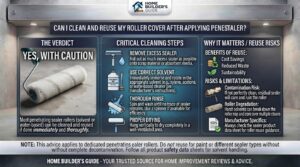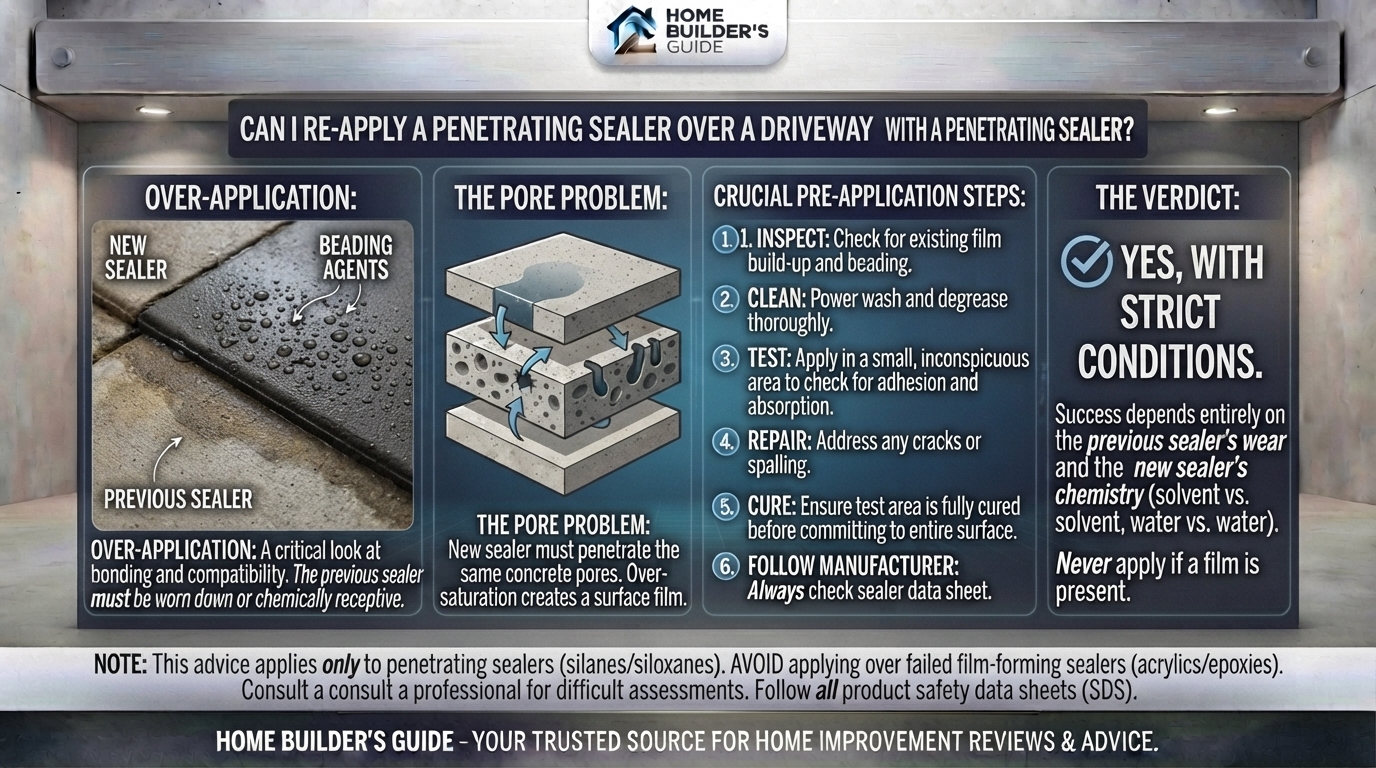
Yes, you can re-apply a penetrating sealer over a driveway previously treated with a penetrating sealer, but only if the original sealer has worn down enough for the concrete’s capillaries to absorb new liquid.
Unlike topical coatings (such as acrylics, epoxies, or urethanes) that form a visible film on top of the slab, penetrating sealers—including silanes, siloxanes, siliconates, and silicate hardeners—work entirely beneath the surface. They migrate into the microscopic pores of the concrete, reacting chemically with calcium hydroxide to form a hydrophobic barrier.
Because penetrating sealers do not form a surface film, you do not need to strip or sand the previous coat before re-application. However, there is a major catch: if the previous penetrating sealer is still actively repelling liquid, new sealer cannot sink into the pores. Applying a fresh coat over fully sealed concrete will cause the liquid to pool on the surface, dry into an unsightly white powder, and go to waste.
The Water Absorption Test: How to Know If Your Driveway Is Ready
Before purchasing gallons of fresh sealer, you must perform a simple Water Absorption Test (also known as a splash test) to determine whether your driveway can accept a new coat.
How to Conduct the Test:
- Choose 3 to 4 spots on your driveway (include high-traffic tire tracks and shaded, low-traffic areas near the garage).
- Pour about 1/4 cup of clean water onto the dry concrete surface.
- Observe the water for 5 to 10 minutes.
| Water Test Observation | Concrete Pore Status | Re-Application Verdict |
| Water beads tightly into droplets like water on a freshly waxed car. | Capillaries are fully sealed and hydrophobic. | 🛑 DO NOT RE-APPLY. The sealer will fail to absorb. |
| Water sits flat without beading, but the concrete does not darken after 10 minutes. | Capillaries are partially protected. | ⚠️ WAIT. Check again in 6 to 12 months. |
| Concrete darkens within 2–5 minutes, absorbing the water completely. | Capillaries are open; old sealer has degraded. | 🟢 READY FOR RE-APPLICATION. |
| Water absorbs immediately (under 30 seconds) with rapid darkening. | Capillaries are completely bare and vulnerable to freeze-thaw or salt damage. | 🟢 URGENT RE-APPLICATION NEEDED. |
Chemistry Breakdown: How Penetrating Re-Application Works
To understand why re-application timing is critical, it helps to look at the chemical mechanism of penetrating sealers compared to topical paints or coatings.
                  [ CONCRETE CAPILLARY CROSS-SECTION ]

    NEW CONCRETE / FULLY DEGRADED              PARTIALLY SEALED (RE-APPLICATION)
    ============================              =================================
    |   Pore Pores Open        |              |  Unreacted Active Silanes      |
    |  [ ]  [ ]  [ ]  [ ]      |              |  [S]   [ ]   [S]   [ ]         |
    |                          |              |                                |
    | Full Sealer Penetration  |              | Sealer Fills Remaining Pores   |
    | Deep Covalent Bonding    |              | Bonds with Unreacted Substrate |
    ----------------------------              ---------------------------------
When you apply a silane/siloxane penetrating sealer for the first time, the small active molecules react with free lime (calcium hydroxide) in the concrete to form a siliconate matrix inside the pores. Over years of traffic, UV exposure, and environmental wear, this barrier slowly degrades near the surface.
When you re-apply:
- If pores are open: The new silane/siloxane molecules travel down into the unsealed depth of the capillary matrix, forming fresh covalent bonds.
- If pores are blocked: The new liquid cannot penetrate. The carrier solvent or water evaporates on top of the driveway, leaving active solids sitting exposed on the surface as a chalky white film.
Compatibility Chart: Mixing Sealer Chemistries
When re-applying, you must match or upgrade your sealer chemistry properly. The table below outlines compatibility when applying a new penetrating sealer over an old one:
| Existing (Old) Sealer Type | New Sealer Type to Apply | Compatibility | Key Recommendation |
| Silane/Siloxane (Water-Based) | Water-Based Silane/Siloxane | 🟢 High | Best standard choice. Simple application and low VOCs. |
| Silane/Siloxane (Water-Based) | Solvent-Based Silane/Siloxane | 🟢 High | Excellent option if concrete is completely dry; offers deeper penetration. |
| Solvent-Based Silane/Siloxane | Solvent-Based Silane/Siloxane | 🟢 High | Solvents in the new coat help re-wet and integrate with remaining old resins. |
| Siliconate (Water-Based) | Silane or Siloxane | 🟢 High | Ideal for highly porous concrete; silanes seal smaller capillaries. |
| Silicate Hardener (Lithium/Sodium) | Silane/Siloxane Penetrating Sealer | 🟢 Excellent | Silicates harden the matrix; silanes add water/salt repellency. |
| Topical Acrylic Clear Coat | Penetrating Sealer (Any Type) | 🔴 IMPOSSIBLE | Penetrating sealers cannot penetrate acrylic films. Strip acrylic first. |
Regional Environmental Factors: TX, NY, CA, WA & San Francisco
Re-applying driveways across different climate zones requires tailored strategies to account for local weather patterns and VOC regulations:
1. California & San Francisco Bay Area (Low-VOC Rules & Coastal Salt Fog)
- Regulations: Local air quality districts (SCAQMD in SoCal, BAAQMD in the SF Bay Area) limit VOC content for concrete sealers to under 50 g/L.
- Re-Application Strategy: You will almost certainly be using a water-based silane/siloxane emulsion. In San Francisco’s damp, foggy climate, ensure you re-apply mid-morning after the ambient fog clears and the sun warms the slab to at least 50°F (10°C). Humidity above 85% slows water-based cure times drastically.
2. Texas (Intense UV Degradation & Heat)
- Climate Pressures: Texas sun and high surface temperatures accelerate the physical wear of penetrating sealers in tire tracks.
- Re-Application Strategy: Never re-apply penetrating sealers during peak Texas afternoon heat (when concrete temperatures exceed 90°F / 32°C). High heat causes the carrier liquid to “flash off” instantly, leaving sealer solids stuck on top of the driveway as white crust. Apply early in the morning when the concrete is cool.
3. New York (Freeze-Thaw & Deicing Salt Attack)
- Climate Pressures: Severe winter freeze-thaw cycles and heavy road salt usage break down concrete pores rapidly.
- Re-Application Strategy: Re-apply every 3 to 5 years in early autumn (September/October) before the first freeze. Use a high-solids Silane (40% active solids), as silane’s small molecular structure provides superior resistance against deicing salt pitting and spalling.
4. Washington State (Pacific Northwest Moisture Saturation)
- Climate Pressures: Extended rainfall keeps concrete capillaries saturated for months at a time.
- Re-Application Strategy: Moisture trapped inside concrete pores will push out oil- or solvent-based sealers during application. Re-apply in late summer (July/August) after the driveway has experienced at least 3 to 4 consecutive dry days.
Step-by-Step Guide: How to Re-Apply a Penetrating Sealer
Follow this step-by-step process to ensure maximum absorption and a seamless finish when re-sealing your driveway:
1.Deep Clean the Driveway:Prep Phase.
Power wash the driveway at 2500–3000 PSI to remove embedded dirt, oil stains, mold, and tire marks. Use a dedicated concrete degreaser on oil spots. Do not use acid etching unless dealing with dense, unsealed troweled concrete.
2.Allow 24–48 Hours of Complete Drying:Drying Phase.
Penetrating sealers need empty capillaries to soak into. Wait at least 24 hours (48 hours in humid climates like WA or SF) after pressure washing before applying sealer.
3.Re-Verify with the Water Test:Testing Phase.
Splash water on cleaned high-traffic and low-traffic areas to confirm the concrete darkens and absorbs water evenly.
4.Apply via Low-Pressure Sprayer:Application Phase.
Apply the sealer using a garden-style pump sprayer equipped with a fan tip (0.5–1.0 GPM). Spray in an even, overlapping pattern until the concrete is wet with a wet-on-wet pass.
5.Back-Roll and Remove Puddles:Finishing Phase.
Immediately follow behind spraying with a 3/8″ nap microfiber roller to distribute puddles evenly. Important: If liquid sits on top without absorbing after 10–15 minutes, mop it up with dry towels to prevent white powdery residue.
Pro Tips for a Perfect Re-Application
- Master the “Wet-on-Wet” Technique: When applying penetrating sealers, apply the second coat (if recommended by the manufacturer) immediately while the first coat is still damp (usually within 10–20 minutes). Once the first coat fully dries and cures, it will repel the second coat!
- Watch Out for Tire Tracking Areas: The area where car tires roll degrades 2x faster than the middle of the driveway due to hot-tire friction and abrasion. You may find that tire tracks absorb water ready for re-sealing, while the center of the driveway still beads water. Spot-treat high-wear areas if necessary.
- Avoid Over-Applying: Penetrating sealers are not “the thicker, the better.” Once the concrete capillaries are full, extra liquid cannot penetrate and will turn into a messy white powder upon drying.
10 Frequently Asked Questions (FAQs)
1. Do I need to strip the old penetrating sealer before re-applying?
No. Unlike topical acrylics or paints, penetrating sealers do not create a surface film that chips or peels. As long as the old sealer has degraded enough to allow water absorption, you can re-apply directly after power washing.
2. What happens if I re-apply a penetrating sealer too soon?
If the concrete pores are still sealed from the previous application, the new sealer will sit on the surface, fail to absorb, and dry into a white, chalky residue or sticky film that must be scrubbed off with solvents or hot water degreasers.
3. Can I apply a penetrating sealer over an old acrylic sealer?
No. Penetrating sealers cannot pass through an intact acrylic film. You must completely strip the topical acrylic sealer using a chemical stripper or pressure washing before applying a penetrating silane or siloxane sealer.
4. How many years does a penetrating sealer last on a driveway?
High-quality silane/siloxane penetrating sealers typically last 3 to 5 years on exterior driveways, depending on traffic volume, UV exposure, and climate. Siliconates can last 5 to 7 years, while silicate hardeners last indefinitely within the concrete matrix.
5. Can I apply a solvent-based penetrating sealer over a water-based one?
Yes, provided the water-based sealer has degraded enough for the concrete to absorb liquid. Solvent carriers are aggressive and can easily penetrate existing porous matrix structures.
6. Will re-applying a penetrating sealer change the color or gloss of my driveway?
No. Penetrating sealers (silanes, siloxanes, siliconates) dry completely clear with a matte, natural finish. They do not alter the appearance, color, or slickness of the concrete unless specifically labeled as an “enhancing” sealer.
7. How long should I wait after re-sealing before driving my car on the driveway?
Keep foot traffic off for 6 to 12 hours and vehicular traffic off for 24 to 48 hours to allow the active silanes to cure inside the concrete pores.
8. Why is my driveway turning white after re-applying a penetrating sealer?
White haze or powder indicates over-application (too much liquid left sitting on top) or trapped substrate moisture. If a water-based sealer dried white, scrub it with a stiff brush and warm water. If a solvent sealer turned white, treat the area with Xylene to re-emulsify the solids.
9. Should I etch my driveway with acid before re-applying a penetrating sealer?
Generally, no. Power washing is sufficient for broom-finished exterior driveways. Acid etching is only necessary for ultra-smooth, steel-troweled indoor concrete floors to open up tight pores.
10. How do I know if my original sealer was topical or penetrating?
Pour a drop of acid or water on the driveway, or scratch it with a key. If you can scrape off a clear plastic-like film, or if the surface has a shiny/satin gloss, it is a topical sealer. If the surface looks completely natural and matte with zero film to scrape, it is a penetrating sealer.
Conclusion
Re-applying a penetrating sealer over a previously sealed driveway is a straightforward maintenance task that requires no chemical stripping or sanding. As long as your concrete passes the 5-minute Water Absorption Test, fresh silane or siloxane liquid will soak deep into the capillaries, restoring crucial protection against freeze-thaw cracking, road salt pitting, and moisture intrusion for years to come.