While clove oil (Syzygium aromaticum) is well known in dentistry due to its high eugenol content and natural anesthetic properties, interest in other essential oils for oral hygiene has surged. From DIY mouthwashes and oil pulling additives to holistic tooth powders, oils like peppermint, tea tree, eucalyptus, and cinnamon are widely discussed online.
However, using essential oils in your mouth without proper dilution, carrier agents, or chemical understanding can lead to tissue burns, enamel erosion, systemic toxicity, or severe allergic reactions.
Quick Answer: Safety Overview of Non-Clove Essential Oils
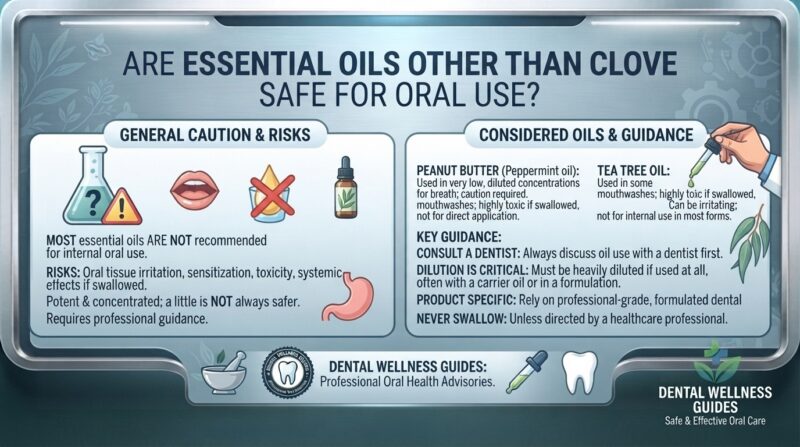
Essential oils other than clove can be safe for topical oral application (swishing/rinsing), BUT ONLY when strictly diluted in an appropriate carrier medium and NEVER swallowed.
- Safe when diluted properly: Peppermint, Spearmint, Tea Tree (Melaleuca), Eucalyptus, and Thyme (in micro-concentrations).
- High-Risk/Irritating: Cinnamon Bark, Oregano, Lemongrass, and Clove (undiluted).
- Toxic if Swallowed: Tea Tree, Wintergreen (Methyl Salicylate), Eucalyptus, and Thyme.
The Biological Risks: Why Undiluted Essential Oils Damage Oral Tissues
Essential oils are volatile, highly concentrated botanical extracts—it often takes several pounds of plant material to produce a single drop.
Unlike the skin on your arms or legs, the oral mucosa (the soft tissue lining your gums, inner cheeks, and tongue) is delicate, highly vascularized, and lacks a thick stratum corneum barrier.
          [ Undiluted Essential Oil Drop ]
                         │
                         ▼
        ┌─────────────────────────────────┐
        │   Lipophilic Action on Mucosa   │
        └────────────────┬────────────────┘
                         │
          ┌──────────────┴──────────────┐
          ▼                             ▼
  [ Cell Membrane Rupture ]     [ Rapid Vascular Absorption ]
          │                             │
          ▼                             ▼
  Chemical Burns & Blisters      Mucosal Inflammation / Systemic Toxicity
1. Water and Oil Do Not Mix
A common misconception is adding 2–3 drops of essential oil to a glass of plain water for a home remedy mouthwash. Essential oils are hydrophobic (water-insoluble). The oil droplets float on top of the water. When you swish, concentrated, undiluted oil contacts your gums directly, causing localized chemical burns or mucosal sloughing.
2. High Mucosal Absorption
Because essential oils are lipophilic (fat-soluble), they pass rapidly through cell membranes in the mouth. Highly concentrated compounds enter local tissue blood vessels quickly, increasing the risk of systemic side effects or allergic contact stomatitis.
3. Oral Microbiome Disruption
Overusing broad-spectrum antibacterial essential oils (like oregano or tea tree) in high concentrations can wipe out beneficial oral bacteria alongside pathogens, opening the door for opportunistic fungal overgrowths like Candida albicans (thrush).
Detailed Profile: Popular Non-Clove Essential Oils in Oral Care
1. Peppermint Oil (Mentha piperita)
- Primary Compound: Menthol (30%–55%).
- Oral Benefits: Excellent cooling sensation, masks halitosis (bad breath), minor analgesic properties.
- Safety Level: Moderate to High (when diluted).
- Risks: High concentrations cause burning sensations on the tongue and inner cheeks. Must be avoided in young children due to risks of laryngospasm caused by menthol.
2. Tea Tree Oil (Melaleuca alternifolia)
- Primary Compound: Terpinen-4-ol.
- Oral Benefits: Potent antifungal and antibacterial properties, helpful against plaque and gingivitis.
- Safety Level: Moderate (STRICTLY TOPICAL / RINSE ONLY).
- Risks: Toxic if swallowed. Ingestion of even small amounts can cause ataxia (loss of muscle coordination), confusion, and central nervous system depression.
3. Cinnamon Bark Oil (Cinnamomum verum)
- Primary Compound: Cinnamaldehyde.
- Oral Benefits: High antibacterial activity against oral pathogens like Streptococcus mutans.
- Safety Level: Low to High-Risk.
- Risks: One of the most common causes of contact stomatitis (oral allergic reactions and tissue peeling). Even at 0.5% dilution, cinnamaldehyde can trigger severe burning and mucosal ulceration.
4. Eucalyptus Oil (Eucalyptus globulus)
- Primary Compound: 1,8-cineole (Eucalyptol).
- Oral Benefits: Anti-inflammatory, reduces plaque buildup; a key ingredient in commercial ADA-approved rinses like Listerine.
- Safety Level: Moderate (In commercial formulations or heavily diluted).
- Risks: Ingestion of pure eucalyptol is toxic, leading to nausea, vomiting, and CNS depression.
Essential Oil Safety Matrix for Oral Care
| Essential Oil | Key Active Ingredient | Oral Safety Rating | Safe Concentration Limit | Ingestion Toxicity Risk | Key Primary Risk |
| Peppermint | Menthol | Safe (Diluted) | < 0.2% – 0.5% | Low (Mild stomach upset) | Mucosal irritation, burning |
| Spearmint | Carvone | Safe (Diluted) | < 0.2% – 0.5% | Low | Mild skin/mucosa allergy |
| Tea Tree | Terpinen-4-ol | Caution (Rinse only) | < 0.1% – 0.2% | HIGH | Ataxia, CNS depression if swallowed |
| Eucalyptus | Eucalyptol | Caution (Rinse only) | < 0.1% | HIGH | Seizures/toxicity in large doses |
| Cinnamon Bark | Cinnamaldehyde | High Risk | < 0.05% | Moderate | Severe contact stomatitis, ulceration |
| Oregano | Carvacrol | High Risk | < 0.05% | Moderate | Extreme chemical burning of gums |
| Thyme | Thymol | Caution | < 0.1% | High | Tissue burning, cardiac effects in toxicity |
| Myrrh | Furanoeudesma | Safe (Diluted) | < 0.5% | Low | Minor tissue allergy |
Safe Oral Care Protocols: How to Use Oils Correctly
If you choose to incorporate natural oils into your oral hygiene routine, stick to safe protocols that minimize mucosal exposure and toxicity.
1. Always Use an Emulsifier or Carrier
Never add essential oils directly to plain water. To disperse essential oils safely in homemade oral rinses, use a carrier:
- Carrier Oils: Fractionated Coconut Oil (MCT), Sesame Oil, or Olive Oil (ideal for oil pulling).
- Solubilizers/Emulsifiers: Vegetable Glycerin or alcohol-free liquid Castile soap (1 drop per cup of wash) to bind oil molecules to water.
2. The Golden Ratio for Home Rinses
For a safe 0.1% dilution in a homemade rinse, use 1 drop of essential oil per 8 oz (240 mL) of carrier fluid + emulsifier.
3. The Oil Pulling Method
If adding essential oils to oil pulling:
- Start with 1 tablespoon (15 mL) of Organic Coconut Oil.
- Add ONLY 1 drop of Peppermint or Spearmint essential oil.
- Swish for 10–15 minutes.
- Spit the mixture into a trash can (never swallow, as it contains pulled bacteria and essential oil residues).
Regional Safety Standards & Access Across Key US Markets
Regulations and access to high-purity, therapeutic-grade essential oils vary depending on local health frameworks across key regions:
🏙️ Texas (Houston, Dallas-Fort Worth, Austin)
- Purity & Sourcing: Texas hosts numerous holistic health stores and apothecary suppliers. When buying essential oils for oral rinse preparation, check that bottles are labeled as 100% pure botanical extracts without synthetic fragrance carriers or phthalates.
🌉 California & San Francisco Bay Area
- Prop 65 Awareness: In California, essential oils and natural dental products are subject to stringent Proposition 65 warnings if they contain trace heavy metals or compounds that exceed safety thresholds.
- Holistic Dental Care: San Francisco and the wider Bay Area feature numerous biological and holistic dental practices that offer professional-grade, essential-oil-infused periodontal therapies under clinical supervision.
🗽 New York (NYC Metro & Upstate)
- Compounding Pharmacies: New York state features specialized botanical compounding pharmacies capable of formulating safe, clinical-grade essential oil rinses tailored for post-periodontal therapy without high alcohol or burning agents.
🌲 Washington State (Seattle & Puget Sound)
- Naturopathic Oversight: Washington state recognizes Naturopathic Doctors (NDs) with broad scope-of-practice. Consumers seeking natural oral remedies can consult licensed naturopathic physicians alongside their dentists for evidence-based botanical formulations.
10 Frequently Asked Questions (FAQs)
1. Can I swallow essential oils if they are labeled “100% Pure Organic”?
No. “100% Pure Organic” refers to the cultivation and distillation method, not toxicity or internal safety. Essential oils are intensely concentrated chemical compounds that can damage the esophagus, stomach lining, liver, and kidneys if ingested.
2. Is Tea Tree oil safe for treating gum disease (gingivitis)?
Tea Tree oil has documented anti-inflammatory and antimicrobial properties that can help reduce gum inflammation. However, it must be used only as a dilute rinse (0.1% concentration) and spit out completely. Never apply pure tea tree oil directly to bleeding or open gum wounds.
3. Why does commercial Listerine contain essential oils if they are dangerous?
Commercial mouthwashes like Listerine utilize purified, highly controlled, and micro-diluted essential oil components (Thymol, Eucalyptol, Menthol, Methyl Salicylate) stabilized with emulsifiers. These laboratory-controlled concentrations kill bacteria safely without burning tissue or causing systemic toxicity.
4. Can essential oils cure a dental cavity?
No. Essential oils cannot remineralize tooth enamel or reverse active tooth decay. While some oils possess antibacterial properties that reduce plaque buildup, once a cavity forms in enamel or dentin, it requires physical restoration by a licensed dentist.
5. What should I do if pure essential oil accidentally burns my gums?
If undiluted essential oil touches your gums and causes severe burning:
- Do not rinse with water immediately (water spreads the oil).
- Swish with a pure vegetable oil (like coconut, olive, or vegetable oil) to dilute and absorb the essential oil molecules.
- Spit out the oil and gently rinse with lukewarm water.
- Contact a dentist or physician if blistering occurs.
6. Is Oregano oil safe for a toothache?
Oregano oil contains high levels of carvacrol, making it an extremely “hot” oil that causes severe chemical burns on soft oral tissues. Using raw oregano oil on teeth or gums is not recommended due to the high risk of mucosal ulceration.
7. Can children use essential oil mouthwashes?
No. Children under the age of 6 should not use essential oil oral products. Children have delicate oral mucosa and an incomplete swallowing reflex, putting them at high risk for accidental ingestion and systemic toxicity or airway spasms (especially from menthol/eucalyptus).
8. Does oil pulling with essential oils replace normal brushing and flossing?
No. Oil pulling with or without essential oils is a complementary practice, not a replacement. It does not replace the mechanical plaque removal provided by toothbrushing and interdental flossing.
9. Can essential oils interact with prescription medications?
Yes. When absorbed through oral mucosa or accidentally swallowed, essential oils can interact with pharmaceuticals. For example, Wintergreen oil (Methyl Salicylate) acts similarly to aspirin and can interact dangerously with blood thinners like Warfarin.
10. How can I tell if I am having an allergic reaction to an oral essential oil product?
Signs of an oral allergic reaction (contact stomatitis) include sudden red patches, white peeling skin on the inner cheeks, swelling of the tongue/lips, burning pain, or small ulcers appearing after using the product. Discontinue use immediately if these symptoms occur.
Conclusion: Balancing Botanical Benefits with Safety
Essential oils like peppermint, tea tree, and eucalyptus offer promising antimicrobial and refreshing benefits for oral care. However, their potency demands respect.
Unlike commercial products engineered for mucosal safety, DIY essential oil preparations carry real risks of tissue burns, systemic toxicity, and allergic reactions if improperly handled.
Key Safety Takeaways:
- Never use undiluted essential oils inside your mouth.
- Never swallow any essential oil mixture.
- Always use an emulsifier or carrier oil—never rely on plain water alone.
- Consult a licensed dentist or health provider before replacing evidence-based oral care products with botanical home remedies.